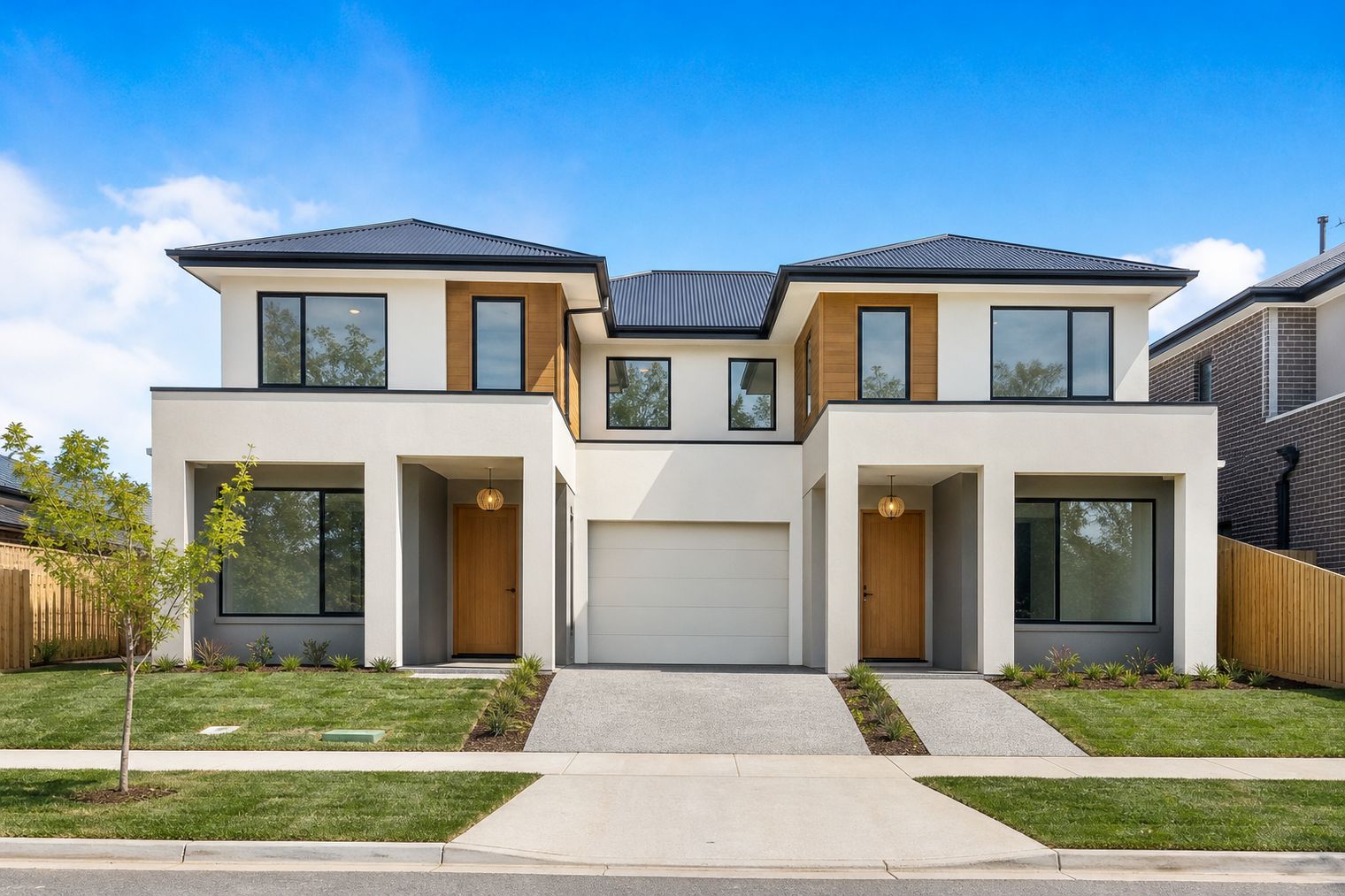
Picture a couple in their mid forties. They have a steady salary, a growing super balance and a block of land they have been watching for a year. They want an investment that keeps working if one tenant leaves, and they want to know how a new duplex compares with a single house. This post sets out the general mechanics. It is general information only.
How a duplex gives you two rents
A duplex is two dwellings on one site, and each one can be leased on its own tenancy. A vacancy on one side does not remove all of the rent, which is the main practical difference from a single house. Ask the developer and a conveyancer early whether the two dwellings sit on one title or are subdivided, because that affects how each side can be owned, financed and sold.
The tax settings for new builds are different from established property. The Act received royal assent on 26 June 2026 and limits negative gearing for residential property investments to new builds from 1 July 2027, subject to some transitional rules. "New residential dwellings" will be exempted, reflecting the policy of restricting negative gearing to new builds. The definition is still subject to finalisation following consultation, so confirm the position with an accountant before you rely on it.
EWC also offers HomePay, a Build Now Pay Later arrangement. There are no payments for the first 12 months during construction. The interest for those 12 months is borrowed, which means it is added to the loan, not waived. Standard repayments start after that. EWC is not the credit provider for HomePay.
Financing a duplex inside an SMSF after 10 August 2026
This is where the rules have changed most recently. LRBAs entered into on or after 10 August 2026 to purchase real property can only be used to acquire business real property. A residential duplex does not meet that definition, so a fund cannot take out a new LRBA to buy it. An SMSF can still invest in residential real property that is not business real property, but it cannot be financed under an LRBA.
Existing arrangements are protected. Contracts exchanged before 10 August 2026 are protected, even if settlement occurs after that date. If the fund has sufficient liquidity, it can purchase residential or commercial property directly, with no borrowing involved and no LRBA required.
For a new residential purchase that needs borrowing, EWC's approach uses an unrelated unit trust. The fund invests in the trust, and the borrowing sits in the trust rather than the fund. The trust must be unrelated to the fund and its associates, and a related trust that borrows can bring the in-house asset rules into play. Whether a trust is unrelated must be confirmed by an SMSF specialist accountant or lawyer. Any loan comes from a lender through a broker who specialises in these structures, not from EWC.
Inside the fund, income is generally taxed at 15% during accumulation phase. In pension phase, earnings on assets supporting the pension are generally tax free, up to the transfer balance cap. The general transfer balance cap for 2026 to 2027 is $2.1 million. Check these settings each financial year.
When a duplex fits and when it does not
A duplex can suit a buyer who has a long holding period, can carry the costs through a vacancy on either side, and wants two tenancies rather than one. It can also suit someone who values a new build's tax settings and a構 fixed-price construction contract. Keep the focus on cash flow and how the numbers hold up under realistic assumptions.
It may not suit someone who needs access to the capital in the short term, or who expects a property to cover all its costs without a buffer. Two dwellings mean two sets of outgoings, possible strata or body corporate levies, maintenance during and after any warranty period, and the risk that construction runs late. In an SMSF, the fund must also hold enough liquidity for those costs. Trustees and their relatives cannot live in the property or rent it from the fund.
Rental income should be tested against an independent rental appraisal, not the figure a seller or developer quotes. Vacancy, letting fees and rent reviews all change the result.
A worked example (illustrative only)
These numbers are invented for illustration. They are not a projection, a rental appraisal or a forecast of any property.
Assume a new duplex costs $950,000, with two three-bedroom dwellings that an independent appraisal places at $620 and $600 a week. Combined gross rent is $1,220 a week, or $63,440 a year. If each dwelling sits empty for two weeks a year, that is $2,440 of lost rent, leaving $61,000 before costs.
In an SMSF in accumulation phase, a cash purchase would have rental income taxed at the 15% accumulation rate. On $61,000 before deductions and fund expenses, that is about $9,150. Actual tax depends on deductions, expenses and the fund's own position, so an SMSF accountant should run the figures.
If the same property were moved into pension phase, the $950,000 value would count toward the $2.1 million general transfer balance cap, which is around 45% of it. That is one reason the member's personal cap matters.
The duplex question is less about the building and more about how the rent, the tax settings and the financing route fit together for your fund or your household.
What to do next
- Ask an SMSF specialist accountant or lawyer whether a borrowing route is available for your fund, whether a proposed trust is unrelated, and how the liquidity buffer should look.
- Speak with a licensed mortgage broker who works with the structure you are considering. EWC refers loans to its broker network and takes no commission on any loan, so the lending terms come from the broker and lender, not EWC.
- Request an independent rental appraisal and read the builder's contract and HomePay details closely before you sign anything.
If you want to talk through how a duplex might sit alongside your other goals, you can book a free call. More general reading is on the insights page.
General information only, not personal financial advice. Speak with a licensed adviser before acting.