

Building a property portfolio in Australia can feel overwhelming, especially when you’re trying to balance capital growth with steady rental income. Many investors struggle to choose the right mix of properties, avoid common pitfalls like high-rise units, and navigate complex SMSF compliance rules. This guide walks you through proven strategies to build and optimise a balanced portfolio that delivers both growth and yield, helping you make informed decisions that align with your financial goals and risk tolerance.
Table of Contents
- Key takeaways
- Understanding balanced property portfolios
- Preparing using market insights and compliance for SMSF investors
- Executing your property portfolio strategy step by step
- Verifying portfolio performance and avoiding common mistakes
- How Elite Wealth Creators can help you build your property portfolio
- Frequently asked questions
Key Takeaways
| Point | Details |
|---|---|
| Balanced growth and yield | A balanced portfolio blends growth assets with high yield to deliver both capital appreciation and steady rental income. |
| Avoid high rise units | Investors should steer clear of high rise units due to poor yields, oversupply risks and limited capital growth. |
| SMSF compliance | SMSF investors must navigate strict compliance rules while building a balanced portfolio. |
| Market growth data | Recent market data show national home prices rising 6.2 per cent in the past year with capital cities around 6.0 per cent and Darwin leading at 11.4 per cent. |
Understanding balanced property portfolios
A balanced property portfolio strategically combines high-growth properties in aspirational suburbs with high-yield properties that generate strong rental returns. High-growth properties typically appreciate faster due to their desirable locations, quality infrastructure, and strong buyer demand. High-yield properties, on the other hand, deliver consistent cash flow through above-average rental returns, helping you service debt and fund additional investments.
One critical mistake many investors make is purchasing high-rise units and similar investor stock, which often deliver poor yields and carry significant risks. These properties face oversupply issues, high body corporate fees, and limited capital growth potential. Instead, focus on established houses or low-rise units in suburbs with strong fundamentals like population growth, employment opportunities, and quality amenities.
Starting your portfolio with growth properties allows you to build equity faster, which you can then leverage to acquire high-yield properties that improve your cash flow position. This sequencing strategy helps you establish a solid financial foundation before diversifying into income-generating assets. Understanding types of property investments for high yields becomes crucial as your portfolio matures.
Location and asset selection determine your portfolio’s success more than any other factor. Research suburbs with strong economic drivers, limited new supply, and historical price growth. Look for properties that appeal to owner-occupiers rather than investors, as these assets typically perform better over time. Quality beats quantity every time, so prioritise well-located properties over accumulating multiple mediocre assets.
Pro Tip: Target suburbs where median house prices sit just below the city-wide median. These areas often deliver the best balance of affordability, growth potential, and rental yield, giving you multiple pathways to profit.
The reasons why invest real estate in Australia remain compelling include stable economic conditions, population growth, and favourable tax treatment for property investors. Building a balanced portfolio positions you to capitalise on these advantages while managing downside risks through diversification.
Preparing using market insights and compliance for SMSF investors
Recent market data shows national home prices rose 6.2% over the past year, with capital cities recording 6.0% growth. This strong performance validates growth-focused investment strategies and demonstrates the resilience of the Australian property market. Darwin led the pack with 11.4% growth, followed by Brisbane with robust appreciation driven by interstate migration and infrastructure investment.
Understanding these market dynamics helps you identify where opportunities exist and which cities offer the best prospects for capital growth. Perth, Adelaide, and regional centres have also shown strong performance, creating diversification opportunities beyond the traditional Sydney and Melbourne markets. Track these trends regularly to adjust your investment strategy as market conditions evolve.
For SMSF investors, property investment offers unique wealth-building opportunities but comes with strict compliance requirements. SMSF risks include sole purpose breach, related party restrictions, and LRBA misuse, with penalties reaching up to $18,780 per breach or a 45% tax rate on non-compliant income. The sole purpose test requires that your SMSF exists solely to provide retirement benefits, meaning you cannot live in or personally use SMSF-owned properties.
Related party rules prevent SMSFs from acquiring assets from related parties except in limited circumstances, and these transactions must occur at market value. Limited recourse borrowing arrangements (LRBAs) allow SMSFs to borrow for property purchases, but strict conditions apply. Misusing these arrangements or failing to maintain proper separation between personal and SMSF assets can trigger severe penalties.
“SMSF trustees must maintain meticulous records and ensure all property transactions comply with superannuation law. The financial and legal consequences of non-compliance far outweigh any perceived benefits of cutting corners.”
Consulting specialists who understand SMSF investment property benefits helps you navigate these complex rules while maximising the tax advantages available. Professional guidance becomes even more critical when structuring purchases, managing ongoing compliance, and planning exit strategies. The potential for SMSF property investment wealth makes proper planning worthwhile.
Executing your property portfolio strategy step by step
Building a successful portfolio requires methodical execution following a proven framework. Here’s how to move from planning to action:
-
Assess your financial position by calculating your genuine borrowing capacity, not just what lenders will approve. Consider your income stability, existing debts, living expenses, and capacity to service loans during vacancy periods or interest rate rises.
-
Choose growth suburbs first by researching areas with strong fundamentals like population growth, infrastructure investment, and limited new supply. Focus on locations where owner-occupiers want to live, not just where investors are buying.
-
Add high-yield properties later once you’ve built sufficient equity through capital growth. These properties improve your cash flow position and help you service debt more comfortably while continuing to expand your portfolio.
-
Manage risks by avoiding low-quality assets like high-rise apartments, properties in oversupplied markets, or regional areas dependent on single industries. Diversify geographically across different cities and suburbs to reduce exposure to localised downturns.
Monitoring market trends allows you to adjust your strategy as conditions change. Stay informed about interest rate movements, lending policy changes, and shifts in buyer demand. Achieving financial security with property requires ongoing attention and strategic adjustments.
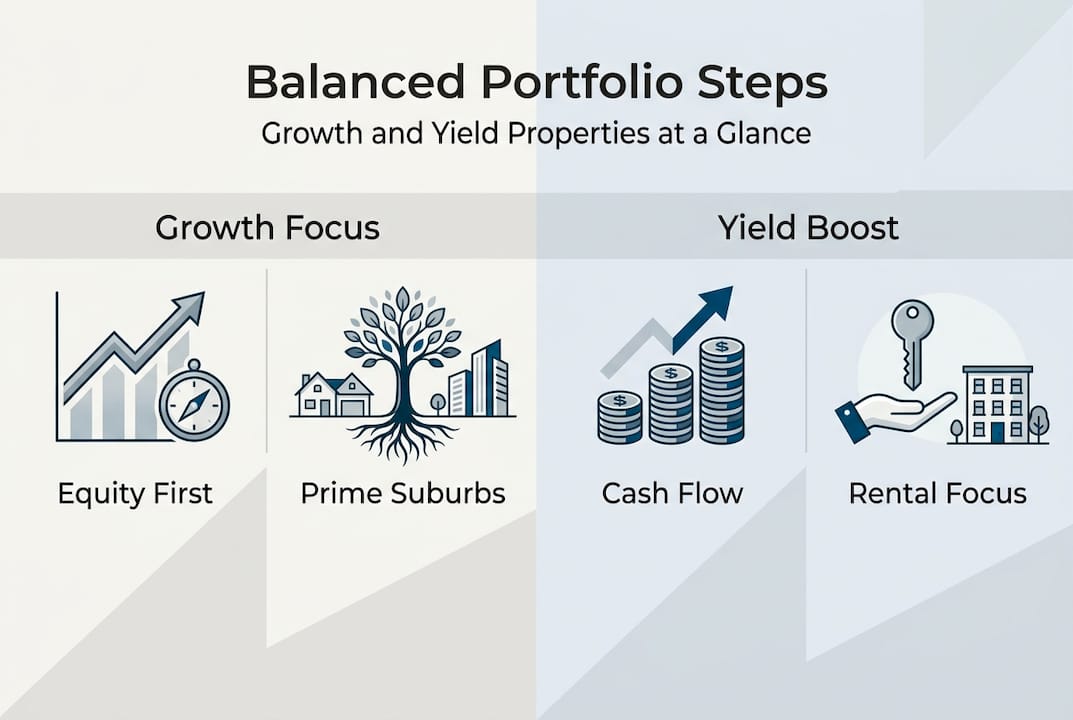
The table below compares key characteristics of growth and yield properties to help you understand how each contributes to your portfolio:
| Factor | Growth properties | Yield properties |
|---|---|---|
| Primary benefit | Capital appreciation | Rental income |
| Typical location | Aspirational suburbs, capital cities | Regional centres, working-class suburbs |
| Cash flow | Often negative or neutral | Positive or strongly positive |
| Risk profile | Higher capital risk, lower income risk | Lower capital risk, higher tenant risk |
| Best for | Building equity, long-term wealth | Improving cash flow, funding expansion |
| Ideal timing | Early in portfolio building | After establishing equity base |
This balanced approach starting with growth properties then adding yield produces optimal portfolio outcomes by leveraging the strengths of each property type at the right stage of your investment journey.
Pro Tip: Work with specialist mortgage brokers and tax advisors who understand property investment to optimise your loan structures and maximise tax deductions. The right structure can save you thousands annually and accelerate your portfolio growth.
Verifying portfolio performance and avoiding common mistakes
Regular performance monitoring ensures your portfolio stays on track to meet your financial goals. Track key metrics including total portfolio value, individual property appreciation, rental yields, and cash flow position. Compare these results against your original projections to identify properties that underperform or exceed expectations.

Calculate your portfolio’s overall return by considering both capital growth and rental income, minus all expenses including loan interest, property management fees, maintenance, and insurance. This comprehensive view reveals your true investment performance and helps you make informed decisions about holding, selling, or refinancing properties.
Common mistakes can derail even well-planned portfolios:
- Neglecting cash flow by overextending on growth properties without sufficient income to service debt comfortably
- Ignoring SMSF compliance requirements, leading to costly penalties and potential fund disqualification
- Creating illiquidity risks by tying up too much capital in property without maintaining accessible reserves
- Using borrowed funds improperly in SMSFs through LRBA misuse or failing to maintain proper loan documentation
- Failing to diversify geographically, leaving your portfolio vulnerable to localised market downturns
- Buying emotionally rather than strategically, choosing properties you like rather than those that meet investment criteria
Avoiding typical SMSF mistakes like illiquidity and improper loan use prevents penalties and maximises gains. Understanding SMSF rental property investment wealth opportunities helps you capitalise on tax advantages while maintaining compliance.
The comparison below shows common mistakes alongside best practice remedies:
| Common mistake | Best practice remedy |
|---|---|
| Buying high-rise apartments | Focus on houses and low-rise units in established suburbs |
| Overextending on debt | Maintain 20% equity buffer and emergency fund |
| Ignoring SMSF rules | Engage specialist SMSF advisors and maintain detailed records |
| Neglecting maintenance | Budget 1% of property value annually for upkeep |
| Poor tenant screening | Use professional property managers with thorough vetting processes |
| Failing to review strategy | Conduct annual portfolio reviews and adjust based on market conditions |
Revisit your investment strategy annually to ensure it remains aligned with your goals, risk tolerance, and changing market conditions. As your portfolio grows and your financial situation evolves, your strategy should adapt accordingly. Stay informed about legislative changes, particularly those affecting SMSF property investment and negative gearing.
How Elite Wealth Creators can help you build your property portfolio
Building a successful property portfolio requires expertise, market knowledge, and strategic planning. Elite Wealth Creators specialises in helping Australian investors navigate the complexities of property investment, from initial portfolio planning through to ongoing optimisation. Our team provides tailored strategies that balance growth and yield based on your unique financial situation and goals.
We offer specialist guidance for SMSF investors, ensuring your property investments maximise tax advantages while maintaining full compliance with superannuation law. Our comprehensive approach covers everything from property investing insights to leveraging SMSF investment property benefits for long-term wealth creation. Whether you’re building your first portfolio or optimising an existing one, we provide the strategic edge you need to achieve financial security through property investment.
Frequently asked questions
What is a balanced property portfolio?
A balanced property portfolio strategically combines high-growth properties that appreciate rapidly with high-yield properties that generate strong rental income. This approach maximises both capital appreciation and cash flow while managing risk through diversification. The portfolio avoids overconcentration in poor-yield assets like high-rise units, which typically deliver suboptimal returns and carry higher risks.
What are common SMSF property investment risks?
SMSF property investors face risks including sole purpose breaches, related party restrictions, and LRBA misuse. Sole purpose violations occur when trustees use SMSF properties for personal benefit rather than solely for retirement savings. Related party rules prevent acquiring assets from connected individuals except under strict conditions. Penalties can reach $18,780 per breach or result in 45% tax rates on non-compliant income, making professional guidance essential.
How do I start building a property portfolio in Australia?
Begin by purchasing growth properties in aspirational suburbs that offer strong capital appreciation potential. These properties help you build equity quickly, which you can leverage to expand your portfolio. Once you’ve established a solid equity base, add high-yield property investments that generate positive cash flow to balance your portfolio and improve serviceability. This sequencing strategy optimises both growth and income over time.
How do I monitor my property portfolio’s performance?
Track key metrics including capital growth, rental yield, cash flow, and total return on investment regularly. Compare your actual performance against original investment goals and market benchmarks to identify underperforming assets. Conduct comprehensive annual reviews that assess whether your portfolio remains aligned with your financial objectives, risk tolerance, and changing market conditions. Adjust your investment strategy based on these insights to maintain optimal performance and manage emerging risks effectively.