

TL;DR:
- Strata properties are a valuable wealth-building option in Australia, offering lower entry costs and strong rental yields. They function through shared ownership of individual lots and common areas, managed by a owners corporation responsible for maintenance and governance. Proper due diligence on financial health and by-laws is essential to ensure a sound investment in this asset class.
Strata properties have quietly become one of the most effective wealth-building vehicles available to Australian investors, yet many people still dismiss them as the domain of downsizers or inner-city renters. The reality is quite different. Whether you’re a first-home buyer looking to secure your foothold in a competitive market, or a seasoned investor seeking strong rental yields with manageable outgoings, strata presents a genuine strategic opportunity. This article walks you through how strata properties work, why they outperform expectations, and how to avoid the pitfalls that catch underprepared investors off guard.
Table of Contents
- What are strata properties and how do they work?
- Key benefits of investing in strata properties
- Strata vs. other property investment options
- Critical due diligence: What you must check before buying
- Who should consider strata property investment?
- Why the typical approach to strata investing misses the mark
- Ready to start your strata property investment journey?
- Frequently asked questions
Key Takeaways
| Point | Details |
|---|---|
| Strata lowers entry costs | Strata investments help you access prime areas with less money upfront than freehold houses. |
| Shared facilities add value | Amenities and security are bundled, enhancing both lifestyle and rental draw. |
| Due diligence is critical | Review all reports, finances, and by-laws before buying to avoid costly pitfalls. |
| Older units may perform better | Established low-rise strata units can offer steadier yields and lower risk than new high-rises. |
| Fits diverse investors | Strata can suit first-time buyers, SMSFs, and seasoned investors alike with the right strategy. |
What are strata properties and how do they work?
With a clear overview of strata’s investment potential, let’s break down what strata properties really are and how they’re structured.
A strata title is a form of property ownership that divides a building or land into individual lots, where each owner holds title to their specific unit alongside shared ownership of common areas. Common areas typically include hallways, lifts, gardens, driveways, and recreational facilities. This ownership structure is distinct from freehold title, where one owner holds the land and everything on it outright.
Strata properties span a range of dwelling types, including:
- Apartments in mid and high-rise buildings
- Townhouses arranged within a complex
- Villas and low-rise residential buildings
- Some commercial and industrial properties
The owners corporation (also known as a Body Corporate in Queensland and some other states) is the governing body made up of all lot owners within a strata scheme. It manages and maintains common property, sets by-laws governing resident behaviour, and collects levies to fund both day-to-day operations and long-term capital works. As a lot owner, you contribute to these levies and have a vote on decisions at general meetings. Knowing your rights and responsibilities within this structure is fundamental before you buy.
Strata properties offer lower entry costs compared to freehold houses, making them accessible for first-time buyers and investors who might otherwise be locked out of premium postcodes. This accessibility is a critical advantage in Australia’s current property climate. If you’re new to this space, brushing up on your property buying essentials before making any commitments is strongly advised.
One often overlooked factor is the by-laws. These are binding rules that govern everything from pet ownership to renovation approvals. Some are restrictive; others are quite permissive. Reading them in full before exchanging contracts can save you significant frustration and financial loss later.
Pro Tip: Always request a copy of the strata’s administrative fund and sinking fund balances, along with the most recent meeting minutes, before signing anything. The financial health of the owners corporation is just as important as the condition of the unit itself.
You can also start small in real estate by entering through strata and scaling over time, which is precisely why this asset class works so well as a portfolio foundation. It also gives you hands-on experience with property management dynamics before you take on more complex assets.
Key benefits of investing in strata properties
Now that you know how the strata model operates, it’s easy to see why so many are attracted to this property class.
The appeal goes well beyond affordability. Strata properties in well-located suburbs offer a combination of lifestyle benefits and investor-grade returns that are genuinely difficult to replicate with a freehold house at the same price point.
What makes strata stand out
- Lower entry price: Strata properties typically cost significantly less than comparable freehold homes in the same suburb, allowing you to enter high-demand markets sooner.
- Built-in amenities: Many modern strata complexes include pools, gyms, rooftop terraces, and secure parking, features that attract quality tenants willing to pay a premium.
- Prime locations: Strata developments are commonly built near CBD fringe areas, train lines, universities, and lifestyle hubs, which drives consistent tenant demand.
- Shared maintenance responsibility: Unlike a freehold property where you carry all repair costs, the owners corporation shares the burden of maintaining common areas.
- Community security: Gated access, intercoms, and security cameras in many complexes add a layer of safety that appeals strongly to renters and owner-occupiers alike.
Strata properties provide access to prime urban locations and amenities like pools and gyms, enhanced security, and community living, which together support higher rental demand and stronger yield profiles.

| Metric | Strata property | Freehold house |
|---|---|---|
| Typical entry price (metro) | Lower | Higher |
| Gross rental yield | 4 to 6% | 2.5 to 4% |
| Maintenance responsibility | Shared | Owner only |
| Amenity access | Included in levies | Additional cost |
| Location flexibility | High demand suburbs | Varies widely |
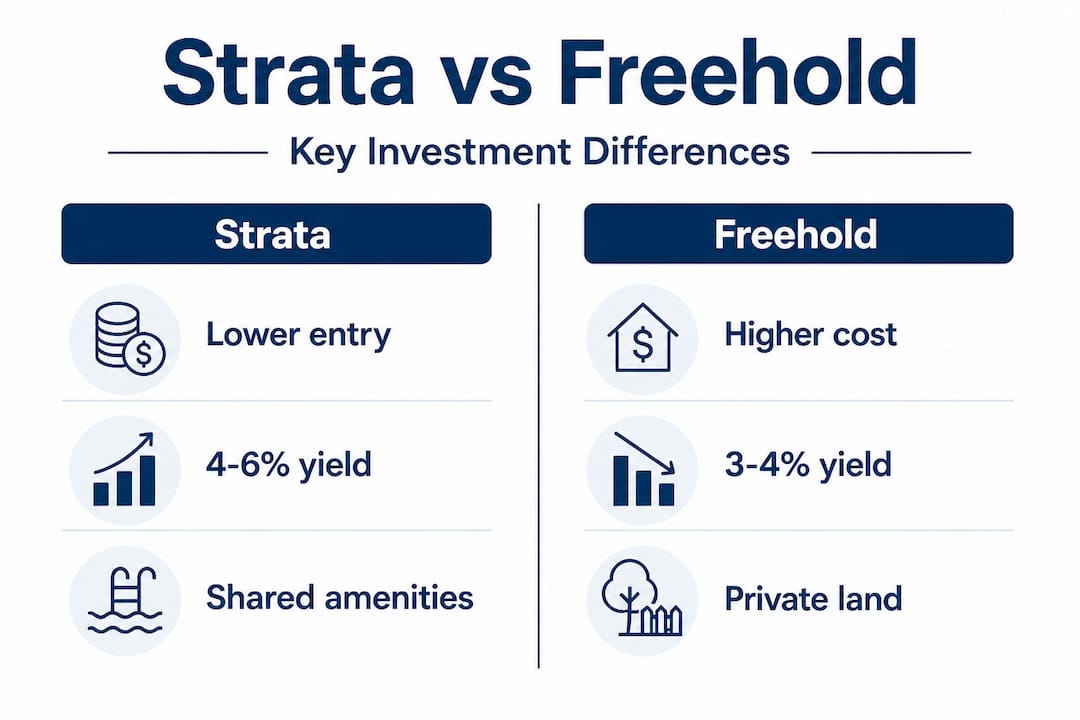
The benefits for beginners in strata are substantial, particularly when you factor in the lifestyle draw for tenants. Gross yields of 4 to 6% in sought-after suburbs are achievable, and in some tightly held inner-ring markets, even stronger figures have been recorded. When you combine yield with location-driven capital growth, the wealth-building case becomes compelling.
For investors interested in advantages of co-living investments and shared living models, strata provides a natural platform to explore these higher-yielding strategies within a familiar legal framework.
Strata vs. other property investment options
Understanding the upsides of strata, it’s important to see how this stacks up against other investment pathways.
Not every investor is best served by strata, and not every strata property is a sound investment. Context matters enormously. Here’s how strata compares across the three most common property investment types in Australia.
| Feature | Strata unit | Freehold house | Off-the-plan/new build |
|---|---|---|---|
| Entry cost | Lower | Higher | Varies |
| Rental yield | 4 to 6% | 2.5 to 4% | Often lower initially |
| Capital growth | Moderate to strong | Strong | Uncertain |
| Maintenance control | Shared | Full control | Limited early on |
| Depreciation benefits | Good | Better | Best (new builds) |
| Levy exposure | Yes | No | Yes (higher) |
When choosing between these options, consider the following factors in order:
- Your borrowing capacity and budget shape which asset type is realistically within reach.
- Your investment timeline determines how important near-term yield versus long-term growth is.
- Your risk appetite influences how comfortable you are with levy uncertainty or development risk.
- Your target tenant demographic affects whether an apartment, townhouse, or house best meets rental demand in your target area.
- Your tax position determines how depreciation benefits and negative gearing interact with each asset type.
“When comparing investment types, well-located strata properties, particularly older low-rise units in established suburbs, often deliver superior yield-to-risk ratios compared to off-the-plan towers or outer fringe houses. The key is understanding the expense structure before you commit.”
Strata suits wealth-building for first-timers through affordability and government schemes, and for seasoned investors through yields of 4 to 6% and portfolio diversification, provided due diligence on levies and by-laws is thorough. For a broader view of how strata fits within a diversified portfolio, explore comparing property investments to identify which asset mix aligns with your financial goals.
Critical due diligence: What you must check before buying
Choosing strata is one thing, but making a safe investment means doing your homework up front.
Too many investors buy a strata property on the strength of its location and finish without adequately reviewing the documents that reveal its true financial condition. This is where costly surprises live.
Here is a clear checklist to guide your due diligence process:
- Strata report and meeting minutes: Review at least two years of meeting minutes to identify disputes, building defects, unresolved maintenance issues, or patterns of owner conflict.
- Administrative fund balance: This covers everyday operational expenses. A low balance relative to outgoings is a warning sign.
- Sinking fund balance and 10-year plan: The sinking fund covers long-term capital works such as roof replacement, lift upgrades, and external painting. A well-funded sinking fund means fewer surprises.
- Special levies: Check whether any special levies have been raised recently or are being proposed. Special levies are one-off charges for unexpected major works and can run into the tens of thousands of dollars.
- By-laws: Review restrictions on renovations, short-term letting (including Airbnb), pet ownership, and parking. These directly affect how you can use and present the property to tenants.
- Building insurance: Confirm that the owners corporation holds adequate building insurance and understand what is and isn’t covered.
- Pending legal action: Some strata schemes are involved in building defect litigation. This can freeze sales, delay settlements, and affect lending.
Reviewing strata reports, meeting minutes, and fund balances gives you a clear picture of a building’s financial health, and experts consistently recommend preferring low-rise older units over new high-rises and targeting high-demand tenant areas for sustained performance.
Red flags to watch for include: levies that have been consistently underpaid or increased rapidly year on year, unresolved water ingress or structural issues, and a history of poor attendance at general meetings suggesting owner disengagement.
Pro Tip: Older, smaller complexes with eight to twelve units often carry lower levies, stronger community cohesion, and more straightforward decision-making than large towers. They may lack a rooftop pool, but they frequently outperform glamorous new developments over a ten-year horizon.
“Always prioritise locations with proven rental demand, access to employment and transport, and a track record of consistent price growth. A well-located, modest unit will outperform a poorly located luxury apartment every time.”
For a thorough framework, use a property due diligence checklist to structure your research systematically, and complement it with in-depth property research techniques to validate suburb fundamentals before proceeding.
Who should consider strata property investment?
Having discussed the practical side of doing your research, let’s pinpoint exactly who stands to benefit most from investing in strata.
Strata is not a one-size-fits-all solution, but it genuinely suits a wider range of investors than most people assume. Here’s a clear picture of who is well positioned to benefit:
- First-home buyers seeking city proximity: Strata properties offer lower entry costs compared to freehold houses, opening doors to suburbs that would otherwise be unaffordable. If your priority is living close to work, cafes, and public transport, a well-chosen unit delivers exceptional lifestyle value at a realistic price.
- Young professionals and dual-income couples: The lower maintenance burden and lock-and-leave convenience of strata suits busy lifestyles, while the yield profile supports early portfolio growth.
- Investors targeting strong rental income: If you’re focused on cash flow rather than immediate capital growth, strata in high-demand suburbs provides reliable tenancy and competitive yields.
- Downsizers transitioning from large family homes: For those simplifying their lives while retaining a quality asset, owner-occupying a strata property delivers both financial security and lifestyle flexibility.
- Self-managed super fund (SMSF) trustees: Strata properties with strong yields and professional tenancy profiles are a practical asset class for SMSFs seeking predictable income and modest capital growth.
- Rent-vestors: Investors who rent where they want to live while owning investment properties in high-yield suburbs can use strata as the cornerstone of their strategy. Exploring the rent-vesting pathway can help clarify whether this approach aligns with your broader financial goals.
If you’re entering the market for the first time, the guide for first-time investors provides a step-by-step roadmap for building a sound investment from scratch, with practical guidance tailored specifically to the Australian context.
Why the typical approach to strata investing misses the mark
With all the fundamentals covered, here’s a hard-won lesson you won’t find in most guides.
The majority of advice circulating about strata investment focuses heavily on building amenities, fresh finishes, and developer reputation. Investors are often drawn to glassy new towers in the CBD or waterfront precincts because they feel premium. But “premium” and “profitable” are not the same thing, and conflating them is one of the most common and costly mistakes we see.
The real value in strata investing lies in understanding the expense structure, not the aesthetic. A building with a rooftop pool, a concierge, and a full-time building manager looks impressive on a brochure, but those features carry a levy cost that can quietly erode your cash flow year after year. When levies climb faster than rents, your yield shrinks regardless of how desirable the address is.
What actually drives sustained performance is this: well-located, older, low-rise buildings with active and transparent owners corporations, conservative levy structures, and proven rental demand. These buildings rarely make headlines, but they consistently deliver. Their by-laws tend to be more straightforward, their maintenance history is visible, and their owners generally care about the long-term condition of the building.
The other mistake investors make is underestimating future levy exposure. A special levy of $15,000 to $40,000 for a major building remediation is not unusual in buildings with deferred maintenance, and it can wipe out several years of positive cash flow in a single invoice. This risk is almost entirely avoidable with proper due diligence, yet it catches investors who focused on the unit’s finishes rather than the building’s finances.
Focusing on maximising rental income in strata requires selecting buildings where management is proactive, levies are sustainable, and rental demand is consistent. That combination is far more valuable than a marble lobby.
Ready to start your strata property investment journey?
If the research, comparison work, and strategic thinking in this article has clarified your path forward, the next step is acting on that knowledge with the right support behind you. At Elite Wealth Creators, we help investors at every stage, from first-time buyers finding their footing to experienced portfolio builders targeting off-market opportunities, to build wealth through well-positioned strata properties.
Explore our property investing insights to sharpen your strategy further, or take the first step toward unlocking financial freedom with personalised guidance designed around your specific goals. Whether you need cash flow modelling, precision sourcing, or a clear investment roadmap, we’re here to help you make your next move with confidence.

Frequently asked questions
What ongoing fees are involved in strata properties?
Strata properties involve regular levies split between an administrative fund for day-to-day costs and a sinking fund for long-term capital works, and additional fees may arise through special levies when major unplanned works are required. It’s essential to review both fund balances and the 10-year maintenance plan before purchasing.
Is it harder to get finance for a strata property?
Banks generally lend on strata properties in the same way as freehold homes, but lenders may apply restrictions or reduce the loan-to-value ratio for high-rise buildings, small lot sizes, or complexes with known defects or ongoing litigation. Engaging a mortgage broker familiar with strata lending is advisable to navigate these nuances effectively.
How do rental yields in strata compare to freehold houses?
Strata properties in high-demand suburbs consistently deliver gross yields of 4 to 6%, which frequently rivals or exceeds yields on houses in the same location, particularly because the entry price is lower relative to achievable rent. The yield advantage is most pronounced in inner-ring suburbs with strong tenant demand and limited housing supply.
What are the typical risks with strata properties?
The most significant risks include unexpected levy increases from underfunded sinking funds, building defect claims that stall resales or refinancing, and poor governance from an inactive or dysfunctional owners corporation. Thorough review of strata reports and meeting minutes before purchase eliminates the majority of these risks before they become your problem.
Recommended
- Build wealth with real estate: proven strategies for Australians | Elite Wealth Creators
- Equity for Property Investing & Wealth | Elite Wealth
- Smart Property Investment Strategies to Grow Wealth | Elite Wealth Creators
- Step-by-step real estate investing in Europe: a clear guide – Article | Crowdinform Investment Guides Real estate crowdfunding
- Comprendre l’investissement locatif et réussir en 2026