

Balancing financial performance with genuine environmental responsibility is now a real consideration for Australian property investors. As the demand for sustainable investments rises and government regulation strengthens, property decisions carry more weight than ever. Embracing sustainable property investment can not only help optimise your SMSF portfolio, but also bring lasting cash flow advantages and greater property liquidity, all while supporting a future-focused investment approach.
Table of Contents
Key Takeaways
| Point | Details |
| Sustainable Investment Growth | The Australian property market is shifting towards sustainable investments driven by regulations and consumer awareness. |
| Investment Diversity | Investors should consider a range of sustainable property types to achieve financial returns while supporting environmental goals. |
| Regulatory Compliance | Staying informed about evolving sustainability regulations is critical for successful investment in SMSFs. |
| Risk Management | Comprehensive risk management strategies are essential to navigate the financial challenges associated with sustainable property investments. |
Sustainable property investment in Australia
Sustainable property investment represents a strategic approach to real estate that integrates environmental consciousness with financial performance. In the Australian context, this means selecting properties and investment strategies that not only generate financial returns but also minimise environmental impact and support long-term ecological sustainability.
The Australian property market has seen a significant shift towards sustainable investment, driven by several key factors:
-
Increasing government regulations around environmental performance
-
Growing consumer demand for energy-efficient properties
-
Rising awareness of climate change impacts
-
Potential for improved long-term asset value
Research from the University of Western Sydney highlights the emerging economic rationale for sustainable property development, demonstrating that green buildings can deliver superior financial performance. Economic benefits of sustainable properties are becoming increasingly clear, with investors recognising that sustainability isn’t just an environmental choice—it’s a smart financial strategy.
Key considerations for sustainable property investment include:
-
Energy efficiency ratings
-
Renewable energy potential
-
Water conservation systems
-
Material sustainability
-
Location and infrastructure resilience
The Australian Housing and Urban Research Institute (AHURI) has extensively researched sustainable housing development, emphasising both new builds and retrofit opportunities. Sustainable apartment housing strategies provide investors with comprehensive insights into creating environmentally responsible property portfolios.
Pro tip: Conduct comprehensive environmental assessments before property acquisition to understand long-term sustainability potential and potential future value appreciation.
Key investment types and variations
Sustainable property investment offers diverse opportunities for Australian investors seeking to balance financial returns with environmental responsibility. Sustainable property investment strategies encompass multiple investment types that cater to different risk appetites and sustainability goals.
The primary investment variations in sustainable Australian property include:
-
Green Commercial Buildings: High-performance office spaces and commercial properties with superior energy efficiency
-
Residential Eco-Developments: Residential complexes designed with sustainable infrastructure and minimal environmental impact
-
Renewable Energy Property: Properties integrated with solar, wind, or other renewable energy systems
-
Retrofitted Sustainable Properties: Existing buildings upgraded to improve energy performance and reduce carbon footprint
-
Sustainable Infrastructure Projects: Mixed-use developments focusing on environmental and social sustainability
Investors can access these investment types through various financial mechanisms. Sustainable finance instruments such as green bonds, ethical equity funds, and specialised green loans provide flexible pathways for sustainable property investment.

Each investment type presents unique characteristics and potential returns:
Here’s a summary of the main sustainable property investment types and their attractive benefits for Australian investors:
| Investment Type | Distinctive Benefit | Suitable Investor Profile |
| Green Commercial Buildings | Enhanced tenant appeal, stable rent | Institutional, SMSF trustees |
| Residential Eco-Developments | Lower operational costs, healthy living | Families, ethical investors |
| Renewable Energy Properties | Access to incentives, reduced bills | Risk-tolerant, innovative |
| Retrofitted Sustainable Properties | Quick value uplift, reduced emissions | Existing property owners |
| Sustainable Infrastructure Projects | Strategic collaborations, future-ready assets | Large-scale project investors |
-
Commercial green buildings typically offer stable, long-term lease agreements
-
Residential eco-developments can attract environmentally conscious tenants
-
Renewable energy properties may qualify for government incentives
-
Retrofitted properties can provide immediate value appreciation
-
Sustainable infrastructure projects often have strategic government support
Pro tip: Diversify your sustainable property portfolio across multiple investment types to balance risk and maximise potential environmental and financial returns.
SMSF strategies for sustainable property growth
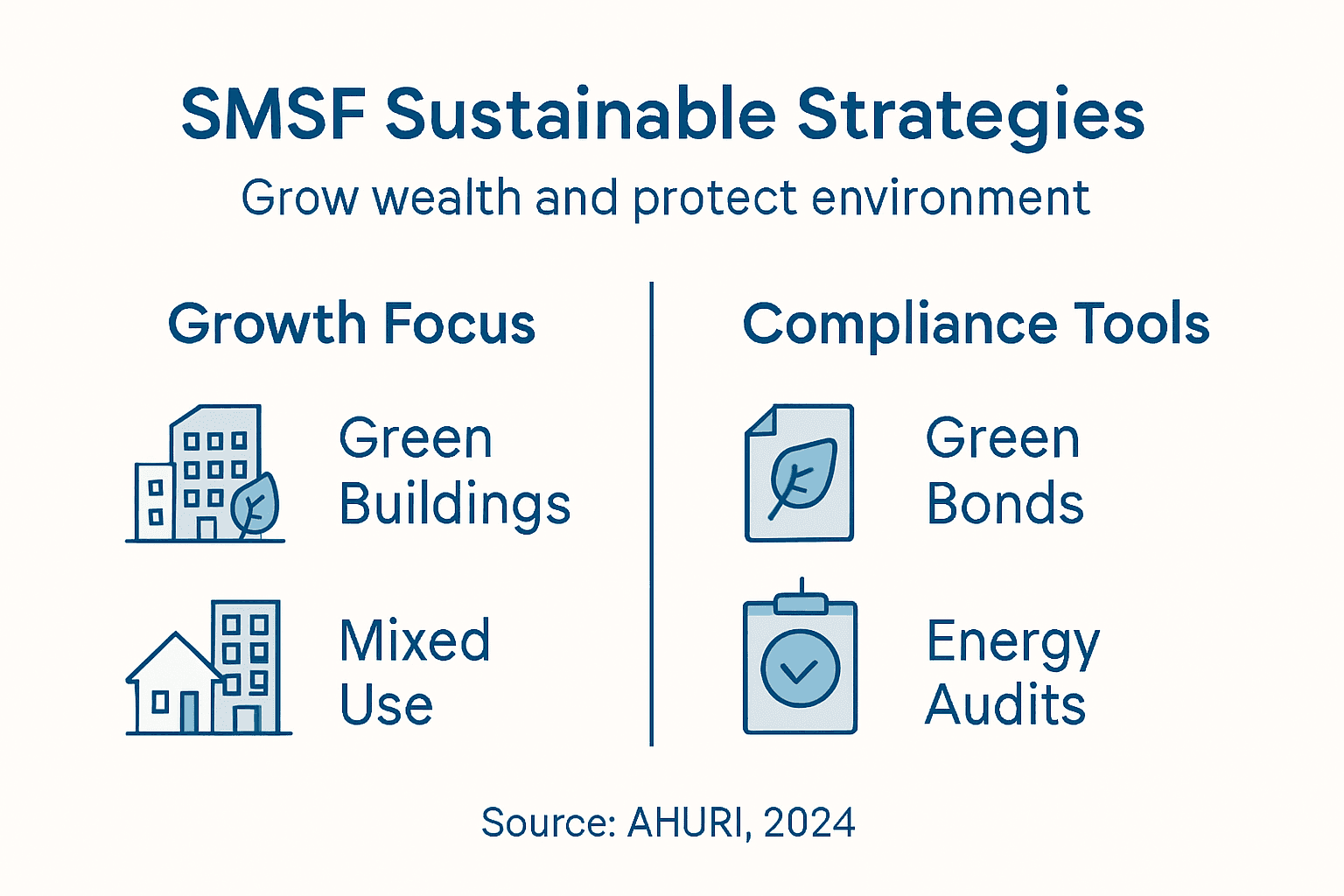
Self-Managed Superannuation Funds (SMSFs) are increasingly recognising the potential of sustainable property investments as a strategic approach to long-term wealth creation. Sustainable investment strategies offer SMSF trustees a sophisticated pathway to align financial goals with environmental responsibility.
Key strategic approaches for sustainable SMSF property investment include:
-
Diversified Portfolio Allocation: Spreading investments across different sustainable property types
-
Green Certification Screening: Selecting properties with high environmental performance ratings
-
Renewable Energy Integration: Identifying properties with existing or potential renewable energy capabilities
-
Long-Term Value Assessment: Evaluating properties based on future sustainability potential
-
Compliance-Driven Investment: Ensuring investments meet evolving regulatory sustainability standards
The regulatory landscape is evolving to support sustainable SMSF investments. Responsible investment frameworks now provide clearer guidelines for integrating environmental, social, and governance (ESG) considerations into superannuation investment strategies.
Strategic implementation requires a comprehensive approach:
-
Conduct thorough sustainability assessments
-
Analyse long-term environmental performance metrics
-
Consider potential government incentives
-
Evaluate carbon reduction potential
-
Assess the future-proofing capabilities of potential investments
Pro tip: Regularly review and rebalance your SMSF’s sustainable property portfolio to maintain optimal alignment with both financial performance and environmental sustainability goals.
The following table compares key SMSF sustainable property strategies and their impact on long-term fund performance:
| SMSF Strategy | Long-Term Financial Impact | Environmental Alignment |
| Diversified Portfolio | Reduces volatility, improves returns | Spreads sustainability gains |
| Green Certification Screening | Improves asset value, attracts tenants | Recognises eco leadership |
| Renewable Energy Integration | Cuts energy costs, increases appeal | Direct renewable adoption |
| Long-Term Value Assessment | Identifies resilient assets | Targets future-proofing |
| Compliance-Driven Investment | Minimises legal risk, future rewards | Adheres to regulations |
Regulatory requirements and compliance essentials
Navigating the complex landscape of sustainable property investment within Self-Managed Superannuation Funds (SMSFs) requires a comprehensive understanding of evolving regulatory frameworks. Sustainable finance regulatory guidelines are increasingly focusing on ensuring transparency, accountability, and environmental responsibility in investment strategies.
Key regulatory compliance requirements for sustainable SMSF property investments include:
-
Mandatory Climate Disclosure: Reporting on climate-related financial risks and opportunities
-
Sustainability Performance Reporting: Documenting environmental impact and efficiency metrics
-
ESG Investment Guidelines: Adhering to environmental, social, and governance investment standards
-
Net Zero Alignment: Demonstrating commitment to carbon reduction strategies
-
Transparent Reporting Mechanisms: Providing clear and comprehensive investment impact assessments
State-level regulations are also playing a crucial role in shaping sustainable property investment standards. Sustainable Buildings Performance Standards in New South Wales, for instance, provide specific guidelines for property development and operational sustainability.
Compliance strategies for SMSF trustees should encompass:
-
Regular sustainability performance audits
-
Ongoing education on regulatory changes
-
Comprehensive documentation of investment decisions
-
Proactive risk management approaches
-
Alignment with emerging sustainable finance taxonomies
Pro tip: Engage with a specialist compliance advisor who understands both SMSF regulations and sustainable investment frameworks to ensure comprehensive regulatory adherence.
Risks, costs and maximising property liquidity
Sustainable property investments within SMSFs demand a nuanced understanding of financial risks and strategic liquidity management. Sustainable property investment risks present complex dynamics that investors must navigate carefully to optimise returns and minimise financial exposure.
Key financial risks in sustainable property investments include:
-
Market Valuation Volatility: Potential fluctuations in green property valuations
-
Upfront Sustainability Costs: Higher initial investment requirements
-
Regulatory Compliance Expenses: Ongoing costs of meeting environmental standards
-
Technology Obsolescence: Risks associated with rapidly evolving sustainability technologies
-
Tenant Attraction and Retention: Potential challenges in specialised sustainable property markets
Effective risk mitigation strategies require a comprehensive approach to understanding and managing potential financial risks. Risk management in sustainable investments emphasises the importance of proactive financial planning and strategic assessment.
Strategies for maximising property liquidity involve:
-
Developing diversified, sustainable property portfolios
-
Maintaining flexible investment structures
-
Conducting regular market value assessments
-
Implementing robust exit strategies
-
Monitoring emerging sustainable property market trends
Pro tip: Develop a comprehensive liquidity management plan that balances sustainable investment goals with financial flexibility, allowing quick adaptation to market changes.
Common mistakes and alternatives to avoid
Sustainable property investment within SMSFs requires strategic awareness and proactive management to navigate potential pitfalls. Common sustainable investment errors highlight critical areas where investors frequently compromise their investment potential.
Most significant mistakes in sustainable property investment include:
-
Inadequate Due Diligence: Overlooking comprehensive property sustainability assessments
-
Regulatory Non-Compliance: Failing to understand evolving environmental regulations
-
Narrow Investment Perspective: Focusing solely on short-term financial returns
-
Insufficient Risk Management: Neglecting long-term sustainability performance metrics
-
Reactive Instead of Proactive: Responding to market changes rather than anticipating them
Sustainable investment management strategies recommend alternative approaches that enhance investment resilience and performance.
Strategies to mitigate common investment mistakes include:
-
Implementing rigorous sustainability screening processes
-
Developing comprehensive ongoing education programs
-
Creating flexible investment frameworks
-
Establishing robust performance monitoring systems
-
Engaging specialised sustainable investment advisors
Pro tip: Cultivate a holistic investment mindset that balances financial returns with long-term environmental and social sustainability objectives.
Unlock the Full Potential of Your SMSF with Sustainable Property Investment
Sustainable property investment offers a path to align your financial goals with environmental responsibility but navigating this complex market can be challenging. With evolving regulatory requirements, diverse investment types, and the need for strategic portfolio diversification, you need a partner who understands these unique demands. At Elite Wealth Creators, we help you overcome the hurdles of upfront sustainability costs, regulatory compliance, and market valuation volatility by providing bespoke solutions tailored to your SMSF.
Discover how our specialised expertise in Investors & Owner Occupied property strategies can empower you to build a resilient, eco-conscious portfolio. Benefit from our exclusive services, including instant liquidity options and precision sourcing that are designed to unlock cash flow and uncover off-market sustainable opportunities. Don’t wait for the market to change – take control of your SMSF’s future today by visiting Elite Wealth Creators and exploring how our Business solutions can create long-term wealth while fostering sustainability.
Frequently Asked Questions
What is sustainable property investment?
Sustainable property investment is a strategy that combines environmental consciousness with financial performance, focusing on selecting properties that generate returns while minimising environmental impact.
How can Self-Managed Superannuation Funds (SMSFs) benefit from sustainable property investments?
SMSFs can enhance long-term wealth creation through sustainable property investments by aligning financial goals with environmental responsibility, diversifying portfolios, and potentially accessing government incentives.
What key considerations should I evaluate when investing in sustainable properties?
When investing in sustainable properties, consider energy-efficiency ratings, renewable energy potential, water-conservation systems, material sustainability, and the property’s location and infrastructure resilience.
What are some common mistakes to avoid in sustainable property investment?
Common mistakes include inadequate due diligence, regulatory non-compliance, a narrow investment focus on short-term returns, and insufficient risk management.