

Finding the right commercial property can open doors to higher yields and resilient long-term growth for Australian investors. With strong rental income and structured tenancy agreements, commercial property stands apart from residential options in both reliability and wealth-building potential. Whether you are growing your portfolio directly or through an SMSF, this guide breaks down the key benefits, differences, and practical strategies needed to create sustainable cash flow in the Australian market.
Table of Contents
- Commercial Property Investing Explained
- Types Of Commercial Properties In Australia
- Yield Potential And Wealth Creation Benefits
- Key Risks, Liabilities And Legal Requirements
- SMSF Strategies And Cash Flow Optimisation
Key Takeaways
| Point | Details |
|---|---|
| Understanding Commercial Property | Commercial property investing offers higher rental yields compared to residential properties, typically ranging from 6–8%. This provides potentially better cash flow and capital appreciation opportunities. |
| Lease Benefits | Longer lease terms with professional tenants reduce vacancy risk and enhance income stability, as tenants operate under binding agreements typically spanning 3–10 years. |
| Investment Strategy | Choosing between long-term growth and immediate cash flow influences property selection and ownership structure, making a clear strategy essential for success. |
| Legal and Compliance | Awareness of legal obligations, risk management, and compliance is crucial for protecting investments and avoiding costly mistakes in commercial property ventures. |
Commercial Property Investing Explained
Commercial property investing is fundamentally different from buying a home or residential investment property. You’re purchasing buildings—office blocks, retail centres, warehouses, or industrial units—where tenants run their businesses and pay rent to you.
The appeal is straightforward: commercial properties often deliver higher rental yields than residential property. A well-positioned office building or retail space can generate 6–8% annual returns, compared to 3–4% for many residential investments.
Why Commercial Property Differs
Commercial tenants operate under formal leases, not the casual terms you’d negotiate with a residential renter. These agreements are legally binding, typically span 3–5 years (sometimes longer), and include built-in rent increases.
Here’s what sets it apart:
- Longer lease terms reduce vacancy risk and provide income certainty
- Professional tenants (businesses) are more reliable payers than individuals
- Higher rental income per property translates to better cash flow
- Triple net leases often mean tenants cover maintenance, rates, and insurance
- Value appreciation often outpaces residential property growth in established precincts
Commercial tenants view property as a business expense, not a home—they pay on time or risk operational disruption.
The Investment Structure
When you purchase commercial property, you’re acquiring an income-producing asset with tax implications you need to understand. Capital gains tax applies to commercial properties when you eventually sell, and rental income is taxable in the year it’s earned.
Your investment strategy matters here. Are you holding for long-term capital growth, or maximising immediate cash flow? This determines everything from the property type you select to how you structure your ownership.
Skills You’ll Need
Commercial property investing requires knowledge across multiple areas—valuation, market analysis, tenant evaluation, and financial modelling. Understanding the investment fundamentals for Australian property markets helps you make informed decisions rather than relying on assumptions.
Key competencies include:
- Lease analysis: Reading what’s actually in the tenant agreement
- Market research: Identifying growth corridors and emerging opportunity areas
- Financial modelling: Calculating true returns, including holding costs
- Tenant assessment: Evaluating whether a business is stable and creditworthy
Pro tip: Always obtain a professional valuation and lease review before committing—the cost is minimal compared to purchasing a property based on incomplete information.
Types Of Commercial Properties In Australia
Australia’s commercial property market offers diverse investment opportunities, each with distinct characteristics, risk profiles, and income potential. Understanding the different property types helps you select assets aligned with your wealth strategy and risk tolerance.
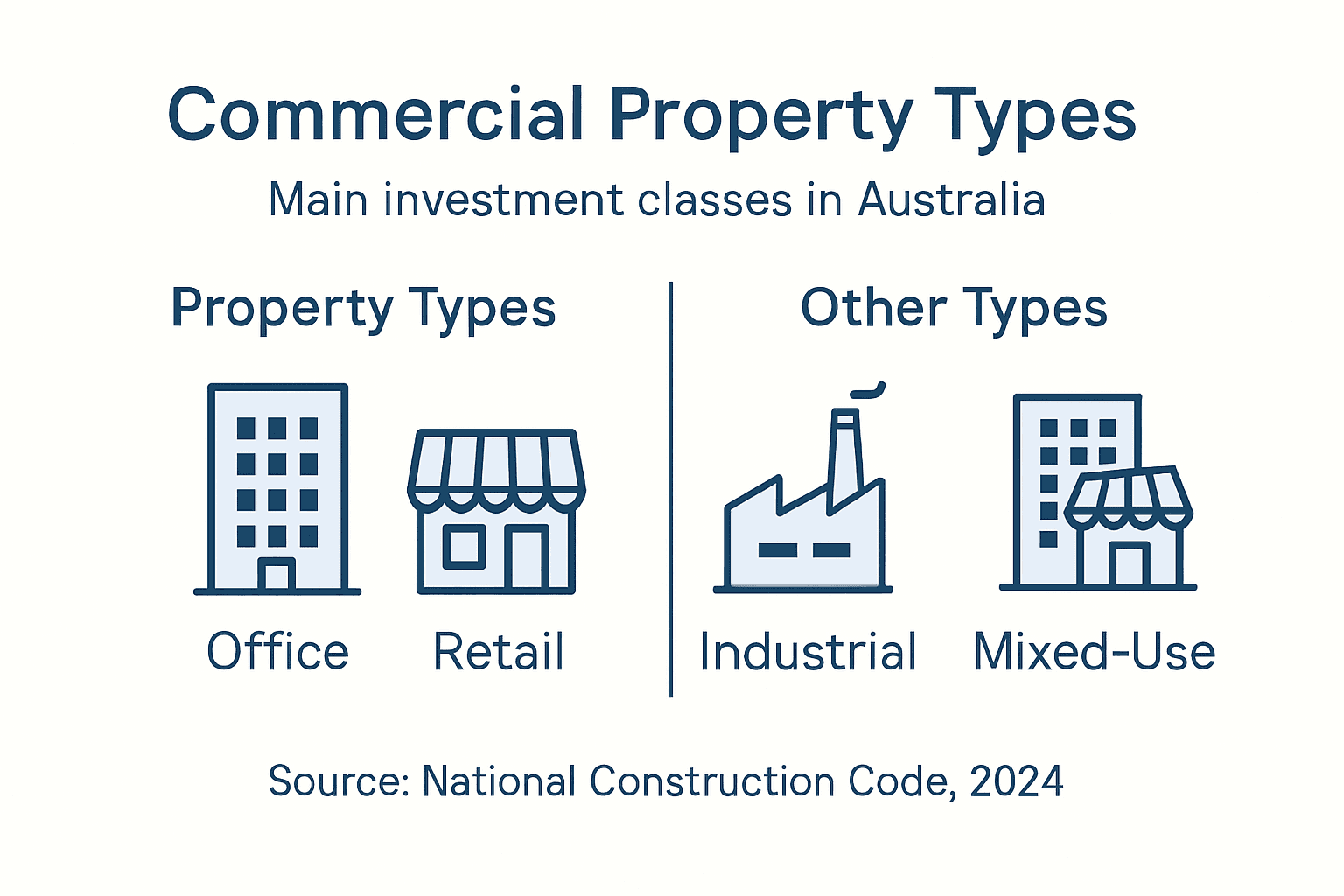
The National Construction Code classifies commercial buildings into categories based on their primary use and function. This classification system directly affects regulatory compliance, insurance costs, and tenant demand.
Here’s a comparison of the main types of commercial properties and their typical investment attributes in Australia:
| Property Type | Typical Lease Length | Average Yield Range | Management Complexity |
|---|---|---|---|
| Office | 3–5 years | 6–8% | Moderate |
| Retail | 3–7 years | 5–7% | High |
| Industrial | 3–10 years | 6–8% | Low |
| Mixed-use | 3–8 years | 5–8% | High |
Office Buildings
Office properties range from small standalone buildings to large corporate towers in prime business districts. They attract stable, professional tenants with strong credit ratings and predictable payment histories.
Office buildings appeal to investors seeking:
- Reliable long-term tenants with corporate lease agreements
- Premium rental yields in established CBD and fringe precincts
- Professional management simplicity with experienced property managers
- Capital appreciation in growing employment hubs
Office property tenants are typically creditworthy businesses with incentive to maintain premises and meet lease obligations.
Retail Centres and Shop Tenancies
Retail properties include shopping centres, strip shops, and standalone retail units where businesses sell goods or services to the public. These properties generate revenue through foot traffic and consumer spending patterns.
Key considerations for retail investment:
- Location drives success—proximity to transport, parking, and population density matters significantly
- Tenant diversity reduces risk if one retailer vacates
- Lease terms often include percentage rent (a share of sales beyond base rent)
- Economic downturns impact retail spending, affecting rental income
Industrial and Warehouse Properties
These properties serve manufacturing, storage, distribution, and logistics operations. They typically offer straightforward tenancy arrangements and lower maintenance requirements than retail or office spaces.
Industrial assets deliver:
- Strong cash flow with minimal tenant turnover
- Lower capital intensity compared to office or retail
- Growing demand from e-commerce and supply chain expansion
- Tenant responsibility for most maintenance under triple net arrangements
Mixed-Use Properties
Mixed-use developments combine multiple property types—office above retail, residential above commercial, or hotel with retail components. These properties diversify income streams and appeal to institutional investors.
They require more sophisticated management but offer portfolio resilience across market cycles.
Different property types perform differently across economic conditions—diversifying across office, retail, and industrial reduces concentration risk.
Pro tip: Match property type to your expertise and available capital; office buildings suit hands-off investors, while retail requires active tenant management for optimal returns.
Yield Potential And Wealth Creation Benefits
Commercial property investing delivers returns through two distinct channels: rental yield (immediate income) and capital appreciation (long-term wealth building). Together, these create a powerful wealth-creation vehicle for Australian investors.

Unlike residential property, commercial assets generate substantially higher rental yields. A quality commercial property yields 6–8% annually, whilst residential typically returns 3–4%. This difference compounds dramatically over time.
Understanding Rental Yield
Rental yield is the annual rental income expressed as a percentage of the property’s purchase price. It directly impacts your cash flow and ability to service debt.
Yield calculation works like this:
- Annual rental income ÷ property purchase price = gross yield
- Deduct operating costs (rates, insurance, maintenance) to determine net yield
- Commercial properties often deliver 6–8% gross yield, sometimes higher in secondary markets
A $1 million commercial property generating $70,000 annual rent delivers a 7% gross yield—compared to typical residential properties at 3–4%.
Capital Appreciation And Long-Term Wealth
Capital appreciation occurs when your property value increases over time. Australian commercial real estate earnings show steady growth, reflecting consistent demand and limited supply in prime locations.
Historically, Australian commercial property appreciates 3–4% annually in established precincts. Over 20 years, this compounds significantly.
Consider this scenario:
- Purchase price: $1 million
- Annual appreciation: 3.5%
- Value after 20 years: $1.99 million
- Total gain: $990,000
Combine this with rental income reinvested, and wealth creation accelerates substantially.
The Leverage Advantage
Most investors don’t pay cash for property—they borrow. Commercial property loans typically allow 70–80% loan-to-value ratios, meaning you control a $1 million asset with $200,000–$300,000 capital.
Banks actively lend against commercial property because tenant quality and lease structures reduce risk. Growing commercial property credit exposure by Australian lenders reflects confidence in this asset class.
Leverage amplifies returns:
To assist investors, here’s a quick reference on the advantages and risks of commercial property leverage in Australia:
| Leverage Feature | Investor Benefit | Associated Risk |
|---|---|---|
| Higher borrowing ratio | Control larger asset | Increased exposure to lenders |
| Equity growth | Access more acquisitions | Risk of negative equity |
| Rental income coverage | Enhanced cash flow | Vacancy gaps impact repayments |
| Favourable loan terms | Lower upfront capital | Potential interest rate rises |
- Invest $250,000; control $1 million in assets
- Generate $70,000 annual rental income
- Your yield on actual capital invested: 28%
- Property appreciates 3.5%; you capture $35,000 on your $250,000
Building A Wealth Portfolio
Multiple commercial properties create momentum. Each asset generates independent cash flow whilst building collective equity.
Key benefits of portfolio growth:
- Diversified income across multiple tenants and property types
- Increased borrowing capacity as equity grows
- Options to refinance and deploy capital into additional acquisitions
- Tax-efficient structure through strategic ownership arrangements
Commercial property investors often deploy equity from one property into acquiring the next—compounding wealth exponentially.
Pro tip: Focus on properties delivering 6%+ net yield in growth corridors; this ensures strong cash flow today whilst capturing capital appreciation tomorrow.
Key Risks, Liabilities And Legal Requirements
Commercial property investment carries obligations beyond capital deployment. Understanding legal frameworks, risk exposure, and compliance requirements protects your asset and wealth position.
Many investors underestimate the complexity. The difference between a thriving investment and a costly mistake often hinges on proper legal structuring and risk management from day one.
Understanding Your Legal Obligations
The Corporations Act 2001 outlines key legal obligations for entities managing investments, including disclosure requirements and fiduciary duties. Your legal structure—whether personal ownership, company, trust, or SMSF—determines specific compliance obligations.
Key areas requiring attention:
- Ownership structure selection (personal, company, trust, SMSF)
- Tax reporting and capital gains tax compliance
- Tenancy law understanding (lease obligations, tenant rights)
- Building and safety codes adherence
- Insurance adequacy for liability protection
Improper legal structuring can cost thousands in unnecessary tax and expose you to personal liability.
Liability Risks And Insurance
Property ownership creates liability exposure. If someone is injured on your property or suffers loss due to neglect, you may face personal liability claims.
Common liability scenarios include:
- Slip and fall injuries in common areas
- Building defects causing tenant business disruption
- Environmental contamination or hazardous materials
- Breach of lease obligations leading to tenant claims
Proper landlord liability insurance is non-negotiable. Most commercial lenders require comprehensive policies before settlement.
Contractual Risk Management
General conditions of contract standards guide risk allocation, responsibility definition, and dispute resolution in commercial property arrangements. Understanding contract terms before signing protects your position.
Critical contract elements:
- Clear responsibility allocation between parties
- Maintenance obligation definitions
- Insurance and indemnity provisions
- Dispute resolution mechanisms
- Termination and exit clauses
SMSF-Specific Compliance
If holding commercial property in an SMSF, additional restrictions apply. SMSFs cannot hold property for personal use and must generate income for members at retirement.
SMSF rules require:
- Property used solely for investment purposes
- Regular valuation for annual reporting
- In-house asset limits compliance
- Annual audit by registered SMSF auditor
- Prohibited transactions avoidance
SMSF breaches attract significant penalties, including loss of concessional tax treatment for entire fund.
Market And Economic Risks
Market conditions affect property value and rental demand. Economic downturns reduce tenant demand, potentially increasing vacancy periods.
Mitigation strategies include:
- Diversified portfolio across property types and locations
- Conservative leverage ratios (60–70% LVR)
- Cash reserves for vacancy periods
- Quality tenant selection with credit checking
Pro tip: Engage a commercial property lawyer before making an offer; they identify contract risks, liability exposures, and structuring issues that save thousands later.
SMSF Strategies And Cash Flow Optimisation
Self-managed super funds offer unique advantages for commercial property investing. An SMSF allows you to control investment decisions, retain all income and capital gains within the fund, and build retirement wealth with tax efficiency unavailable through personal property ownership.
The key difference: rental income generated inside an SMSF is taxed at 15% (concessional rate), whilst personal property income is taxed at your marginal rate—often 37% or 45%. This alone can double your after-tax returns over time.
SMSF Property Investment Rules
SMSF investment rules allow commercial property acquisitions as part of your retirement strategy. However, strict compliance requirements apply.
Key rules:
- Property must be held purely for investment (never personal use)
- In-house asset limits cap holdings at 5% of fund assets per asset
- Borrowing allowed through limited recourse borrowing arrangements (LRBAs)
- Related-party transactions restricted; purchase prices must be fair market value
- Annual valuations required for annual fund reporting
SMSF breaches attract penalties exceeding the original transgression cost—compliance is non-negotiable.
Leveraging Borrowing Within SMSFs
SMSFs can borrow to acquire property through Limited Recourse Borrowing Arrangements. This allows you to control larger properties than your cash balance permits, amplifying returns whilst limiting liability exposure.
Key LRBA features:
- Lender’s recourse limited to the property (not personal assets)
- Loan must be repaid before member retirement
- Interest and holding costs reduce taxable income
- Property appreciation captured tax-free within the fund
Cash Flow Management Strategy
Optimal cash flow management within an SMSF involves reinvesting rental income strategically. Rather than distributing income, retain it to build reserves and fund additional acquisitions.
A practical approach:
- Collect rental income from existing properties
- Retain surplus after expenses in fund cash account
- Use accumulated cash to reduce LRBA debt or acquire additional assets
- Build portfolio equity systematically
Effective management of SMSF property investments demonstrates competitive performance when tailored strategies optimise cash flow and diversification across property types.
Tax-Efficient Structuring
Structure acquisitions to maximise tax deductions. Rental expenses—council rates, insurance, maintenance, property management fees, and interest—reduce taxable income dollar-for-dollar.
Deductible expenses include:
- Body corporate levies and rates
- Insurance premiums
- Maintenance and repairs
- Property management fees
- Loan interest (not principal)
- Depreciation on plant and equipment
Capital improvements (renovations adding value) cannot be deducted immediately but may generate depreciation deductions over time.
Diversification Within Your SMSF
Holding multiple property types—office, retail, industrial—within a single SMSF reduces concentration risk. If one property underperforms, others buffer returns.
Diversification benefits:
- Income stability across market cycles
- Reduced vacancy impact
- Geographic spread reduces location-specific risks
- Asset class diversity captures multiple growth drivers
A diversified SMSF property portfolio outperforms single-asset concentration during economic downturns.
Pro tip: Build SMSF property portfolios gradually; start with one quality asset generating strong cash flow, then reinvest income into additional acquisitions as equity grows.
Unlock the Power of Commercial Property with Expert Guidance
Navigating the complexities of commercial property investing in Australia requires more than just passion. With challenges like understanding lease analysis, managing legal obligations, and optimising SMSF strategies, you need a partner who transforms these hurdles into opportunities. Whether it is leveraging long-term leases for stable cash flow or structuring your investments to maximise capital growth and tax benefits, Elite Wealth Creators provides the precision sourcing and strategic insight to align your portfolio with your wealth goals.
Ready to elevate your investment game? Discover tailored solutions designed for savvy investors on our Business | Elite Wealth Creators page. Don’t miss the chance to access off-market commercial properties and unlock exclusive financial advantages today by visiting Elite Wealth Creators. Start turning higher yields and smarter investment structures into lasting wealth now.
Frequently Asked Questions
What are the benefits of investing in commercial property?
Commercial properties often deliver higher rental yields compared to residential properties, typically ranging from 6% to 8%. This, combined with longer lease terms, professional tenants, and lower vacancy risks, makes commercial property a lucrative investment option.
How does rental yield differ between commercial and residential properties?
Rental yield in commercial properties generally ranges from 6% to 8%, whereas residential properties usually yield around 3% to 4%. This substantial difference in yields makes commercial properties more attractive for generating immediate cash flow.
What types of commercial properties can I invest in?
Key types of commercial properties include office buildings, retail centres, industrial properties, and mixed-use developments. Each type has distinct characteristics, lease structures, and risk profiles that can align with different investment strategies.
What legal obligations do I have when investing in commercial property?
As a commercial property owner, you must understand the legal obligations related to ownership structure, tenancy laws, insurance requirements, and compliance with local building codes. Properly structuring your investment and being aware of your liabilities is crucial for mitigating risks.