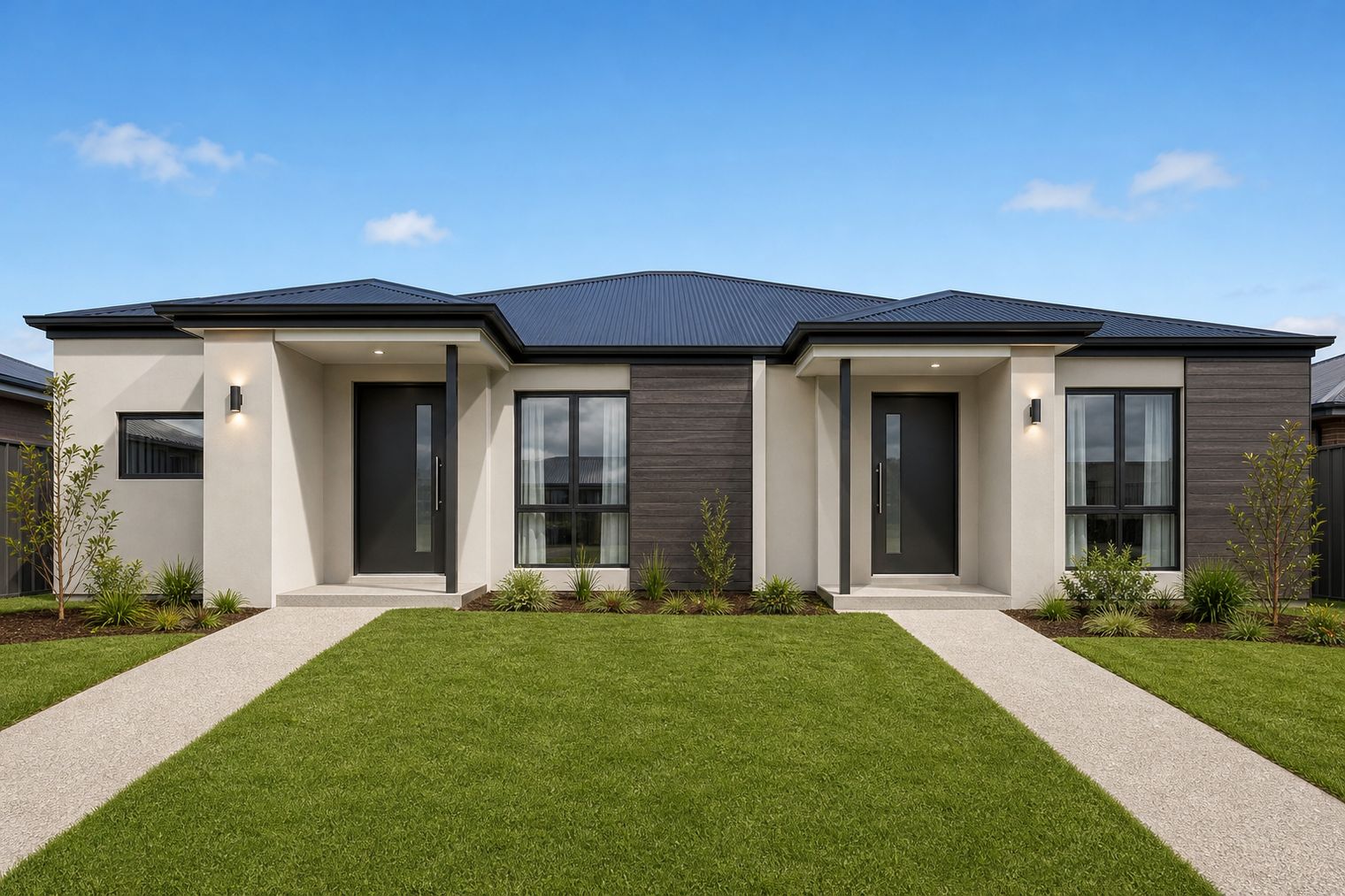
Picture a couple in their late thirties. Both work PAYG, they have a healthy emergency fund, and they have just heard another rate rise discussed on the news. They want an investment property, but a single tenancy feels like a lot to hang a loan on.
How a dual key property is structured
A dual key property is one home on one title, split into two self-contained parts. It is one building, constructed under a single building approval, internally divided into two self-contained dwellings. Each part can be let separately, so the income can come from two households rather than one.
The two parts cannot be sold separately. A dual key is one home on one title split into two self-contained parts, so the two parts can't be sold separately. The property is bought and sold as a single asset.
Approvals matter. Building a dual key property is generally acceptable as long as the appropriate building and planning permits are obtained. Whether the two parts can be metered separately depends on the service authority, the state and the way the property is titled.
On tax, rental income is the full amount of money you earned when you rented out your property, so rent from both parts is declared. If the owner lives in one part, the costs have to be split. Deductions should be apportioned to exclude the private or domestic use of the property. The ATO's rental property guidance sets out the detail, and a registered tax agent can work through your own position.
Where it suits, and where it does not
The main appeal is resilience in the cash flow. A vacant studio still leaves the main home earning, although a vacancy in either part still carries a real cost. The trade-off sits in the loan, the valuation and the exit.
- It may suit: buyers whose own income can carry the loan if one tenancy is empty for a period, and who want two leases working on one asset.
- It may not suit: buyers who may need to sell just one part later, since a dual key sits on a single title, so it is bought and sold as one property.
- Valuation risk: the pre-settlement valuation may take the potential risk into consideration, and the formal valuation might be lower than the contractual purchase price.
- Lending may tighten: one commentator flagged a risk that lenders would introduce stronger lending requirements either in the form of greater deposits (lower LVR) and/or greater serviceability.
- Insurance and tenants: occupants may have limited options for insurance, although some specialist insurers do cover separate rented areas in dual key properties. You will also be competing with all of the other property types to attract suitable tenants.
How lenders read the rent
Lenders do not usually count rent at face value. Lenders calculate rental income at 75 to 80 per cent of gross rent to allow for vacancy and costs. Some Australian lenders will assess dual key builds using the combined rental income from both dwellings, but policies differ between lenders.
The rate test is the bigger constraint when rates are rising. ADIs must assess all new borrowers' ability to meet their housing loan repayments at an interest rate that is at least 3.0 percentage points above the loan product rate.
A worked example
The figures below are illustrative arithmetic only, not a rent forecast or a quote.
- Rent: the main home at $420 a week and the studio at $380 a week, or $800 a week combined (about $41,600 a year gross).
- Assessed rent: at 75 per cent, about $31,200 a year, or roughly $2,600 a month. At 80 per cent, $33,280.
- Loan: $600,000 over 30 years, principal and interest, at an illustrative 6.00 per cent. Repayments are roughly $3,598 a month.
- Buffered test: the same loan tested at 9.00 per cent is roughly $4,828 a month.
At the actual rate, the assessed rent covers about 72 per cent of the repayment. At the test rate it covers about 54 per cent, so the household's own income has to carry the rest after other debts and living costs. Rates, council charges, insurance and management fees are left out here, and each one reduces what remains.
Now take a vacancy. If the studio sits empty for four weeks, gross rent falls by $1,520 for the year, about 3.7 per cent of the $41,600. The loan repayment does not change.
A second tenancy can soften a vacancy, but lenders test the loan at a higher rate and usually count only part of the rent.
What to do next
- Get an independent rental appraisal for each part. Ask for realistic figures for both dwellings and for the vacancy assumptions behind them, not a marketing range.
- Talk to a mortgage broker who works with dual key and two-tenancy builds. Ask how they assess rent, how the buffered test applies to your income, and which lenders accept combined rent. EWC refers loans to its broker network and does not take commission on any loan.
- Speak with a tax adviser, and if super is involved, an SMSF specialist accountant and lawyer. The rules on borrowing inside a fund are specific, and each structure needs its own review.
If you want to talk through how these pieces fit your own situation, you can book a free call. More background is on the insights page.
General information only, not personal financial advice. Speak with a licensed adviser before acting.