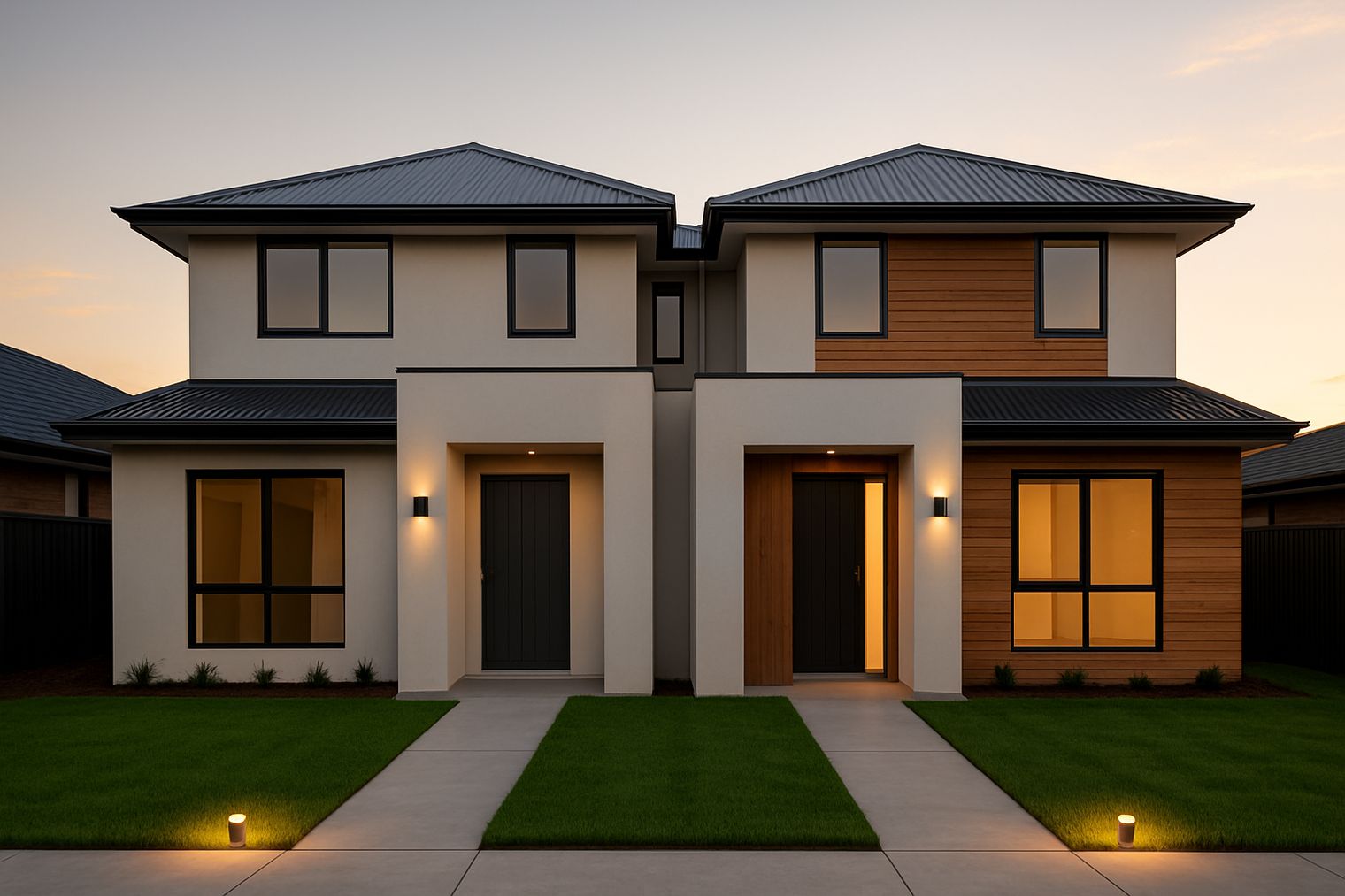
You buy a site, you build two dwellings on it, and when the valuer comes out at completion, the combined value of those two dwellings is higher than what you spent. That gap is manufactured equity. It does not depend on the suburb going up. It comes from what you built.
This is the core appeal of a duplex development for investors who want a result that is within their control rather than one that depends on timing.
How the Mechanic Works
A duplex is two separate dwellings on a single lot, built under one construction contract. The equity gap opens because banks and valuers assess the end product, two independent homes, at a combined figure that typically exceeds the sum of land cost plus construction cost.
Construction costs for a duplex in Australia typically range from $700,000 to $1.5 million, not including land acquisition or demolition. On a per-square-metre basis, a standard duplex runs $2,000 to $3,800/m², with total build prices for most designs falling between $550,000 and $1.2 million depending on finishes, location, and site conditions.
That construction figure does not include everything. Key additional costs include land preparation, council fees, and material selections, with council contributions, soil tests, utility connections, and landscaping often adding 15 to 20% to the base cost. Professional fees for architects, engineers, and certifiers typically add a further 8 to 12% to the construction budget.
The subdivision question matters here too. If the plan is to keep one dwelling and sell or rent the other, Torrens title costs an additional $30,000 to $60,000 but each dwelling sells as its own parcel and finances like a freestanding house. Strata is cheaper upfront, but banks tend to treat the product as two units, which flows through to valuation.
The Trade-Offs: When It Works and When It Does Not
Manufactured equity is a real outcome, but it is not automatic. Several things need to line up.
Site selection is the first filter. Zoning, lot size, street frontage, and council development controls determine whether a duplex is even permissible. A site that works on paper can fail at the DA stage if the footprint or design does not meet local planning rules. Get a planning report before exchanging.
The feasibility margin matters. If total project costs (land plus construction plus soft costs plus holding costs) sit close to the combined end value, there is no equity gap. There may even be a shortfall. Independent quantity surveyor estimates and independent valuation of the proposed end product are the only way to test whether a feasible gap actually exists before you commit.
Construction risk is real. Construction loan set-up, progress-claim interest, builder's risk, and home warranty insurance average 8 to 12% of the contract sum, and a 10% contingency buffer is recommended as insurance against surprises. Fixed-price contracts reduce variation risk, but scope creep and site conditions can still affect the final figure.
Rental income is not guaranteed. Both dwellings need tenants. Vacancy periods, property management fees, and local rental demand all affect the income picture. Get an independent rental appraisal for your specific location rather than relying on broad suburb averages.
SMSF Duplex: An Important 2026 Update
Some investors have asked whether a duplex can be purchased or built inside an SMSF using a Limited Recourse Borrowing Arrangement (LRBA). This is an area where the rules changed significantly in mid-2026, and it requires a careful read.
The federal government announced in June 2026 that self-managed super funds may no longer be allowed to enter new borrowing arrangements to buy residential property, as part of a deal struck with the Greens to secure passage of the government's wider tax bill through the Senate. The operative date is 45 days after Royal Assent, expected to land in the middle of August 2026. Contracts signed on or after that day cannot use an LRBA for residential property.
If your SMSF already has an LRBA in place, nothing is expected to change. Existing borrowing arrangements are expected to be fully grandfathered under the new rules. An unleveraged acquisition of residential property remains permissible if it fits the fund's investment strategy and diversification requirements.
For those exploring SMSF property generally, the existing tax treatment inside the fund is worth understanding. In accumulation phase, an SMSF pays 15% tax on net rental income and a maximum effective CGT rate of 10% on assets held for 12 months or more, compared with marginal rates of up to 47% for personal ownership. Recent CGT reform legislation changed the rules for individuals, trusts, and partnerships, but explicitly excludes complying super funds from the new regime. In pension phase, capital gains on the sale of an asset are ignored where an SMSF is entirely in retirement phase, producing no CGT liability.
Any SMSF strategy for property, including what structures remain available after the LRBA change, requires advice from a licensed SMSF specialist accountant and financial adviser familiar with the current legislative position.
A Worked Example (Illustrative Only)
This scenario uses round numbers to show the structure. It is not a projection or a promise of any outcome.
Assume a flat, zoned lot in a metropolitan growth corridor is purchased for $650,000. The duplex construction contract, fixed price, covers two 3-bedroom dwellings at a combined build cost of $800,000. Soft costs, including DA fees, engineering, landscaping, insurance, and holding costs during the 12-month build, add approximately $120,000. Total project cost: $1,570,000.
At completion, an independent valuation assesses each dwelling separately. Each is valued at $870,000, giving a combined end value of $1,740,000.
The manufactured equity is $170,000 before transaction costs. That figure emerged from design, site selection, and builder contract management, not from the market rising.
Note: stamp duty on the land purchase, agent fees if one dwelling is sold, and tax on any profit realised (at your applicable rate or your fund's rate) all affect the net outcome. Run your actual numbers with a licensed accountant before treating any feasibility estimate as a decision.
The equity gap in a duplex comes from cost discipline and good site selection. It exists regardless of whether prices move during the build period.
What to Do Next
If this structure interests you, three practical steps will tell you whether it suits your situation:
- Check the site first. Have a town planner or conveyancer review zoning, setbacks, and council controls for any site you are considering. Do this before spending money on design.
- Run a full feasibility. Work with a quantity surveyor and an independent valuer to produce realistic cost and end-value estimates. Your broker or financial adviser can then assess what finance structure fits, whether that is standard construction lending, HomePay (which provides zero monthly payments for the first 12 months during the build, with standard repayments commencing after that), or another arrangement.
- Get the right professionals in the room. A licensed broker for finance, a licensed accountant for tax treatment (including depreciation and CGT), and a solicitor for contract review are the minimum team for a duplex project. If SMSF is in the picture, an SMSF specialist accountant is essential given the mid-2026 rule changes.
You can explore how EWC sources and coordinates investment property projects at /services, read more on the topic at /insights, or book a call to talk through whether a duplex fits your position.
General information only, not personal financial advice. Speak with a licensed adviser before acting.