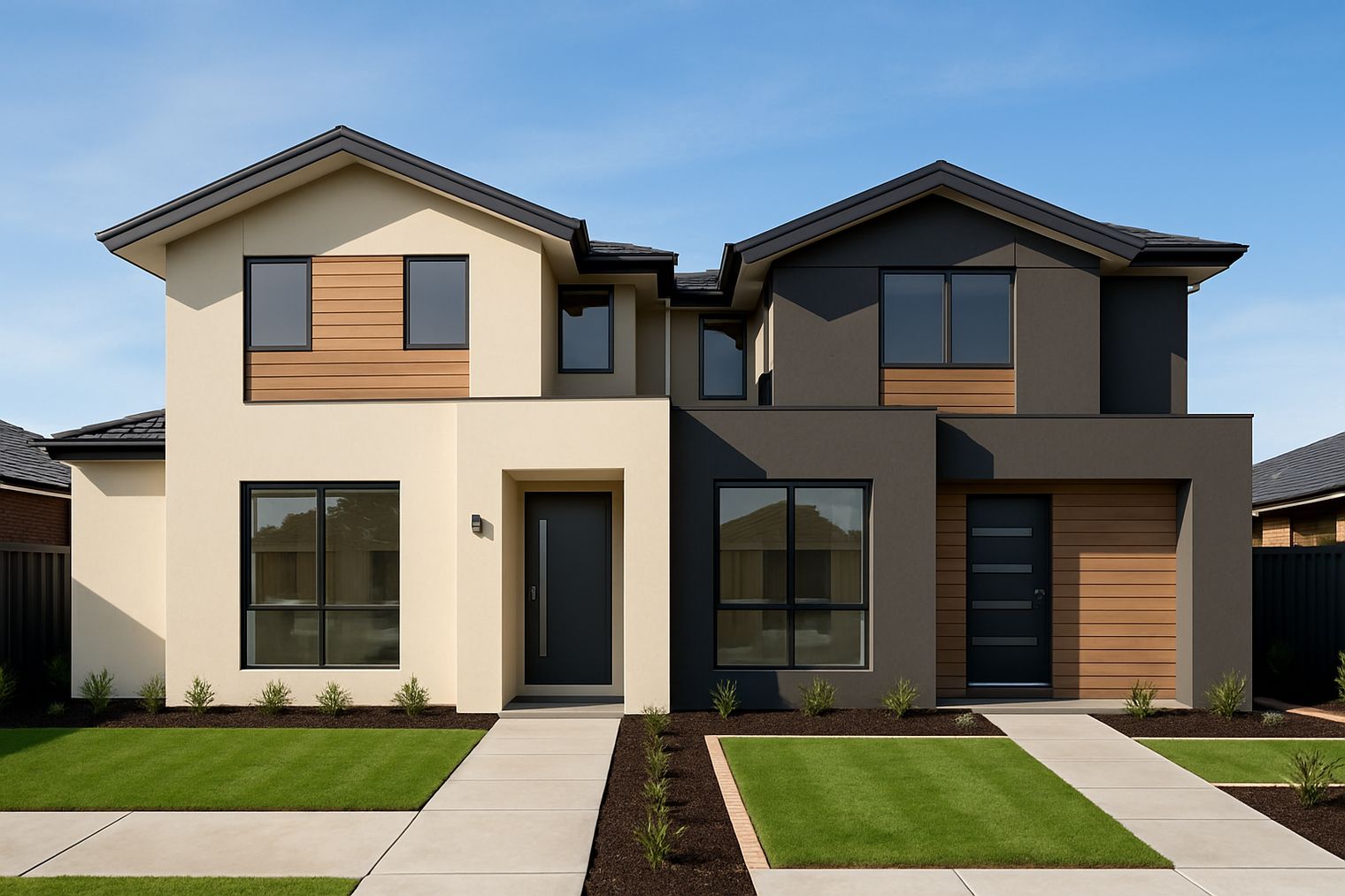
You have found a site that could fit two dwellings. Or you are looking at an existing duplex and wondering whether the numbers stack up differently from a standard house. Either way, the question is the same: does putting two dwellings on one block actually change the investment picture, and if so, how?
This post covers the mechanics, the trade-offs, and how duplexes sit inside both personal and SMSF structures under the rules as they currently stand.
What Makes a Duplex Different
A duplex (formally called a dual occupancy in most state planning frameworks) is two separate dwellings built on a single parcel of land. There is no specific planning term for a duplex in Australia; the correct planning term is "dual occupancy." The two dwellings may share a common wall or sit side by side. They can be held on a single title or, where council and state rules permit, subdivided into two separate Torrens or strata titles.
The rental income dynamic is the core distinction. The biggest attraction is the potential for two income streams from one property, and renting out both dwellings may double rental income compared to a single house. That is not automatic, and it depends on local demand, the quality of each dwelling, and independent rental appraisals, but the structural possibility is there from day one.
For investors, having two tenancies means diversifying rental income. If one unit becomes vacant or a tenant leaves, the remaining unit still generates income, providing more stability in cash flow compared to a single-dwelling investment where a single vacancy results in a temporary loss of income.
The Yield Comparison
The numbers vary significantly by location, construction cost, and local rent levels, so the figures below are illustrative, not projections. Always obtain an independent rental appraisal before relying on any income estimate.
To give a sense of scale, a worked example using 2026 numbers in an affordable Brisbane suburb shows a single dwelling at $550,000 with a gross yield of around 4.5%, while a comparable dual income property at $720,000 with both sides renting at $450 and $430 per week respectively achieved a combined gross yield of around 6.4%. That gap narrows once you account for two sets of property management fees, insurance, and maintenance, but the principle holds: two income streams can lift gross yield meaningfully above the single-dwelling equivalent.
For context, Cotality's April 2026 data puts the national gross rental yield at 3.6%, and even in higher-yielding capitals like Adelaide, single dwellings struggle to break 5%, while dual income listings in affordable regional markets can show gross yields of 6.0% to 6.9%.
The Trade-Offs: When It Works and When It Doesn't
A duplex is not the right structure for every block or every investor. Here are the factors worth weighing honestly.
Planning approval. Dual occupancy is permissible as of right in some council zones and requires a full development application in others. Some councils still prohibit it outright on certain lot sizes. Check your local council's LEP or planning scheme before you buy a site.
Construction cost and timeline. Building two dwellings costs more than building one. Council approval, building permits, and construction timelines all add complexity. Cost overruns and approval delays are genuine risks on any construction project, and a budget buffer matters.
Title structure. Keeping both dwellings on a single title is simpler to finance and manage. Subdividing into separate titles, where permitted, can increase the end value of each dwelling but adds subdivision costs and, in most states, additional stamp duty considerations.
Tax position as a new build. This matters more than ever under the rules as they currently stand. On 12 May 2026, as part of the 2026-27 Federal Budget, the Government announced it would reform negative gearing and capital gains tax arrangements, and these measures are now law. From 1 July 2027, negative gearing will be limited to residential property investments in new builds, and the 50% CGT discount for individuals, trusts and partnerships will be replaced with cost base indexation and a 30% minimum tax rate on capital gains.
Critically, new residential builds are exempt from the negative gearing changes, so investors in new builds can still negatively gear and access the 50% CGT discount. A duplex built as a new development may qualify as a new build for these purposes. The ATO's guidance notes that a duplex built through a knock-down rebuild that replaces a single freestanding house, where the result is a net increase in the number of dwellings, can count as a new build. The specifics of your situation are something to discuss with a licensed tax adviser.
Properties held in super. Property held in a complying super fund is excluded from the negative gearing and CGT changes, and the one-third CGT discount for complying super funds remains unchanged.
Duplexes Inside an SMSF: What the 2026 Rules Mean
For SMSF trustees considering a duplex, the borrowing rules changed significantly in 2026.
The ATO has implemented a new rule that only allows SMSFs to take out a Limited Recourse Borrowing Arrangement (LRBA) for business real property. SMSFs can no longer use an LRBA to purchase residential properties, and this rule took effect for borrowing arrangements entered into on or after 10 August 2026. A residential duplex cannot be funded by a new LRBA inside the fund.
The changes do not apply where an SMSF entered into a binding contract to acquire real property before 10 August 2026, even if settlement occurs on or after that date. The SMSF may also continue to maintain or refinance an existing LRBA after 10 August 2026.
Importantly, the 2026 reforms restrict borrowing rather than residential property ownership itself, and the changes have not stopped SMSFs from investing in property. An SMSF with sufficient cash or liquid assets can still purchase a residential duplex outright. Where borrowing is needed, some trustees are exploring unit trust structures where the borrowing sits at the trust level rather than inside the fund. These structures carry specific compliance requirements, including rules about related-party ownership and the in-house asset test, and require specialist legal and accounting advice to set up correctly.
Inside super, rental income from a duplex is taxed at 15% in accumulation phase and 0% in pension phase (up to the Transfer Balance Cap). The CGT discount for complying super funds remains one-third for assets held over 12 months, giving an effective CGT rate of 10% in accumulation phase and 0% in pension phase. Both trustees and relatives of members cannot live in a residential SMSF property or rent it from the fund.
A Worked Illustration
The following is for general illustration only. It is not a projection or forecast.
Suppose a couple in their mid-40s, both working, are looking at a 600sqm block in a regional Queensland town. They engage a builder to construct two three-bedroom dwellings. The total all-in cost (land, build, professional fees) comes to around $850,000.
- Both dwellings rent at $450 per week each: $46,800 per year gross.
- Management, insurance, rates, and maintenance reduce this to a net figure; the exact amount depends on local rates and actual costs.
- If the property is a qualifying new build, negative gearing on the net loss (if any) can be offset against their salary income from 1 July 2027 onwards under the current rules.
- There is a CGT discount of 50% for Australian resident individuals who own an asset for 12 months or more, meaning they pay tax on only half the net capital gain on that asset, assuming the property qualifies as a new build under the transitional rules.
If they later strata or Torrens subdivide into two separate titles, each dwelling can potentially be sold independently. That changes the exit strategy and the cost base allocation. Both outcomes require advice from a solicitor and accountant before acting.
What to Do Next
Check planning feasibility first. Before anything else, confirm with your local council whether a dual occupancy is permitted on the specific lot you are considering, what the minimum lot size requirement is, and whether subdivision is available. This is free to establish and filters out sites quickly.
Get an independent rental appraisal. Speak to a local property manager, not just a builder or sales agent, to understand realistic weekly rents for the location, current vacancy levels, and tenant demand for that dwelling type.
Discuss the structure with the right professionals. Whether you are looking at a personal investment or an SMSF purchase, the right structure, the tax position, and the borrowing options all need to be confirmed by a licensed adviser, SMSF specialist accountant, or broker. These professionals work alongside the EWC team and can be referred to you through our network. You can book a free call to talk through how EWC sources and coordinates duplex projects, or visit our services page to see how property and finance coordination works together.
General information only, not personal financial advice. Speak with a licensed adviser before acting.