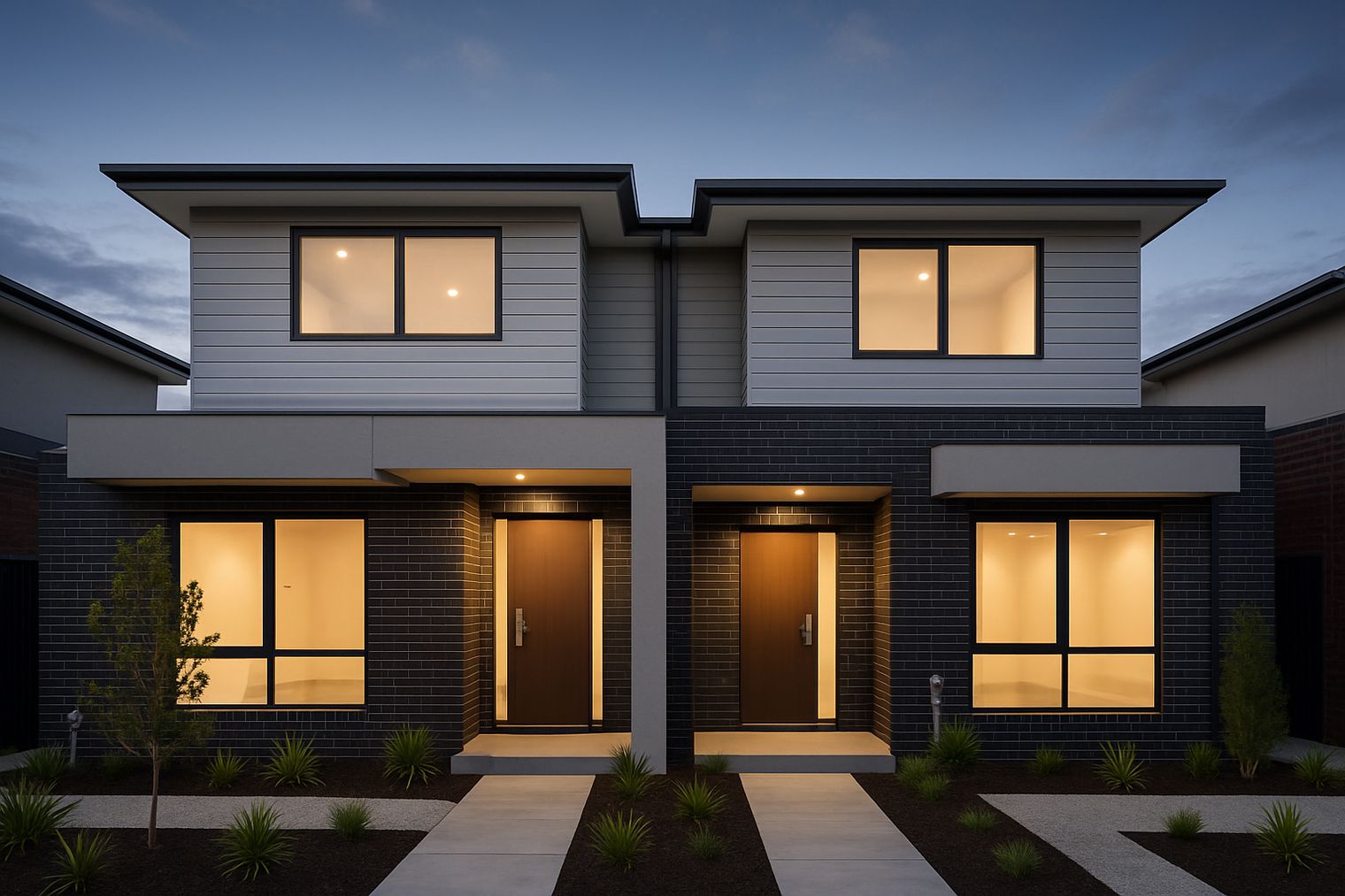
You own one block of land, one title, one property on the books. Yet the property has two front doors, two kitchens, two separate tenancies. That is a dual key investment in plain terms: a purpose-built structure that generates two rental income streams from a single purchase. For Melbourne investors weighing yield against holding costs, it is worth understanding how the structure works before assuming it suits your situation.
How Dual Key Properties Actually Work
A dual key property sits on a single title and contains two fully self-contained dwellings, typically a larger primary residence (three or four bedrooms) and a smaller secondary dwelling (one or two bedrooms), each with its own entrance, bathroom, kitchen, and meter. The two tenancies are leased separately, often to different tenants at different rent levels.
Because both dwellings sit under a single title, you pay one lot of stamp duty and one set of council rates (though both tenancies are assessed for land tax purposes). Finance is also treated as a single property loan, which means one application and one set of borrowing costs. You do not need to subdivide to start collecting two rents.
Dual key properties are purpose-built investment properties containing two self-contained dwellings under a single title. The layouts come in a few common forms in Melbourne: back-to-back on a deeper block, or side-by-side where the site is wide enough. Corner blocks are the premium option, where each dwelling gets its own street frontage, which generally means better privacy, higher rents, and stronger resale values.
The Yield Picture and the Melbourne Rental Backdrop
The core appeal of a dual key purchase is the yield jump relative to a comparable single-dwelling property.
Dual key properties typically deliver gross yields of 5.5 to 6.5%, compared with 3.2 to 3.8% for standard houses in the same location. To put that in dollar terms: a dual key property in a Melbourne growth corridor might cost around $620,000 and generate $750 per week in combined rent, a 6.3% gross yield, while a comparable single-dwelling house in the same suburb might cost $580,000 and rent for $520 per week, a 4.7% gross yield. The dual key structure delivers roughly $12,000 more in annual rental income on a marginally higher purchase price.
Those figures are illustrative, not projections. Actual rental income depends on the specific suburb, property quality, and what the market will bear at the time of leasing. Independent rental appraisals from local property managers are the right reference point, not developer estimates.
On vacancy, Melbourne's rental market has been running below what most regard as a balanced level. According to SQM Research data reported in July 2026, Melbourne's rental vacancy rate held at 1.6% in June 2026, lower than June 2025 and still well below the 3% level often associated with a balanced rental market. Melbourne's outer ring tightened back to 1.8% as of Q1 2026, returning to early 2025 levels, which points to sustained underlying demand in Melbourne's growth corridors. A dual key property carries two vacancies to manage rather than one, so a strong vacancy track record in the chosen suburb matters more here than with a single dwelling.
The Trade-offs: When It Works and When It Doesn't
The stronger yield and cashflow position are genuine. A dual key property at the same purchase price as a single dwelling, generating materially higher annual rent, can be cashflow neutral or positive from settlement. That annual difference compounds over time and preserves borrowing capacity for subsequent acquisitions.
Set against that, there are real costs and risks to weigh:
- Two tenancy management streams. Two leases, two sets of bond lodgements, two separate maintenance calls. Property management fees typically apply to each tenancy. Factor that into your net yield calculation.
- Stamp duty: no concession for investors. Investment properties in Victoria pay the full land transfer duty rate with no concessions. The standard rate runs on a progressive scale from 1.4% to 6.5% based on property value. On an $800,000 dual key, the stamp duty liability would be around $43,070. That is an upfront cost to model before comparing properties across states.
- Victoria's land tax threshold is low. For the 2026 land tax year, the general threshold is $50,000 of total taxable Victorian land. The State Revenue Office threshold is just $50,000, meaning almost every investment property in the state triggers land tax from day one. A dual key property does not create two separate land tax assessments, but the site value is part of your aggregated Victorian landholding. A licensed tax adviser can model the annual liability against the rental income.
- Resale market is narrower. Dual key properties appeal most to other investors. Owner-occupiers are a smaller buyer pool, which can affect liquidity. This is a factor to weigh if your strategy involves selling within a specific timeframe.
- Builder and contract quality matter. A dual key is almost always a new build or off-the-plan purchase. Construction quality, builder track record, completion timelines, and defect liability provisions deserve careful independent assessment.
A Worked Scenario
Consider a newly completed dual key property in Melbourne's southeastern growth corridor, purchased at $750,000.
- Stamp duty (Victorian investor rate): approximately $40,070 per the State Revenue Office progressive scale.
- Illustrative combined rent: $800 per week ($42,000 per year), drawn from a primary dwelling at $500 per week and a secondary dwelling at $300 per week.
- Gross yield: approximately 5.6% on the $750,000 purchase price.
- Holding costs: council rates, body corporate (if applicable), property management (typically charged per tenancy), insurance, maintenance, and land tax, all reduce net yield materially.
If the same investor held a single-dwelling house at $750,000 in the same suburb generating $520 per week ($27,000 annually), gross yield is approximately 3.6%. The dual key structure in this scenario adds roughly $15,000 in gross annual income. Whether that covers the additional management overhead and holds up through vacancy periods is a question for a properly structured cash flow model.
For investors holding inside an SMSF, note that the new LRBA rules apply to new borrowing arrangements involving real property from 10 August 2026, and according to the Australian Taxation Office, an LRBA can now only be used to acquire real property where that property is business real property. This means ordinary residential property generally cannot be acquired through a new LRBA. A dual key residential property inside an SMSF would need to be purchased either as a cash acquisition within the fund, or through the SMSF/unit trust structure where the borrowing sits in the unit trust rather than the fund. Whether an SMSF's borrowing to acquire units in a unit trust is permissible is a complex question that depends on the specific structure and has been the subject of ATO guidance. Specialist legal advice is necessary.
What to Do Next
Dual key properties can make sense for the right investor in the right suburb, but the numbers need to be stress-tested against realistic vacancy, full management costs, and the Victorian holding cost environment before any comparison with alternatives.
Three concrete next steps:
- Get an independent rental appraisal from a local property manager in the suburb you are considering, not the developer's own estimate. Ask for separate appraisals for both dwellings and an honest view of current vacancy in that postcode.
- Work through the cash flow with a licensed broker and a tax adviser. Stamp duty, land tax, depreciation schedules on a new build, and loan serviceability across two notional tenancies all affect the real return. These are matters for a licensed mortgage broker and a registered tax agent, not general reading.
- Clarify your SMSF position if relevant. If you are considering a dual key inside a superannuation structure, speak with an SMSF specialist accountant and solicitor about the unit trust pathway and the in-house asset rules before committing to any structure. The rules changed materially on 10 August 2026.
If you want to understand how EWC sources dual key investment properties in Melbourne and coordinates the finance process, visit /services or book a free call to start the conversation.
General information only, not personal financial advice. Speak with a licensed adviser before acting.