

TL;DR:
- Property investment in Australia is a reliable long-term wealth builder when approached with a disciplined, strategic process.
- Setting clear goals, assessing finances, and understanding market fundamentals are essential steps before acquiring properties.
- Maintaining a long-term perspective, diversifying assets, and leveraging expert guidance optimize growth and manage risks effectively.
Property investment remains one of the most reliable vehicles for building long-term wealth in Australia, yet countless investors stall before they even begin. The sheer volume of advice, conflicting market opinions, and financial jargon can make the whole process feel impossible to navigate. The good news is that a structured, repeatable approach cuts through the noise. This guide gives you a clear, step-by-step property investment strategy built specifically for Australians, whether you’re acquiring your first investment property or expanding an existing portfolio with sharper intent.
Table of Contents
- Get prepared: laying strong investment foundations
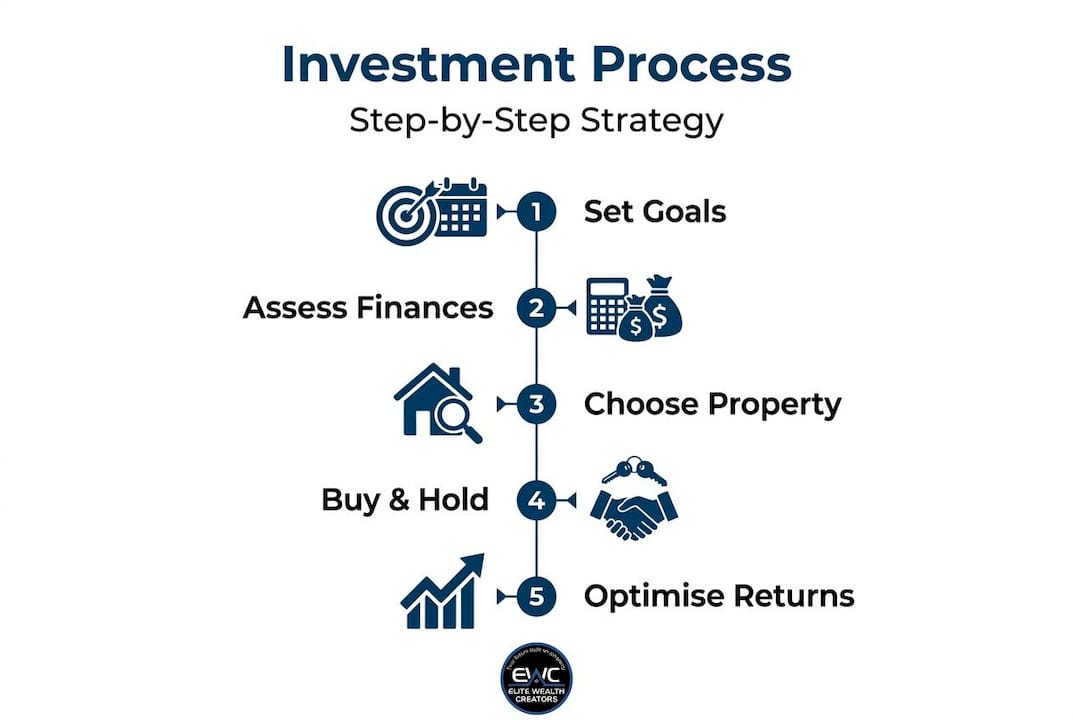
- Step-by-step strategy: the investment process in action
- Maximising returns: using tax benefits and structured exits
- Diversification, risk management, and adjusting for the future
- Why following a method matters more than chasing the market
- Maximise your property investment strategy with expert support
- Frequently asked questions
Key Takeaways
| Point | Details |
|---|---|
| Start with strong foundations | Set clear goals and maintain financial buffers before investing in property. |
| Follow a structured process | A step-by-step approach maximises long-term success and minimises costly errors. |
| Use available tax benefits | Negative gearing and CGT discounts can significantly amplify your returns. |
| Diversify and adapt | Balancing your portfolio and responding to policy changes keeps your wealth plan secure. |
Get prepared: laying strong investment foundations
With the case for a clear path established, let’s dive into the critical groundwork every successful investor needs. Before you search for a single property, you need to know exactly what you’re trying to achieve, because the market will not define success for you.
Start by writing down specific investment goals. Are you chasing passive income through rental yield, long-term capital growth, or a combination of both? Perhaps you’re working toward financial independence by a target age. The clearer your objective, the more precisely you can select properties, ownership structures, and financing arrangements that align with it. A goal like “I want $3,000 per month in passive income by age 55” gives your strategy a measurable target, which is far more useful than a vague desire to “invest in property.”
Next, review your financial position honestly. This means calculating your borrowing capacity with your lender or mortgage broker, identifying how much deposit you can access, and ensuring you have adequate emergency buffers. A buffer of at least three to six months of mortgage repayments is a baseline, not a luxury. You also need to assess your risk tolerance. Some investors are comfortable with higher leverage and short-term cash flow pressure in exchange for growth-oriented assets, while others prefer lower gearing and steadier income.
Understanding which property types suit your goals matters enormously. Residential houses, apartments, duplexes, and townhouses all carry different yield profiles, vacancy risks, and capital growth trajectories. As a starting point for anyone building their foundation, the first property investment guide is a valuable resource for structuring early decisions.
| Preparation area | Key action |
|---|---|
| Goal setting | Define income, growth, or independence targets |
| Finance review | Confirm borrowing capacity and emergency buffer |
| Risk tolerance | Match property type to your comfort level |
| Ownership structure | Consider individual, joint, trust, or SMSF |
| Buffer maintenance | Hold 3 to 6 months of repayment reserves |
Key considerations before you invest:
- Target owner-occupier appeal properties for stronger capital growth
- Use leverage strategically, but never stretch beyond your buffer capacity
- Factor in vacancy rates, council rates, and property management costs
- Consider the impact of future interest rate movements on cash flow
As property investment experts note, you should prioritise owner-occupier appeal properties for growth and use leverage wisely while maintaining a buffer for rate rises and vacancy periods. This principle separates disciplined investors from those who are simply gambling on timing.
Pro Tip: Run a basic cash flow model before committing to any purchase. Factor in rent, mortgage repayments, property management fees, insurance, maintenance, and rates. If the numbers don’t work on paper, they rarely improve in reality.
For further guidance on building a smart foundation, explore these smart investment tips to sharpen your decision-making process before you commit any capital.
Step-by-step strategy: the investment process in action
With your foundations set, here’s how to move step by step through the property investment journey. Each stage builds on the last, which means skipping steps often leads to costly mistakes that take years to correct.
- Research your target market. Identify suburbs or regions with strong population growth, infrastructure investment, and low vacancy rates. Look at historical price data over 10 to 20-year periods, not just recent peaks.
- Select your location with precision. Proximity to schools, transport, employment hubs, and lifestyle amenity drives tenant demand and future resale appeal. Avoid locations that rely on a single employer or industry.
- Assess individual properties. Walk through your shortlisted properties with a critical eye. Consider structural condition, renovation potential, rental yield, and body corporate fees if applicable.
- Secure your finance. Get pre-approval in place before making offers. Understand whether an interest-only or principal-and-interest loan structure suits your cash flow strategy at this stage.
- Conduct thorough due diligence. Commission a building and pest inspection, review the contract of sale with a solicitor, check zoning rules, and verify rental income claims with local property managers.
- Finalise the purchase. Exchange contracts, pay your deposit, and coordinate settlement. Ensure landlord insurance is in place from day one.
- Manage ongoing tenancy. Engage a reputable property manager or, if self-managing, stay across your legal obligations under state tenancy laws. Review rent annually against market conditions.
“Long-term property ownership smooths out market cycles over time, and property generally offers lower volatility than shares, though it remains an illiquid asset class.”
Holding property for over 10 years is not just a conservative approach, it is a well-evidenced strategy. Short-term market noise, interest rate cycles, and economic uncertainty become far less threatening when your time horizon is measured in decades rather than months.
| Approach | Advantages | Disadvantages |
|---|---|---|
| DIY investing | Full control, no advisory fees | Time-intensive, relies on self-knowledge |
| Buyers’ agent | Market access, negotiation expertise | Advisory fees, trust dependent |
| Full investment adviser | Tailored strategy, tax integration | Higher cost, requires ongoing engagement |
Explore more about different property investing strategies to determine which combination of approaches suits your circumstances. You might also find it helpful to compare the various property investment types before finalising your asset selection.
Pro Tip: If a property feels like a good deal because it’s cheap, ask yourself why it’s cheap. Cheap properties in low-demand locations often stay cheap. Focus on fundamentals, not price alone.
Maximising returns: using tax benefits and structured exits
Now that you’ve purchased, managing your property well and using available benefits is key to maximising profit. Australia’s tax system offers several advantages to property investors that, when used correctly, can significantly improve your overall return on investment.

Negative gearing is perhaps the most discussed tax benefit available to Australian investors. When your property expenses, including mortgage interest, council rates, repairs, and property management fees, exceed your rental income, you make a loss on the property. That loss is deductible against your other assessable income, reducing your overall tax liability. For high-income earners, this can result in a meaningful annual tax saving while the property continues to grow in value.
The capital gains tax (CGT) discount is another powerful tool. If you hold an investment property for more than 12 months, you are entitled to a 50% CGT discount on any gain realised when you sell. This means only half of your capital gain is added to your taxable income in the year of sale, which can produce significant savings, particularly on high-value properties.
| Tax benefit | How it works | Key condition |
|---|---|---|
| Negative gearing | Losses offset against other income | Property must be genuinely income-producing |
| CGT 50% discount | Half the gain is taxed on sale | Asset must be held for over 12 months |
| Depreciation claims | Claim wear and tear on fittings | Requires a quantity surveyor’s report |
| Interest deductions | Deduct loan interest from income | Loan must relate to the investment property |
Key tax and exit strategy points to keep in mind:
- Plan your exit strategy before you buy, not after. Know whether you intend to sell, continue renting, or eventually transfer the asset into superannuation.
- Consider the timing of any sale relative to your income year. Selling in a lower-income year can reduce the CGT impact considerably.
- Obtain a depreciation schedule from a qualified quantity surveyor for any property built after 1985. The annual deductions can meaningfully improve your cash flow position.
- Always engage a tax adviser who specialises in property. Rules around negative gearing, CGT, and depreciation are subject to legislative change, and generic advice can cost you money.
Understanding how property builds wealth over the long term helps you see these tax benefits not as annual bonuses but as compounding advantages that accelerate your overall wealth creation strategy.
Statistic callout: According to the Australian Taxation Office, hundreds of thousands of Australians use investment property as a component of their tax planning each year, making it one of the most widely used and legitimate wealth-building mechanisms available under current Australian law.
Diversification, risk management, and adjusting for the future
With your investment established, it’s vital to protect your gains and future-proof your strategy. Property is a powerful wealth-building tool, but concentrating all your capital in a single asset class creates unnecessary vulnerability.
Diversifying your investments across multiple asset types, including shares, managed funds, fixed income, and property, creates a more resilient portfolio that can absorb shocks in any single market. If property values fall or rental demand softens in your region, other assets can stabilise your overall position. Over-reliance on property, particularly when heavily leveraged, can leave investors exposed during prolonged downturns or when personal circumstances change unexpectedly.
Key risk management and diversification principles:
- Blend property with other asset classes to reduce single-market exposure
- Maintain adequate cash reserves to cover mortgage repayments through vacancy periods
- Review your loan-to-value ratios annually to ensure you’re not over-leveraged
- Stay informed about proposed changes to negative gearing and CGT concessions, as policy shifts can alter the investment equation significantly
- Monitor interest rate movements closely, particularly if your portfolio carries significant variable-rate debt
- Consider income protection and life insurance as backstops for your investment obligations
“Avoid over-reliance on property and be aware of potential policy changes to negative gearing and capital gains tax concessions, which can affect long-term investment outcomes.”
Flexibility is not a weakness in property investing; it is a strategic asset. The investors who adapt their approach as markets and policies evolve consistently outperform those who rigidly apply a single strategy regardless of changing conditions.
Pro Tip: Every two years, conduct a formal portfolio review. Reassess your loan structures, insurance cover, rental income, and overall asset allocation. Markets change. Your strategy should evolve with them.
Building a diversified property portfolio is one of the most effective ways to stabilise your returns and reduce concentration risk across economic cycles.
Why following a method matters more than chasing the market
Having covered caution and adaptability, it’s worth reflecting on what experience shows about the most effective property investors. The pattern is consistent and, frankly, less glamorous than most people expect.
The investors who build genuine, lasting wealth through property rarely do so by picking the right suburb at the right moment. They succeed because they follow a disciplined process, consistently and without emotional interference. When headlines announce a property boom, they don’t chase prices. When headlines announce a crash, they don’t panic-sell. They check their strategy, review their numbers, and act according to their plan.
This matters because the most common cause of underperformance in property investment is not bad markets. It’s strategy drift. Investors who switch approaches based on what they read online, what their colleagues are doing, or what feels exciting in the moment consistently fail to achieve the compounding returns that patient, methodical investors accumulate over time.
A repeatable investment process gives you something that market-chasing never can: a rational framework for decision-making when conditions are uncertain. You know what you’re looking for, why you’re looking for it, and when to act. That clarity is worth more than any hot tip.
The data on property’s long-term growth consistently supports the value of patience and process over reactive timing. Investors who hold quality assets in fundamentally strong locations and manage them with discipline tend to outperform those who over-trade, over-renovate, or over-leverage in pursuit of faster gains.
The lesson? Build your method. Trust it. Refine it through experience. The market will do what the market does. Your results depend on what you do in response.
Maximise your property investment strategy with expert support
If you’re ready to put this step-by-step approach into action, expert help is just a click away. At Elite Wealth Creators, we work alongside investors at every stage of their journey, from setting clear goals and identifying the right assets to structuring finances and managing long-term growth. Our team brings deep market knowledge, off-market access, and tailored strategies that align with your individual financial goals. Explore our latest property investing insights for practical, current guidance, or take the next step toward unlocking financial freedom with a team that treats your goals as their own. Your vision deserves more than generic advice.
Frequently asked questions
What is the first step to start property investing in Australia?
Begin by setting clear investment goals and evaluating your financial position, including your budget, borrowing capacity, and available deposit. A well-defined goal shapes every subsequent decision in your investment strategy.
How does negative gearing benefit Australian property investors?
Negative gearing allows you to deduct property losses against your other assessable income, reducing your overall tax bill for that financial year. It is most advantageous for investors in higher tax brackets.
Is it better to hold property long term in Australia?
Holding property over 10 years smooths out market cycles and generally produces more stable, compounding returns than short-term trading approaches. Property is illiquid, so a long-term mindset suits the asset class naturally.
What tax advantages are available for property investors?
Australian investors can benefit from negative gearing deductions and a 50% CGT discount on gains from assets held for more than 12 months, along with depreciation claims and interest deductions.
How can I manage risk in a property investment strategy?
Diversify across asset classes and maintain cash buffers to reduce exposure, while staying informed about potential policy changes to negative gearing and CGT that could affect your long-term returns.
Recommended
- Top real estate investing strategies for higher returns | Elite Wealth Creators
- Maximise rental income: Expert strategies for Australian investors | Elite Wealth Creators
- Step-by-step real estate investing in Europe: a clear guide – Article | Crowdinform Investment Guides Real estate crowdfunding
- Comprendre l’investissement locatif et réussir en 2026