

Property flipping looks deceptively simple on television. You buy a rundown home, spend a few weekends renovating, and sell for a tidy profit. The reality for Australian investors is far more demanding. Real returns are eroded by acquisition costs, renovation blowouts, holding expenses, and taxes that can quietly consume your margin before settlement day arrives. This guide cuts through the noise to give you a clear, honest picture of what property flipping actually involves, what it costs, how the Australian Taxation Office views it, and whether it genuinely suits your wealth-building goals.
Table of Contents
- Defining property flipping: What it is and how it works
- Breaking down the costs: What eats into your profit?
- Profit or pitfall? Taxes, business rules and the ATO
- Flipping versus holding: Which strategy builds more wealth?
- Is property flipping for you? Factors every Australian investor must consider
- Next steps for serious property investors
- Frequently asked questions
Key Takeaways
| Point | Details |
|---|---|
| Flipping is complex | Property flipping is more risky and nuanced than reality shows suggest and requires deep planning. |
| Hidden costs matter | With up to 50% extra costs, profits are quickly eroded by fees, taxes, and market swings. |
| Tax rules are strict | Flipping one property may trigger capital gains tax, but repeated deals could see ATO tax everything as business income. |
| Renovate-hold often wins | Expert opinion suggests renovators fare better keeping properties than aiming for quick flips. |
| Know your fit | Assess your finances, skills, and appetite for risk before entering the flipping market. |
Defining property flipping: What it is and how it works
Property flipping is the practice of purchasing a property at below-market value, improving it through renovation, and selling it quickly for a profit. The entire strategy hinges on speed and margin. Unlike a renovate-and-hold approach, where you build equity over time and benefit from rental income, flipping demands that you generate your return entirely from the sale price.
The core mechanics follow a clear sequence:
- Acquisition: Identify and purchase an undervalued property, ideally off-market or at auction.
- Renovation: Complete targeted improvements that add measurable value, prioritising cosmetic upgrades over structural work.
- Sale: List and sell the property as quickly as possible to minimise holding costs.
A widely used guideline among experienced flippers is the 70% rule. The 70% rule means you should never pay more than 70% of the property’s after-renovation value, minus your estimated renovation costs. For example, if a property will be worth $600,000 after renovation and your reno budget is $60,000, the maximum you should pay is $360,000.
| Feature | Property flipping | Renovate and hold |
|---|---|---|
| Primary return | Sale profit | Rental income and capital growth |
| Timeframe | Short term (months) | Long term (years) |
| Tax treatment | Potentially business income | Capital gains with CGT discount |
| Cash flow during hold | Negative | Positive (if tenanted) |
| Risk level | Higher | Moderate |
Pro Tip: Focus on cosmetic renovations such as kitchens, bathrooms, paint, and flooring rather than structural changes. Cosmetic upgrades typically deliver the highest return on investment for the least time and cost, which is exactly what a successful flip requires. Understanding property buying essentials before you commit to a purchase will sharpen your acquisition decisions considerably.
Breaking down the costs: What eats into your profit?
Once you understand the flipping process, the financial realities deserve your full attention. Many investors enter their first flip focused on the potential sale price and underestimate how quickly costs accumulate.
Buying, renovation, holding, and selling costs can add up to 50% above the purchase price. On a $400,000 property, that is a sobering figure.

| Cost category | Estimated amount |
|---|---|
| Stamp duty (varies by state) | $13,000 to $16,000 |
| Legal and conveyancing fees | $1,500 to $3,000 |
| Building and pest inspection | $500 to $800 |
| Renovation costs | $40,000 to $75,000 |
| Holding costs (mortgage, rates, insurance) | $8,000 to $15,000 |
| Agent commission on sale | $10,000 to $14,000 |
| Marketing and styling | $3,000 to $6,000 |
| Total additional costs | $76,000 to $129,800 |
Consider a scenario where you purchase for $400,000, spend $75,000 on renovation, and sell for $510,000. After all costs, your net profit could be negligible or even negative. That is not a hypothetical warning; it is a common outcome for investors who do not model their numbers rigorously before committing.
Here are five practical steps to protect your margin:
- Get three renovation quotes before purchasing, not after.
- Build a 15% contingency buffer into every renovation budget.
- Minimise your hold period by having trades booked before settlement.
- Research comparable sales in the suburb to validate your target sale price.
- Explore innovative finance options that reduce your interest burden during the hold period.
Solid cash flow modelling is the foundation of every successful flip. Reviewing your approach to property investment success before you start will help you build a realistic financial blueprint.
Profit or pitfall? Taxes, business rules and the ATO
With costs and returns mapped out, the next hurdle is understanding how Australian taxes can dramatically shape your bottom line. The Australian Taxation Office takes a close interest in property flipping, and the tax treatment depends heavily on your intent and activity level.
An isolated flip may qualify as a capital gain and attract the 50% CGT discount if you hold the property for more than 12 months. However, repeated flips are treated as business income, meaning the full profit is taxed at your marginal rate with no CGT discount available.
Key tax considerations for Australian flippers include:
- Capital gains tax (CGT): Applies to one-off flips held for more than 12 months, with a 50% discount available for individuals.
- Main residence exemption: Only applies if the property was genuinely your primary home, not a deliberate flip.
- Business income: If the ATO determines you are running a property renovation business, all profits are ordinary income.
- GST: May apply if your annual turnover exceeds $75,000 or if your renovation is classified as a “substantial renovation” that effectively creates new residential premises.
The ATO assesses your intent, the scale of your activity, and whether you operate in a businesslike manner. Keeping detailed records of every decision and expense is not optional; it is essential.
Pro Tip: Always engage a qualified tax adviser with specific property investment experience before you begin a flip. The difference between paying CGT and paying full income tax on the same profit can be tens of thousands of dollars. Explore the property tax benefits available to investors and understand which deductible expenses for property investment may apply to your situation.
Flipping versus holding: Which strategy builds more wealth?
Knowing your tax obligations leads to a bigger question: is flipping even the best approach, or does holding renovated property outshine short-term projects?
Property expert Michael Yardney advises that most Australian investors should favour renovate-and-hold over flipping, citing better equity accumulation, stronger cash flow, and more favourable tax outcomes over time.
This perspective is worth taking seriously. Flipping concentrates your risk into a short window. If the market softens, your trades run over schedule, or your sale price falls short of projections, there is no rental income to cushion the blow.
| Factor | Flipping | Renovate and hold |
|---|---|---|
| Risk level | High | Moderate |
| Timeframe | Months | Years |
| Profit source | Sale margin | Equity growth and rent |
| Tax impact | Potentially full income tax | CGT discount after 12 months |
| Cash flow | Negative during hold | Positive if tenanted |
| Who it suits | Experienced, well-capitalised investors | Most Australian investors |
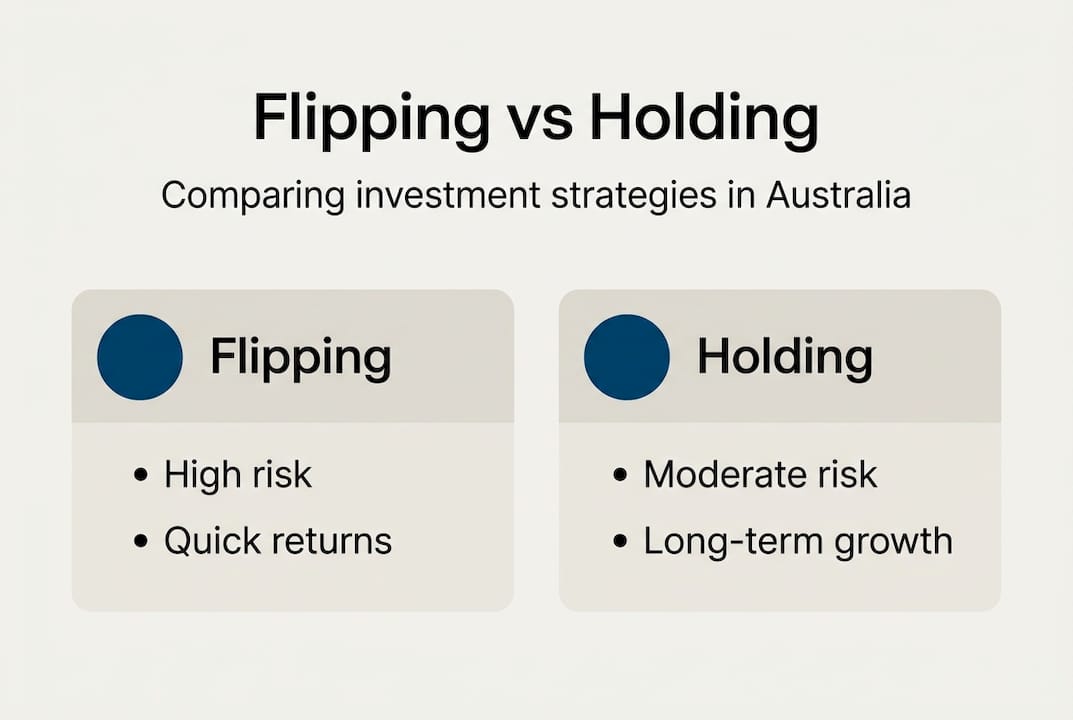
The renovate-and-hold strategy allows you to benefit from long-term capital growth, claim depreciation and other deductions, and build a portfolio that generates passive income. Flipping, by contrast, requires you to repeat the process continuously to maintain income, which increases your tax exposure and operational demands.
If building lasting wealth from property investment is your primary goal, the evidence strongly favours a long-term hold strategy for most investors, particularly those who are earlier in their investment journey.
Is property flipping for you? Factors every Australian investor must consider
Before you commit capital to a flip, make sure the strategy genuinely aligns with your skills, risk appetite, and personal circumstances. Flipping suits those with experience and market timing; most beginners lose to costs and taxes without the right preparation.
Use this self-assessment checklist to evaluate your readiness:
- Capital reserves: Do you have sufficient funds to cover the purchase, all costs, and a contingency buffer without financial stress?
- Renovation knowledge: Can you accurately scope, cost, and manage a renovation project, or will you rely entirely on contractors?
- Market research skills: Are you confident in your ability to identify undervalued properties and validate your target sale price?
- Risk tolerance: Can you absorb a loss if the market moves against you or costs exceed your budget?
- Tax awareness: Have you spoken with a tax adviser about how your flip will be treated by the ATO?
- Time availability: Do you have the time to manage trades, inspections, and the sale process actively?
Green flags for a successful flip include strong local market knowledge, access to reliable and affordable trades, a clear renovation scope with fixed-price contracts, and a realistic exit price supported by recent comparable sales. Understanding timing the property market in your target suburb is equally important, as buying at the wrong point in the cycle can erode even a well-executed renovation.
Red flags include tight capital reserves, no prior renovation experience, an unfamiliar suburb, and a reliance on best-case sale price assumptions. If several of these apply to you, a renovate-and-hold strategy may serve your wealth goals far more reliably.
Next steps for serious property investors
You now have a clear picture of what property flipping involves, where the risks lie, and how to assess whether it suits your goals. Whether you decide to pursue a flip or explore a longer-term strategy, the quality of your next decision depends on the quality of your preparation. At Elite Wealth Creators, we work with Australian investors at every stage, from first acquisition through to portfolio optimisation. Explore our property investing strategies to find an approach that matches your risk profile and financial objectives, or discover how to unlock financial freedom with property through a strategy built around your specific vision.
Frequently asked questions
Is property flipping legal in Australia?
Yes, flipping is legal in Australia, provided you comply with all tax, disclosure, and building regulations. The ATO imposes rigorous tax and regulatory requirements that every flipper must meet.
How much capital do I need to start flipping in Australia?
You typically need enough to cover your deposit, stamp duty, renovation, holding, and selling costs, which often means upwards of $100,000 in accessible funds. Total entry costs for a flip can run 50% higher than the purchase price alone.
Do I pay GST when flipping property in Australia?
GST may apply if you flip properties regularly or undertake substantial renovations that effectively create new premises. GST liability applies when your turnover exceeds $75,000 or when a substantial renovation results in a new residential property.
What is the 70% rule in property flipping?
The 70% rule means you should never pay more than 70% of the property’s after-renovation value, minus your estimated renovation costs, to preserve a viable profit margin.
Can beginners make money flipping in 2026?
Yes, but most beginners lose money due to unexpected costs and tax obligations, making thorough research, accurate budgeting, and professional advice essential before you begin.