

Every Australian investor knows the challenge of turning property wealth into accessible capital quickly. As your portfolio matures, pinpointing untapped equity and prime liquidity targets becomes critical for accelerating growth. With tools like the Australian Taxation Office’s depreciation calculator and advanced portfolio performance evaluation, you can reveal hidden tax benefits and unlock capital more efficiently. This guide shows how to structure your holdings for maximum cash flow, harness exclusive finance strategies, and target superior off-market acquisitions without risky guesswork.
Table of Contents
Quick Summary
| Key Insights | Explanations |
| 1. Assess Your Portfolio Diligently | Clearly evaluate each property’s performance, cash flow, and equity to identify capital unlock opportunities. |
| 2. Utilise Effective Financing Options | Use refinancing, debt consolidation, and interest-only loans strategically to maximise liquidity without compromising long-term growth. |
| 3. Target Off-Market Properties | Build a sourcing network to identify off-market properties that meet specific investment criteria, minimising competition. |
| 4. Validate Cash Flow and Growth Plans | Conduct thorough market research to ensure rental and appreciation projections are realistic and sustainable. |
| 5. Maintain a Systematic Approach | Document assessments and strategies in a spreadsheet for ongoing tracking and informed decision-making. |
Step 1: Assess Your Portfolio for Unlockable Capital
Before you can unlock liquidity, you need to know exactly what you’re working with. This step involves taking a hard look at your investment properties, understanding their performance, and identifying which assets hold the most potential for releasing capital quickly.
Start by listing every property you own. Include the purchase price, current estimated value, mortgage balance, and monthly rental income. This creates your baseline. You’re looking for a clear picture of your equity position across all holdings.
Next, evaluate each property’s performance metrics. Calculate your cash flow for each asset by subtracting expenses (rates, insurance, maintenance, body corporate fees) from rental income. Properties generating strong positive cash flow are often your best candidates for strategic leverage, whilst underperforming assets may need restructuring or repositioning.
Understand the tax implications of each holding. Use tools like the depreciation and capital allowances calculator to identify deductible expenses tied to your properties. This knowledge helps you see which assets carry hidden tax benefits that might influence your liquidity strategy.
Compare each property’s returns against current market benchmarks and your original investment thesis. Ask yourself: Is this property delivering the growth I expected? Could the capital locked in this asset perform better elsewhere? Which properties have already exceeded their purpose in your portfolio?
Look for properties with solid equity but modest returns. These are your prime liquidity targets. A property worth $650,000 with a $250,000 mortgage, for example, carries $400,000 in unlocked equity that could fuel your next acquisition.
Create a simple ranking system: High performers (keep and hold), moderate performers (evaluate for refinance), and underperformers (consider for strategic sale or restructure). This clarity prevents emotional decisions and keeps you focused on your wealth-building timeline.
The properties generating the strongest cash flow aren’t always the ones holding your most accessible capital—focus on total portfolio performance, not individual asset sentiment.
Once you’ve completed this assessment, you’ll have a clear picture of your available capital and know exactly which properties to leverage for liquidity. This foundation prevents costly mistakes and accelerates your next investment move.
Pro tip: Document everything in a spreadsheet and update it quarterly, so you’re always tracking shifts in equity, cash flow, and market value without scrambling when opportunity knocks.
Here is a summary of key portfolio performance indicators to help prioritise liquidity decisions:
| Indicator | What It Reveals | Impact on Liquidity Strategy |
| Net Equity | Total value minus debt | Determines available capital |
| Net Monthly Cash Flow | Rent minus all expenses | Informs the ability to service loans |
| Yield vs. Market Avg. | Rent return compared | Highlights outliers for review |
| Tax Deductions Potential | Claimable depreciation | Identifies hidden monetary value |
| Asset Growth History | Appreciation trend | Predicts future performance |
Step 2: Leverage Exclusive Finance Strategies for Liquidity
Now that you’ve identified your unlockable capital, it’s time to deploy financing strategies that efficiently release that equity. This step focuses on structuring your borrowing and capital deployment to maximise liquidity without derailing your long-term wealth plan.
Start by understanding your refinancing options. Most investors can refinance existing mortgages to pull out equity at competitive rates. This is often faster than selling and allows you to keep performing assets whilst accessing capital. Calculate what your properties could borrow against based on current valuations and lending criteria.
Consider debt consolidation strategies. If you’re carrying multiple mortgages across different lenders, consolidating into a single facility can simplify cash flow management and sometimes unlock better rates. This frees up mental bandwidth and reduces administrative burden.
Explore interest-only loan structures. Switching from principal-and-interest to interest-only payments temporarily reduces your monthly outgoings, improving cash flow liquidity. This works particularly well when you’re acquiring additional properties and need breathing room in your serviceability calculations.
Understand the tax implications of your chosen structure. Funding and finance strategies can significantly impact your tax position when structured correctly. Separating investment debt from personal debt, for example, protects your tax deductions and optimises your overall financial position.
Implement tiered equity release. Rather than pulling all available equity at once, release capital in tranches aligned with your acquisition pipeline. This approach manages your serviceability profile and prevents over-leveraging during market fluctuations.
Your finance strategy should match your investment timeline. Properties delivering strong cash flow can support higher leverage, whilst growth-focused assets may benefit from conservative borrowing until they mature.
The most profitable liquidity strategy isn’t always the one that releases the most capital—it’s the one that maximises your borrowing power for future acquisitions whilst maintaining comfortable serviceability.
Once your financing structure is locked in, you’ll have clear access to your unlocked capital and a roadmap for deploying it strategically.

Pro tip: Lock in refinance quotes from multiple lenders before committing, as rates and terms vary significantly—a 0.5% difference on a $300,000 loan saves thousands annually and dramatically improves your cash flow.
Compare common finance strategies for unlocking property equity:
| Finance Strategy | Best For | Pros | Cons |
| Refinancing | High-equity, performing assets | Unlocks capital, keeps asset | May increase monthly repayments |
| Debt Consolidation | Multiple small mortgages | Simplifies finances, possible savings | May incur new fees or longer loan terms |
| Interest-Only Loan | Growth or acquisition phase | Reduces outgoings, improves cash flow | Does not reduce principal while in use |
| Tiered Equity Release | Staged property acquisition plans | Matches funding to need, reduces risk | Requires discipline and forecasting accuracy |
Step 3: Source Off-Market Properties with Precision
With capital unlocked and financing locked in, you’re ready to deploy that money strategically. This step teaches you how to identify and secure off-market properties that deliver superior returns and accelerate your wealth timeline.
Off-market properties are your secret weapon. These deals bypass public auction campaigns, reducing competition and creating room for negotiation. Sellers often move quietly through private channels when they need speed or discretion, creating opportunities for savvy investors.
Build a sourcing network before you need it. Connect with real estate agents, accountants, property managers, and fellow investors who can alert you to upcoming opportunities. Personal referrals beat public listings every time. When your network knows you’re actively acquiring, deals come to you.
Focus on below-valuation entry points. Off-plan property purchases often carry price discounts compared to completed homes, giving you built-in equity from day one. Properties still under construction allow you to acquire at today’s prices whilst benefiting from tomorrow’s market appreciation.
Understand your target criteria precisely. Are you chasing cash flow, capital growth, or both? What’s your maximum price point? Which suburbs align with your strategy? Clarity prevents emotional decisions and keeps you focused on deals that genuinely move your needle.
Evaluate properties against your portfolio’s gaps, not against what you think is a “good deal.” A property worth $550,000 with 6% yield in a growth corridor serves a different purpose than a $450,000 property generating 8% cash flow. Both could be right depending on where your portfolio needs balance.
Move quickly on genuine opportunities. Off-market deals have shorter windows. Your pre-approval letter, pest and building inspections, and finance structure need to be ready before you make an offer. Speed kills competition.
The best off-market property isn’t the cheapest one—it’s the one that fills a specific gap in your portfolio strategy and positions you for your next acquisition.
Once you’ve secured your next property, you’ll have deployed your unlocked capital strategically and created momentum in your investment journey.
Pro tip: Build relationships with development sites and project managers—they often know about off-market opportunities months before public release, giving you a first-look advantage on premium properties.
Step 4: Verify Cash Flow and Growth Projections
Before committing capital to your new acquisition, you need to validate that your cash flow and growth assumptions are realistic. This step ensures your projections hold up under scrutiny and survive economic changes without derailing your strategy.
Start with rental income analysis. Research comparable properties in the suburb to establish realistic rental rates. Don’t assume 5% annual growth if the market’s been flat for three years. Use actual market data, not wishful thinking. Contact local property managers to understand tenant demand and vacancy rates.
Calculate your net cash flow accurately. Subtract all expenses from gross rental income: council rates, water charges, insurance, maintenance reserves (aim for 8-10% of rent), body corporate fees if applicable, and property management fees. Many investors underestimate maintenance costs. Properties always need more than expected.
Test your assumptions against economic reality. Review Reserve Bank growth forecasts to validate whether your property market assumptions align with broader economic trends. If the RBA is predicting slower wage growth, expect softer rental increases in your forecasts.
Build sensitivity scenarios into your analysis. What happens to your cash flow if interest rates rise 1%? If vacancy hits 10% instead of 5%? If you need major repairs in year three? Conservative investors model downside cases to ensure their strategy survives stress.
Compare your projections to your portfolio’s historical performance. Have your past predictions held up? Are you consistently optimistic or pessimistic? Adjust your forecasting approach based on what actually happened with previous acquisitions.
Validate growth assumptions against long-term economic indicators. Suburbs with strong employment growth, infrastructure investment, and population increases typically deliver more reliable capital appreciation than stagnant areas.
Accurate projections beat optimistic ones every time—they keep you acquiring the right properties at the right prices and prevent money traps disguised as opportunities.
Once you’ve stress-tested your assumptions, you’ll proceed with confidence knowing your investment can withstand real-world conditions.
Pro tip: Model three scenarios for every property—conservative, realistic, and optimistic—then proceed only if the conservative case still delivers your target returns; this single practice eliminates most poor investment decisions.
Accelerate Your Investment Journey with Expert Liquidity Solutions
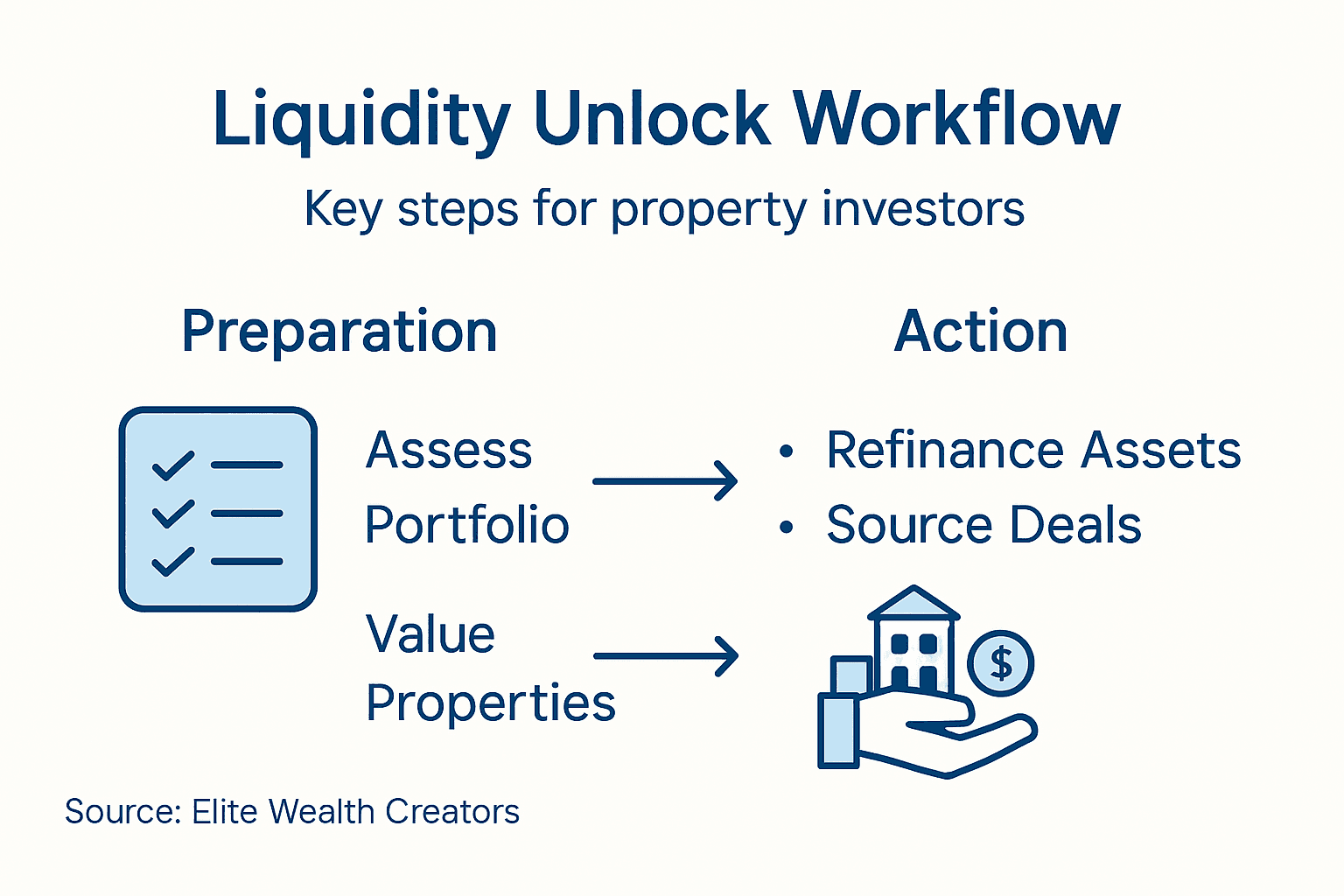
Unlocking liquidity fast is the key challenge for property investors looking to scale their portfolio confidently and strategically. If you are aiming to leverage your existing equity while maintaining strong cash flow and serviceability, you understand the importance of precise refinancing, staged capital release, and sourcing off-market deals as highlighted in this property investment workflow. These critical steps demand expert guidance to avoid costly mistakes and to ensure every move aligns with your long-term wealth goals.
At Elite Wealth Creators, we transform these challenges into opportunities by providing instant liquidity options, tailored finance strategies, and exclusive access to off-market properties. Whether you are refining your approach or ready to act, explore how our expertise can unlock your portfolio’s potential in Investors & Owner Occupied | Elite Wealth Creators and discover strategic insights from our Business | Elite Wealth Creators resources. Don’t wait to seize the next property acquisition — visit Elite Wealth Creators today and start engineering your financial freedom with confidence.
Frequently Asked Questions
How can I assess my property portfolio for unlockable capital?
To assess your property portfolio, start by listing each asset’s purchase price, current estimated value, mortgage balance, and monthly rental income. This will give you a clear picture of your equity position and help identify which properties could be leveraged for liquidity.
What refinancing options should I consider to unlock liquidity from my investments?
Consider refinancing existing mortgages to access equity at competitive rates. Calculate how much you can borrow against your properties’ current valuations, and compare offers from different lenders to secure the best deal.
How can I use off-market properties to enhance my investment portfolio?
To access off-market properties, build a network with real estate agents, property managers, and fellow investors. Establish criteria for your ideal acquisitions, and act quickly on opportunities that align with your investment strategy.
What steps should I take to ensure my cash flow and growth projections are realistic?
To validate your projections, conduct a thorough rental income analysis by researching comparable properties in your area. Adjust your expectations based on market data, historical performance, and economic forecasts to ensure your assumptions hold up under scrutiny.
How often should I review my property portfolio to track shifts in liquidity and performance?
Review your property portfolio at least quarterly to keep track of changes in equity, cash flow, and market value. Regular updates in a spreadsheet can help you stay informed and make timely decisions about your investments.
What financial strategies can I implement to maximise liquidity from my properties?
Implement strategies such as debt consolidation and interest-only loans to free up cash flow. Consider tiered equity release to manage your serviceability profile effectively while acquiring new properties without over-leveraging.