

TL;DR:
- An SMSF offers powerful, compliant opportunities for tax-advantaged property investment in Australia.
- Strict rules like the sole purpose test and independent valuations are essential for SMSF property compliance.
- Long-term, disciplined strategies with expert guidance maximize the benefits of SMSF property investment.
Many Australian property investors assume that a Self-Managed Super Fund (SMSF) is either too complex, too risky, or simply reserved for the ultra-wealthy. That assumption leaves real wealth-building potential sitting idle. When structured correctly, an SMSF can be one of the most powerful vehicles for acquiring investment-grade property in Australia, offering tax advantages, greater control, and the ability to leverage borrowing within a compliant framework. This article cuts through the noise to explain exactly how SMSF property investment works, what the rules require, and how you can apply this strategy to strengthen your retirement portfolio with confidence.
Table of Contents
- Understanding SMSF and property investment basics
- The unique benefits of using SMSF for property investment
- Essential rules and risks to understand before buying property in SMSF
- Steps to purchase property with an SMSF: Practical application
- Why most investors misunderstand SMSF property — a fresh take
- Discover the next step: SMSF property investing with expert support
- Frequently asked questions
Key Takeaways
| Point | Details |
|---|---|
| SMSF enables control | Managing property via SMSF gives you direct say in investment decisions and strategy. |
| Tax and retirement benefits | SMSF property allows access to unique tax concessions and can boost retirement outcomes if managed compliantly. |
| Strict compliance required | All SMSF property deals must comply with ATO rules to avoid costly penalties. |
| Not for every investor | SMSF property suits Australians willing to navigate complexity and long-term commitment. |
| Expert support recommended | Professional advice is invaluable to meet requirements and maximise investment advantages. |
Understanding SMSF and property investment basics
A Self-Managed Super Fund is a private superannuation fund that you manage yourself, typically with up to six members who are also trustees. Unlike retail or industry funds where investment decisions are made by fund managers on your behalf, an SMSF places the decision-making power directly in your hands. That control is both the greatest advantage and the greatest responsibility.
The core difference between an SMSF and a standard super fund is governance. You are legally responsible for every investment decision, every compliance obligation, and every reporting requirement. This is not a passive arrangement. It demands active engagement, sound record-keeping, and a clear investment strategy documented in writing.
When it comes to property, the SMSF structure allows trustees to acquire residential or commercial real estate as part of the fund’s investment portfolio. Understanding the SMSF property investment basics is essential before committing capital, because the rules governing what you can and cannot do are precise.
Here are the foundational compliance requirements every trustee must satisfy:
- Sole purpose test: The fund must exist solely to provide retirement benefits to its members. No personal use of fund assets is permitted.
- In-house asset rule: No more than 5% of the fund’s total assets can be invested in assets connected to a related party.
- Independent valuations: All fund assets, including property, must be valued at market value annually by a qualified, independent party.
- Arm’s length transactions: All purchases and dealings must occur at market rates, with no preferential pricing between related parties.
As the ATO’s SMSF guidelines make clear, all SMSF investments must meet the sole purpose test, adhere to the in-house asset rule, and require independent valuations for compliance.
Key takeaway: An SMSF is not a shortcut. It is a structured, compliance-driven vehicle that rewards disciplined investors who understand the rules and commit to long-term strategy.
Exploring the SMSF superannuation benefits available to Australian investors reveals why this structure continues to attract serious property buyers who want more than a passive super balance.
The unique benefits of using SMSF for property investment
With a firm grasp of SMSF property foundations, let’s explore the top reasons savvy investors choose this route over direct personal ownership.
The financial case for SMSF property investment is compelling when you understand the tax environment within which the fund operates. During the accumulation phase, investment income including rental returns is taxed at just 15%. Capital gains on assets held for more than 12 months are taxed at an effective rate of 10%. Once the fund moves into pension phase, both income and capital gains can reduce to zero. These rates are significantly lower than personal marginal tax rates for most investors.
| Feature | Personal ownership | SMSF ownership |
|---|---|---|
| Rental income tax rate | Up to 47% (marginal) | 15% (accumulation phase) |
| Capital gains tax (12+ months) | Up to 23.5% | 10% (accumulation), 0% (pension) |
| Borrowing structure | Standard mortgage | Limited recourse borrowing arrangement |
| Asset protection | Limited | Strong, separate from personal assets |
| Investment control | Full personal control | Trustee-directed within compliance rules |
Beyond tax, the ability to borrow within an SMSF through a Limited Recourse Borrowing Arrangement (LRBA) means you can acquire a property worth more than your current fund balance. The lender’s recourse is limited to the asset itself, protecting the rest of the fund’s assets if the loan defaults.
Key benefits at a glance:
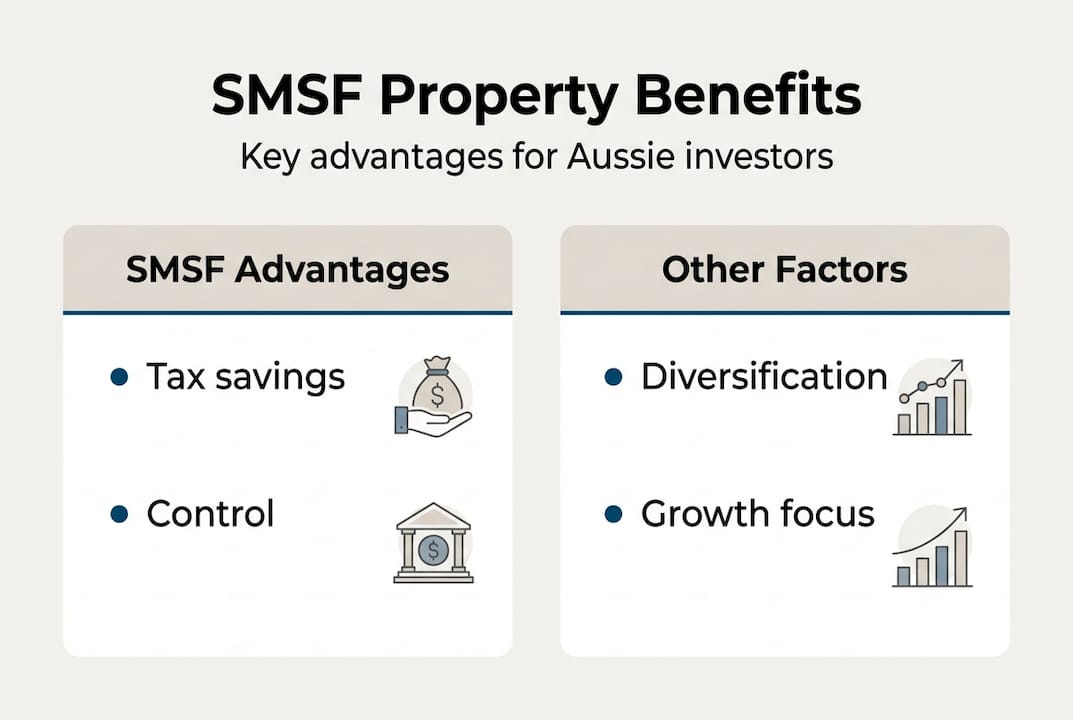
- Tax efficiency across accumulation and pension phases
- Asset protection from personal creditors in most circumstances
- Pooling of member balances to increase purchasing power within a family SMSF
- Greater control over asset selection, timing, and strategy
- Diversification beyond shares and cash into tangible real estate
Exploring SMSF property investment strategies helps you identify which approach aligns best with your retirement timeline and risk profile. For those focused on retirement income, understanding how to boost SMSF property returns through careful asset selection is a critical part of the process.
Pro Tip: If you have family members with super balances, consider a family SMSF with multiple members. Pooling balances can significantly increase your purchasing capacity and allow you to grow SMSF property wealth faster than a single-member fund.
The sole purpose test compliance requirement underpins every benefit listed above. Stay within the rules, and the advantages are substantial.
Essential rules and risks to understand before buying property in SMSF
Understanding the benefits is vital, but knowing how to avoid legal traps can save you thousands. Here’s what every SMSF property investor must know before buying.

The Australian Taxation Office monitors SMSF compliance closely, and the penalties for breaches are serious. A fund declared non-compliant can lose its concessional tax status, meaning its entire asset base could be taxed at 47%. That is not a theoretical risk. It happens to investors who cut corners or misunderstand the rules.
Here are the five most critical compliance obligations to follow:
- Satisfy the sole purpose test at all times. Every investment decision must be made with the singular goal of providing retirement benefits. Personal benefit, even indirect, is a breach.
- Never allow personal use of SMSF property. You, your family members, or any related party cannot live in, holiday in, or use the property in any way. This applies to residential property without exception.
- Keep fund assets completely separate from personal assets. Mixing fund money with personal finances is a serious breach and a common error among new trustees.
- Ensure all transactions occur at arm’s length. Buying a property from a related party at below-market value, or leasing it to a related party at below-market rent, breaches the in-house asset rule.
- Obtain independent valuations annually. The ATO’s SMSF legal obligations require that independent valuations are conducted to reflect current market value.
A common scenario that trips up investors: purchasing a holiday property through an SMSF and then using it for personal stays, even occasionally. This single act can render the entire fund non-compliant.
Pro Tip: Before acquiring any property, review the SMSF property benefits guide alongside your trust deed to confirm the acquisition aligns with your documented investment strategy. Your SMSF auditor will check this every year.
For ongoing rental property management, following structured SMSF rental property tips ensures your fund remains compliant while generating consistent income. The compliance edge is not a burden. It is a discipline that protects your retirement wealth.
Steps to purchase property with an SMSF: Practical application
If you’re ready to take action, here’s a practical pathway to secure property through your SMSF, from setup to settlement.
| Stage | Key action | Professional required |
|---|---|---|
| Fund establishment | Draft trust deed, appoint trustees | SMSF solicitor |
| Investment strategy | Document property investment rationale | Financial adviser |
| Property selection | Due diligence, independent valuation | Buyer’s agent, valuer |
| Finance (if borrowing) | Structure LRBA, bare trust deed | SMSF lender, solicitor |
| Settlement | Transfer title to bare trustee | Conveyancer |
| Post-purchase | Annual audit, valuation, reporting | SMSF auditor |
Follow these steps to move from intention to ownership:
- Establish or review your SMSF. Ensure your trust deed permits property investment and that your investment strategy explicitly includes real property as an asset class.
- Document your investment strategy. The strategy must address risk, return, liquidity, diversification, and how property fits your members’ retirement objectives.
- Identify a suitable property. The property must meet ATO compliance requirements, including the sole purpose test. Residential property cannot be purchased from or leased to a related party.
- Arrange finance if required. An LRBA requires a separate bare trust to hold the property during the loan period. This structure is more complex than a standard mortgage and requires specialist legal and lending support.
- Commission an independent valuation. This is mandatory before purchase and annually thereafter.
- Complete settlement through the bare trustee. Title is held by the bare trustee until the loan is repaid, at which point it transfers to the SMSF.
- Maintain post-purchase compliance. Engage your SMSF auditor annually, keep detailed records, and review your investment strategy regularly.
Building sustainable SMSF property strategies means thinking beyond the purchase itself and planning for the full lifecycle of the asset within your fund. For broader context, the Australian property investment guide provides a useful framework for evaluating opportunities across different market conditions.
Why most investors misunderstand SMSF property — a fresh take
Having walked through the practical pathway, let’s step back and challenge some assumptions with an honest viewpoint from within the industry.
The media tends to frame SMSF property as either a golden ticket or a compliance minefield. Neither portrayal serves you well. The real opportunity sits in the middle: a disciplined, long-horizon strategy that rewards patience and precision over short-term speculation.
What we consistently observe is that investors who struggle with SMSF property are those who treat it as a tax minimisation tactic rather than a retirement wealth strategy. The tax benefits are real, but they are a byproduct of sound investing, not the goal itself.
The investors who genuinely benefit are those who commit to a 10 to 20-year view, select quality assets in strong rental markets, and maintain rigorous compliance. They also seek guidance early rather than after a costly mistake. Reviewing real SMSF wealth stories from experienced investors reinforces one consistent truth: the compliance discipline that feels like a constraint is actually the framework that protects your wealth over decades. Approach SMSF property as a long-term blueprint, not a quick win, and the results speak for themselves.
Discover the next step: SMSF property investing with expert support
Inspired to act on your SMSF property insights? Here’s how to connect with expert help tailored for Australian investors.
At Elite Wealth Creators, we work with property investors who are serious about building retirement wealth through strategic SMSF acquisitions. Our team understands the compliance landscape, the lending structures, and the asset selection process required to make SMSF property work for your specific situation. Whether you need SMSF property investment guidance to clarify your options or you’re ready to move through the full financial freedom process with a dedicated adviser, we are here to support every stage of your journey. Your vision, backed by our expertise, is where real results begin.
Frequently asked questions
Is property in SMSF only for high net-worth investors?
No, but SMSF property is generally more suitable for investors with larger super balances, as upfront costs and compliance requirements can erode returns in smaller funds.
Can I live in a property owned by my SMSF?
No. The sole purpose test strictly prohibits personal use of SMSF-owned residential property by members or related parties at any time.
Do SMSF property loans work like regular home loans?
Not exactly. SMSF property loans must be structured as Limited Recourse Borrowing Arrangements, which are governed by strict SMSF regulations and require a separate bare trust structure.
How can I make sure my SMSF stays compliant with property investments?
Engage a qualified SMSF auditor annually, ensure all investments satisfy the sole purpose test, and seek professional advice before making any acquisition or structural change.