

TL;DR:
- New developments offer higher depreciation, better energy efficiency, and modern tenant amenities.
- They provide significant tax benefits, government incentives, and lower maintenance costs for investors.
- Successful investing requires thorough research, careful developer selection, and understanding market dynamics.
Many Australian property investors default to established homes, assuming they offer safer returns and fewer surprises. Yet this assumption quietly costs portfolios real money every year. New developments carry a distinct set of financial advantages, from significant tax depreciation and government incentives to lower maintenance costs and stronger tenant demand, that established properties simply cannot match. If you are building wealth or diversifying your portfolio in 2026, understanding the full picture of new developments is not optional. It is essential.
Table of Contents
- What makes new developments unique for investors?
- Financial advantages: Tax, incentives and long-term returns
- Rental returns and tenant demand: Why new builds attract quality tenants
- Risks, myths and key considerations when investing in new developments
- Our perspective: What most investors miss about new developments
- Start maximising your returns with expert guidance
- Frequently asked questions
Key Takeaways
| Point | Details |
|---|---|
| Tax and incentive edge | New developments offer greater depreciation and government incentives, improving cash flow and returns. |
| Tenant appeal | Modern features and warranties make new builds attractive to quality tenants and boost rental yields. |
| Mitigate investment risk | Success with new developments relies on research, due diligence and understanding your market. |
| Long-term wealth growth | When chosen carefully, new builds can form a powerful base for property portfolio growth in Australia. |
What makes new developments unique for investors?
With an interest in new developments sparked, let’s look at what actually sets them apart from established properties.
New builds are constructed to current Australian standards, which means better insulation, energy-efficient appliances, and layouts designed for modern living. For investors, this translates directly into lower immediate repair costs and a property that tenants find genuinely appealing from day one. There are no ageing hot water systems to replace, no outdated wiring to worry about, and no structural surprises lurking behind the walls.
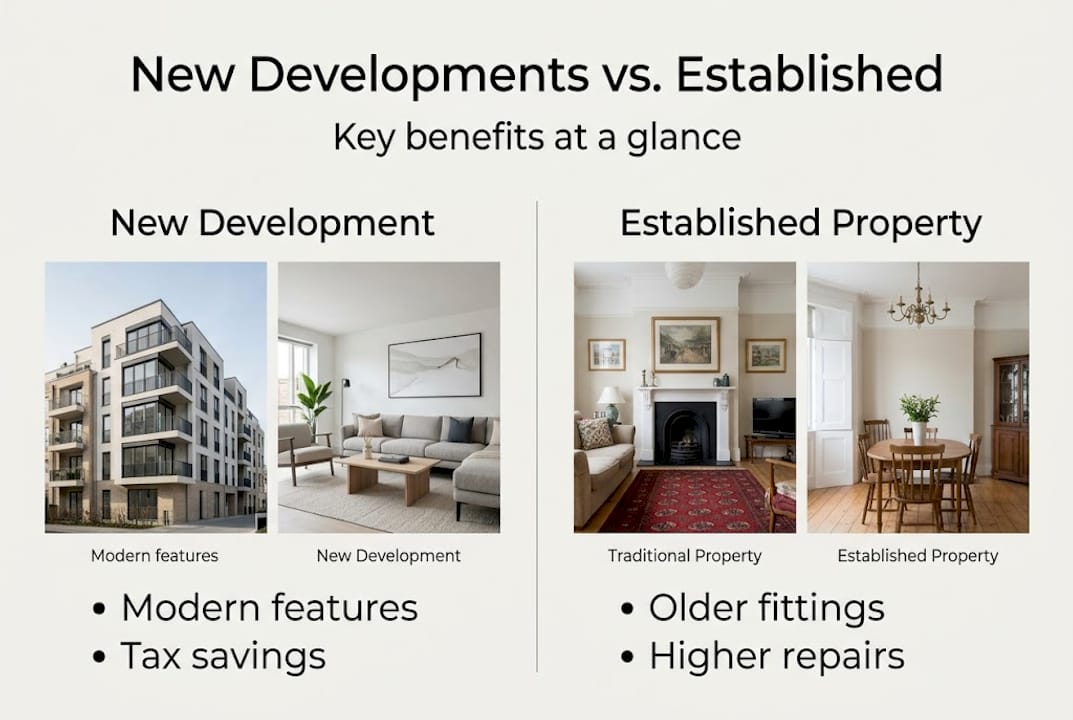
As noted by Elite Wealth Creators, new developments offer modern features, builder warranties, and greater depreciation benefits compared to older properties. These warranties alone can cover major structural defects for up to six years in most Australian states, giving you a meaningful buffer in the early years of ownership.
Several misconceptions still hold investors back. Many believe new properties always cost more upfront, are slower to rent out, or are harder to finance. In reality, developer incentives and off-the-plan pricing often bring purchase costs in line with comparable established stock. Lenders also view new builds favourably when they are in high-demand locations.
| Feature | New development | Established property |
|---|---|---|
| Builder warranty | Yes, up to 6 years | No |
| Depreciation benefits | High (Division 40 and 43) | Lower |
| Immediate repair costs | Minimal | Potentially significant |
| Tenant appeal | High (modern amenities) | Variable |
| Energy efficiency | High (current standards) | Often lower |
The property tax benefits available on new stock are particularly compelling for investors who want to reduce their taxable income while building equity. Equally, NDIS property investment opportunities in the new development space are growing, with purpose-built NDIS housing investment offering some of the strongest yields in the current market.
- New builds come with full builder warranties on structural defects
- Energy efficiency ratings are higher, reducing tenant utility costs
- Contemporary layouts attract a broader range of quality tenants
- Lower maintenance means more predictable cash flow modelling
Pro Tip: Many investors underestimate how much modern amenities influence tenant decisions. Features like air conditioning, secure parking, and fibre-ready connectivity are no longer luxuries. They are baseline expectations for quality tenants willing to pay a premium.
Financial advantages: Tax, incentives and long-term returns
Once you know what sets new developments apart, it is time to address the question every investor asks: how do they affect your bottom line?
Depreciation is one of the most powerful tools in a property investor’s arsenal, and new builds maximise it. Under the Australian Tax Office’s Division 40 and Division 43 schedules, you can claim depreciation on both the building structure and the plant and equipment inside it. Older properties often have limited or exhausted depreciation schedules. New builds, by contrast, start fresh.

New builds allow for greater tax deductions through higher depreciation schedules and often qualify for government incentives. Investors in new apartments can claim up to $10,000 per year in depreciation benefits, meaningfully improving annual cash flow without requiring any additional outlay.
Here is a simplified five-year cash flow model to illustrate the impact:
| Year | Rental income | Depreciation claimed | Net taxable income | Estimated tax saving |
|---|---|---|---|---|
| 1 | $28,000 | $10,000 | $18,000 | $3,200 |
| 2 | $29,000 | $9,500 | $19,500 | $3,000 |
| 3 | $30,000 | $9,000 | $21,000 | $2,800 |
| 4 | $31,000 | $8,500 | $22,500 | $2,600 |
| 5 | $32,000 | $8,000 | $24,000 | $2,400 |
These figures are illustrative and vary by property type, location, and individual tax circumstances. However, they demonstrate how depreciation systematically reduces your taxable income over the early years of ownership.
Beyond depreciation, several government and developer incentives apply specifically to new builds:
- Stamp duty concessions for eligible buyers purchasing new properties in certain states
- First Home Owner Grant (FHOG) available on new builds in most Australian states
- Developer-funded incentives such as rental guarantees, furniture packages, or settlement cost contributions
- GST margin scheme benefits that can reduce the effective purchase price for some buyers
Monitoring current investment trends is equally important, as state governments periodically introduce new concessions to stimulate housing supply. Staying informed means you capture incentives before they are withdrawn.
Rental returns and tenant demand: Why new builds attract quality tenants
With the financial incentives established, let’s see how new developments perform when it comes to everyday rental income and the realities of tenant demand.
New properties consistently attract tenants who are willing to pay above-market rent for the right features. This is not merely anecdotal. Modern properties command a premium in the rental market due to their features, energy efficiency, and lower maintenance. For investors, this means higher gross yields and fewer vacancy periods, both of which directly improve your portfolio’s performance.
Tenants today are discerning. They compare properties online, weigh up running costs, and prioritise comfort and security. New builds tick these boxes in ways that many older properties cannot.
In major Australian cities, new apartments and townhouses typically command a rental premium of 8 to 15 per cent over comparable established properties in the same suburb, according to recent market analysis.
The features tenants most expect in new developments include:
- Ducted or split-system air conditioning
- Secure parking and building access
- In-unit laundry facilities
- High-speed internet connectivity
- Quality kitchen and bathroom fittings
- Energy-efficient appliances that reduce utility bills
To maximise rental returns, selecting the right property type matters as much as the building itself. Townhouses and boutique apartment buildings in lifestyle precincts tend to outperform large-scale high-rise developments in terms of both yield and capital growth. Understanding high-yield property types before you commit is a critical step in your due diligence process.
Pro Tip: Location and local amenities make or break rental demand for new stock. A new build near public transport, schools, and retail precincts will consistently outperform an equivalent property in an isolated suburb, regardless of how impressive the finishes are. Always research walkability scores and infrastructure pipelines before purchasing.
Strategies to boost rental cash flow on new developments include negotiating furnished packages with developers, targeting corporate or professional tenant segments, and timing your settlement to align with peak rental demand periods in your chosen market.
Risks, myths and key considerations when investing in new developments
Even with compelling upsides, shrewd investors protect themselves by understanding the risks and realities of the market. Here is what you need to know.
New development investment is not without its challenges. Settlement delays are common, particularly when construction timelines shift due to labour shortages or material costs. Developer defaults, while rare, do occur, making thorough due diligence on the developer’s track record non-negotiable.
Before committing to any new development purchase, work through these key questions:
- What is the developer’s history of delivering projects on time and to specification?
- Is the local market experiencing oversupply of similar new stock?
- Have you reviewed the contract with an independent solicitor familiar with off-the-plan agreements?
- What is the realistic rental demand in the target suburb based on current vacancy rates?
- Does the purchase price reflect genuine market value, or is it inflated by developer marketing costs?
A persistent myth is that all new apartments are overvalued and deliver inferior capital growth. This is simply not accurate across the board. Some markets have seen oversupply of new apartments, affecting capital growth in the short term, but research is essential because well-located, well-designed new stock in supply-constrained suburbs has consistently delivered strong long-term returns.
The investors who succeed with new developments are those who treat every purchase as a business decision. They analyse supply pipelines, review comparable sales, and never rely solely on developer-provided projections. Independent research is the foundation of every sound acquisition.
Assessing future resale value requires looking beyond the property itself. Infrastructure investment, population growth projections, and employment hubs in the surrounding area all influence how a new development will perform over a five to ten year horizon. Reviewing 2026 property market trends gives you the macro context needed to make confident, well-grounded decisions.
Our perspective: What most investors miss about new developments
To conclude this guide, here is a frank look at what actually separates successful investors from the rest when it comes to new developments.
Most investors follow the same playbook. They browse listings, attend open homes, and buy what everyone else is buying. The result is that they pay retail prices and capture average returns. The investors who genuinely build wealth through new developments do something different. They build relationships with proven developers before projects are publicly listed, giving them access to off-market pricing and preferred lot selection.
The contrarian insight is this: new developments are not inherently risky. Lack of research is risky. Investors who take time to understand depreciation schedules, incentive structures, and local demand dynamics consistently outperform those who dismiss new builds based on outdated assumptions.
There is also a compounding advantage that is rarely discussed. The combination of higher depreciation, lower maintenance costs, and quality tenant profiles means your cash flow position in years one through five is often materially better than an equivalent established property. That freed-up capital becomes the fuel for your next acquisition.
Accessing specialist insights on new developments is the first step toward making decisions that are grounded in evidence rather than emotion. The edge belongs to those who seek it deliberately.
Start maximising your returns with expert guidance
Ready to act on these insights? New developments offer a genuinely powerful vehicle for wealth creation when approached with the right strategy and support. At Elite Wealth Creators, we work with investors at every stage, from first-time buyers exploring their options to experienced portfolio holders optimising their asset mix. Whether you want to invest smart for property wealth, explore SMSF property benefits within a new development strategy, or simply want a clear roadmap to unlock wealth with property, our specialists are ready to guide you. Speak with our team before your next acquisition and ensure every decision is backed by expertise.
Frequently asked questions
What makes a new development a smart investment?
New developments offer high depreciation, government incentives, and typically attract quality tenants, delivering strong long-term returns. New builds provide greater depreciation and tax advantages that established properties cannot replicate.
Are there extra costs when buying new developments?
While purchase prices can be higher, major repairs and upgrades are minimal for years, and many stamp duty concessions apply for eligible buyers. Stamp duty concessions are available on new property purchases in some states, reducing your upfront outlay.
How do I reduce risks when investing in new developments?
Investigate the developer’s track record, research local demand, and get legal reviews of contracts before committing. Due diligence is essential in new development investments to minimise risks and protect your capital.
Do new developments always yield better returns than established properties?
Returns depend on location, demand, and price paid. New builds have unique tax benefits but require careful market research. Capital growth can be impacted by local supply and market timing, so independent analysis is always warranted.