

TL;DR:
- A well-structured SMSF offers unique control over asset selection and retirement planning, especially with property. Its tax advantages vary across different phases, from concessional taxation during accumulation to potentially tax-free income in pension phase. However, strict compliance requirements, borrowing restrictions, and liquidity risks demand careful planning and professional advice for sustained success.
Most investors assume an SMSF is simply a tax shelter you park money inside and forget. That belief leaves an enormous amount of strategic value on the table. A well-structured self-managed super fund gives you direct control over asset selection, ownership structures, and retirement-phase planning in ways that no retail super fund can match. When property is added to that picture, the advantages multiply, but so do the responsibilities. This guide cuts through the confusion and gives you a clear, evidence-based roadmap for using SMSF property to build genuine, long-term financial freedom.
Table of Contents
- What makes SMSF property unique for Australian investors
- Tax benefits and property lifecycle in SMSF
- Navigating borrowing and compliance: SMSF property pitfalls
- Critics’ concerns: weighing SMSF property pros and cons
- The uncomfortable truth about SMSF property most investors miss
- Explore SMSF property solutions for your financial freedom
- Frequently asked questions
Key Takeaways
| Point | Details |
|---|---|
| Direct control advantage | SMSF property strategies let you personally manage assets and align them with your retirement objectives. |
| Tax benefits explained | SMSF delivers concessional tax rates on rental income and capital gains, and can achieve tax-free earnings in the pension phase. |
| Borrowing and compliance complexity | Borrowing via SMSF comes with strict structures and limits; compliance mistakes can be costly. |
| Balanced risk assessment | Successful SMSF property investing requires careful risk management around liquidity, lending rates, and asset concentration. |
What makes SMSF property unique for Australian investors
An SMSF, or self-managed super fund, is a regulated retirement savings vehicle that you control as a trustee. Unlike industry or retail super funds, where a professional manager decides how your money is invested, an SMSF puts every asset decision squarely in your hands. That shift in control is not just philosophical. It has real, practical implications for how you build wealth across your working life and into retirement.
Property within an SMSF sits in an entirely different category from property you own personally. The fund owns the asset. You, as trustee, manage it according to strict rules set by the Australian Taxation Office and the Superannuation Industry (Supervision) Act 1993. This regulated structure creates both opportunities and obligations that you need to understand before committing capital.
According to Your Investment Property Magazine, the key strategic rationale for property in SMSFs is direct asset management and control within a regulated retirement vehicle, where trustees can choose assets and structure them to align with retirement-phase objectives, but must carefully manage complexity, liquidity, and compliance risk.
Here is what genuinely sets SMSF property apart from other investment structures:
- Direct asset control: You personally select properties, negotiate terms, and manage tenancy arrangements within your fund’s investment strategy.
- Retirement-phase alignment: You can plan which assets to hold, when to sell, and how to transition properties into pension phase to maximise tax outcomes.
- Regulated protections: The legal framework around SMSFs, while demanding, also creates clear accountability and creditor protections for your retirement assets.
- Strategic flexibility: You can hold residential, commercial, or industrial property depending on your fund’s objectives and liquidity position.
The difference between an SMSF and a generic investment structure is not just tax. It is the ability to architect your retirement asset base with precision, matching property type, cash flow, and timing to your long-term financial goals.
That level of intentional design is what separates high-performing SMSF investors from those who simply tick a box. Our SMSF property investment guide walks through how to match property selection to fund objectives at every stage, while our overview of SMSF benefits for property explains why more Australians are making this strategic choice.
Now that you see SMSF is more than a generic tax wrapper, let’s break down how property strategies work within this powerful vehicle.
Tax benefits and property lifecycle in SMSF
The tax treatment of property inside an SMSF is one of the most compelling reasons to explore this structure, provided you understand how it applies across different phases of your fund’s life. Most investors have a vague awareness that “super is taxed less,” but the specifics matter enormously for planning purposes.

Aries Financial explains that SMSFs can buy property and potentially benefit from concessional taxation: in the accumulation phase, rental income is taxed at 15%, and capital gains may receive a one-third CGT discount on eligible gains held longer than 12 months, effectively bringing the tax rate to around 10%. In the retirement (pension) phase, investment earnings can be tax-free if the assets support a complying pension, subject to transfer balance limits set by the ATO.
To make this concrete, compare the tax treatment across ownership structures:
| Tax category | Personal ownership | SMSF accumulation phase | SMSF pension phase |
|---|---|---|---|
| Rental income tax rate | Marginal rate (up to 47%) | 15% flat | 0% (within balance limits) |
| Capital gains (held 12+ months) | 50% CGT discount applied | One-third CGT discount (eff. ~10%) | 0% (within balance limits) |
| Deductibility of losses | Can offset personal income | Contained within fund | Contained within fund |
The numbers speak clearly. A high-income earner paying 47% tax on rental income personally is losing nearly half of every rent dollar to the ATO. Inside an SMSF accumulation phase, that same dollar is taxed at 15%. In pension phase, it may not be taxed at all.
Key lifecycle planning points to keep in mind:
- Accumulation phase: Focus on yield-positive properties where the 15% rental tax rate delivers strong net returns compared to personal ownership.
- Transition to retirement: Consider which properties to retain, which to sell before pension phase commences, and whether capital gains should be triggered before or after the fund moves to pension mode.
- Pension phase: Assets supporting a complying pension can generate tax-free income, making high-yield property particularly valuable in this phase.
- Transfer balance cap: From 2026, the general transfer balance cap limits how much can be moved into the tax-free pension phase, so strategic timing of asset transfers matters greatly.
Key takeaway: The tax lifecycle of SMSF property is not a single advantage. It is a sequence of strategic decisions across decades. Investors who plan each phase deliberately can dramatically outperform those who focus only on the purchase moment.
Explore our SMSF property tax strategies page for detailed guidance on structuring your fund across each phase, and review our SMSF retirement investing resources for retirement-phase planning insights.
Understanding tax perks is important, but SMSF property strategies also require careful compliance and risk management.
Navigating borrowing and compliance: SMSF property pitfalls
Borrowing to buy property inside an SMSF is possible, but it operates under a completely different framework from a standard investment loan. Getting this wrong is not just expensive. It can result in compliance breaches, penalties, and even fund disqualification.
The ATO is clear that SMSF borrowing is restricted to limited circumstances, most commonly through a Limited Recourse Borrowing Arrangement, or LRBA. Under an LRBA, the loan must be limited recourse, meaning the lender can only claim against the specific asset purchased, not the entire fund. The property must be held in a separate holding trust during the loan period, and ownership only transfers to the SMSF once the loan is fully repaid.
Understanding the compliance landscape means knowing exactly what the SMSF investment restrictions require around related-party transactions, in-house asset limits, and the sole purpose test.
Here is a numbered breakdown of the critical compliance requirements you must address before proceeding:
- Establish the holding trust correctly: The property must be held in a bare trust or holding trust during the loan period, with clear documentation establishing the SMSF as the beneficial owner.
- Confirm the loan is truly limited recourse: The lender’s recourse must be limited to the specific asset. Any agreement that allows broader claims against fund assets breaches LRBA rules.
- Respect related-party restrictions: You cannot purchase residential property from a related party. Commercial property acquisitions from related parties have their own strict arm’s-length pricing requirements.
- Monitor in-house asset limits: SMSF investments in related parties or entities generally cannot exceed 5% of the fund’s total assets, a rule that catches many trustees off guard.
- Maintain the sole purpose test: Every investment decision must be made with the primary purpose of providing retirement benefits to fund members. Personal use of SMSF-owned property, with very limited commercial exceptions, is prohibited.
| Feature | Standard investment loan | SMSF LRBA |
|---|---|---|
| Recourse | Full personal recourse | Limited to specific asset |
| Asset ownership during loan | Borrower directly | Separate holding trust |
| Rates (approximate) | From 6.0% | Typically 6.5% to 7%+ |
| Related-party restrictions | Minimal | Strict ATO guidelines |
| Compliance oversight | Standard lender checks | ATO and auditor scrutiny |
Pro Tip: Before signing any SMSF property purchase contract, engage both a specialist SMSF accountant and a property solicitor familiar with LRBAs. The cost of professional advice at this stage is a fraction of the penalty risk you avoid by getting the structure right from the beginning.
Our SMSF loans guide provides a practical overview of how LRBAs work in real transactions, and our SMSF property and lending resources can help you compare your options with clarity.
Once you have navigated compliance and borrowing restrictions, you can weigh the advantages against common criticisms and risk factors.
Critics’ concerns: weighing SMSF property pros and cons
Not everyone is enthusiastic about SMSF property investing, and their concerns deserve a fair hearing. Informed decisions require understanding both sides of the argument, not just the tax benefits that are frequently promoted.
Some commentators argue that SMSF property, especially leveraged residential property, can be less attractive once you account for SMSF lending constraints, higher loan rates typically between 6.5% and 7%, upfront transaction costs such as stamp duty and legal fees, and a reduced ability to use tax losses compared to personal ownership.
The key criticisms worth considering honestly include:
- Higher borrowing costs: SMSF loans carry rates meaningfully above standard investment loans, eroding the net yield benefit over the life of the loan.
- Transaction costs absorbed within the fund: Stamp duty, legal fees, and acquisition costs cannot be offset against personal income the way they might influence personal ownership strategies.
- No negative gearing benefit: If an SMSF property runs at a loss, that loss stays inside the fund. Unlike personal ownership where negative gearing can reduce your taxable income, an SMSF cannot pass losses to individual members.
- Concentration risk: A single property can represent a disproportionate share of a smaller SMSF’s total assets, creating genuine liquidity risk if the fund needs to meet pension payments or cover unexpected costs.
- Liquidity challenges: Property is illiquid by nature. An SMSF with a large property holding and ageing members may struggle to meet regulatory drawdown requirements without selling assets at inopportune times.
“The question is never just whether SMSF property is possible. It is whether it is the best use of your fund’s capital given your specific retirement timeline, risk tolerance, and liquidity requirements.”
Pro Tip: Before committing to SMSF property, stress-test your plan against a 1% to 2% rate rise, a six-month vacancy period, and a scenario where you need to liquidate the asset within 18 months. If your fund cannot absorb those stresses without breaching compliance obligations, you need a different strategy or a larger fund balance before proceeding.
Our resource on property leverage in SMSF covers exactly how to model these scenarios before you commit to a purchase.
With both benefits and risks clearly in view, let’s consider how SMSF property strategies align with true financial freedom from a seasoned perspective.
The uncomfortable truth about SMSF property most investors miss
Here is what we see consistently across our work with SMSF investors: the people who do exceptionally well are not necessarily those who found the best property. They are the ones who built the best structure around their property decisions.
Too many investors approach SMSF property by starting with the asset. They find something appealing, then try to make the compliance and tax mechanics fit around it. That is exactly backwards. The investors who build genuine long-term wealth through SMSF property start with their fund’s retirement timeline, cash flow requirements, and compliance framework, and then identify the property that fits that blueprint.
Compliance mistakes cost far more than any tax advantage gains. A single breach, whether an incorrect related-party transaction or a failure to maintain the holding trust properly, can trigger penalties that wipe out years of tax savings. The regulatory environment is not forgiving of shortcuts, even well-intentioned ones.
Liquidity deserves far more attention than most Australians give it. We have seen funds where property represents over 80% of total assets. When the member approaches retirement age and regulatory pension drawdown requirements increase, those funds face genuine crisis. Property cannot be partially sold. You either hold it or you sell it entirely, often at a moment that is dictated by necessity rather than market conditions.
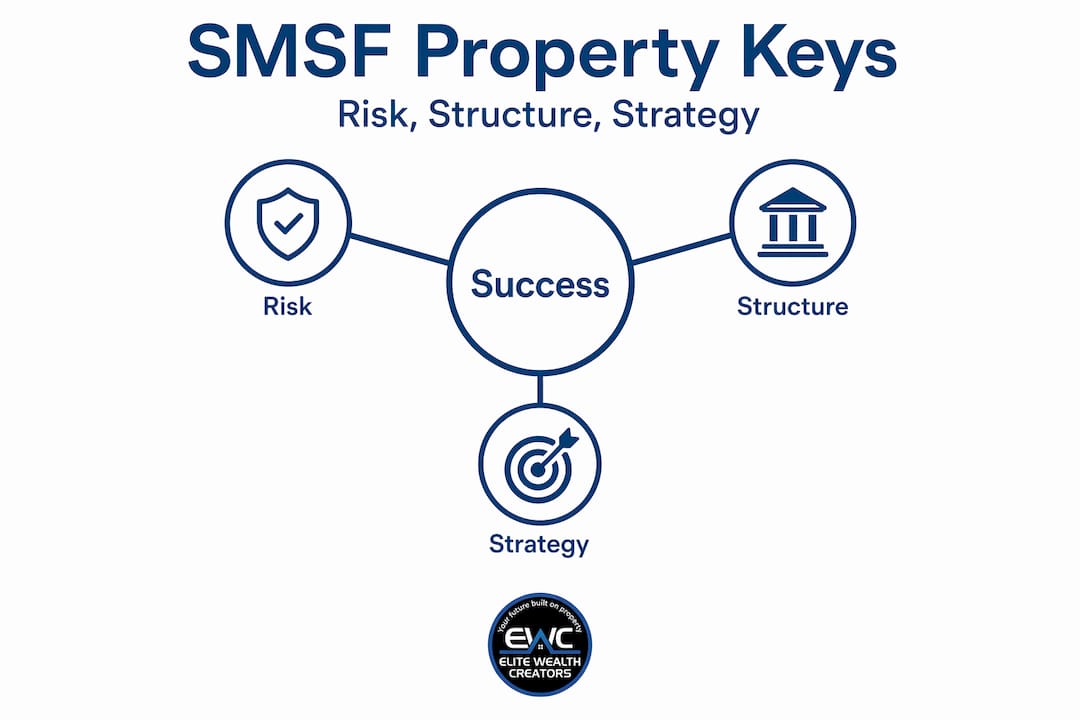
The investors who thrive manage three things deliberately: risk, structure, and strategic balance. They review their fund’s investment strategy annually, model their cash flow against retirement phase requirements, and make property decisions as part of a whole-of-fund plan rather than as isolated acquisitions. Our SMSF property investment guide reflects this whole-of-fund thinking at every stage.
The uncomfortable truth is that SMSF property is not a passive strategy. It rewards investors who stay engaged, take professional advice seriously, and treat their fund as the sophisticated financial vehicle it is designed to be.
Explore SMSF property solutions for your financial freedom
At Elite Wealth Creators, we work with SMSF investors who are ready to move beyond the basics and build property strategies that are compliant, cash-flow positive, and genuinely aligned with their retirement goals. Whether you are researching your first SMSF property acquisition or looking to optimise an existing portfolio, our team provides the strategic guidance and precision sourcing you need to make confident decisions.
Explore our property investing insights to understand how smart asset selection drives long-term returns, or review the full range of SMSF investment property benefits available through our tailored approach. When you are ready to take action, our financial freedom resources map out the practical steps from where you are now to where you want to be.
Your vision, backed by our expertise, creates unlimited potential.
Frequently asked questions
Can my SMSF purchase residential or commercial property?
Yes, SMSFs can purchase both residential and commercial property, but must comply with SMSF investment restrictions around borrowing structures, related-party transactions, and in-house asset limits. Commercial property in particular can be acquired from a related party if purchased at arm’s length and used wholly in a business.
What are the tax advantages of property held in SMSF?
Rental income is taxed at 15% in accumulation phase, capital gains on assets held over 12 months may attract a one-third CGT discount, and investment earnings can be entirely tax-free in pension phase subject to transfer balance limits. These advantages compound significantly over a long investment horizon compared to personal ownership.
Can an SMSF use borrowings to acquire property?
Borrowing is permitted through a Limited Recourse Borrowing Arrangement under strict ATO conditions, including holding the asset in a separate holding trust and ensuring the loan is limited recourse only. Any deviation from these conditions constitutes a compliance breach with serious financial consequences.
What are the main risks of SMSF property investing?
Key risks include compliance errors, concentration of assets, restricted liquidity in retirement, and the inability to use tax losses the way personal property ownership allows. Careful cash flow modelling and professional compliance advice are essential before committing your fund to a property acquisition.