Many aspiring investors assume property development is reserved for seasoned professionals with deep pockets and years of experience. Yet thousands of everyday Australians are discovering that starting small with projects like granny flats or subdivisions can unlock financial growth far beyond passive rental returns. Property development offers unique control over your investment outcomes, allowing you to create value rather than simply waiting for market appreciation. This guide explores why property development deserves serious consideration in your wealth strategy and how to approach it safely in 2026.
Table of Contents
- Understanding The Property Development Process In Australia
- Comparing Property Development With Passive Property Investment
- Managing Risks And Pitfalls In Property Development
- Getting Started With Property Development In Australia
- Discover Expert Support For Your Property Development Journey
- Frequently Asked Questions
Key takeaways
| Point | Details |
|---|---|
| Multiple development stages | Property development spans 7 to 9 distinct stages from site selection through to final settlement. |
| Active versus passive investing | Development demands hands-on involvement but delivers higher control and potential returns compared to passive property strategies. |
| Start small to build skills | Beginning with granny flats or subdivisions reduces risk while teaching essential development capabilities. |
| Education prevents costly failures | Comprehensive learning and financial buffers protect against the unknowns that cause many developments to fail. |
| Different from buy and hold | Development functions like running a business, requiring strategic planning rather than passive income collection. |
Understanding the property development process in Australia
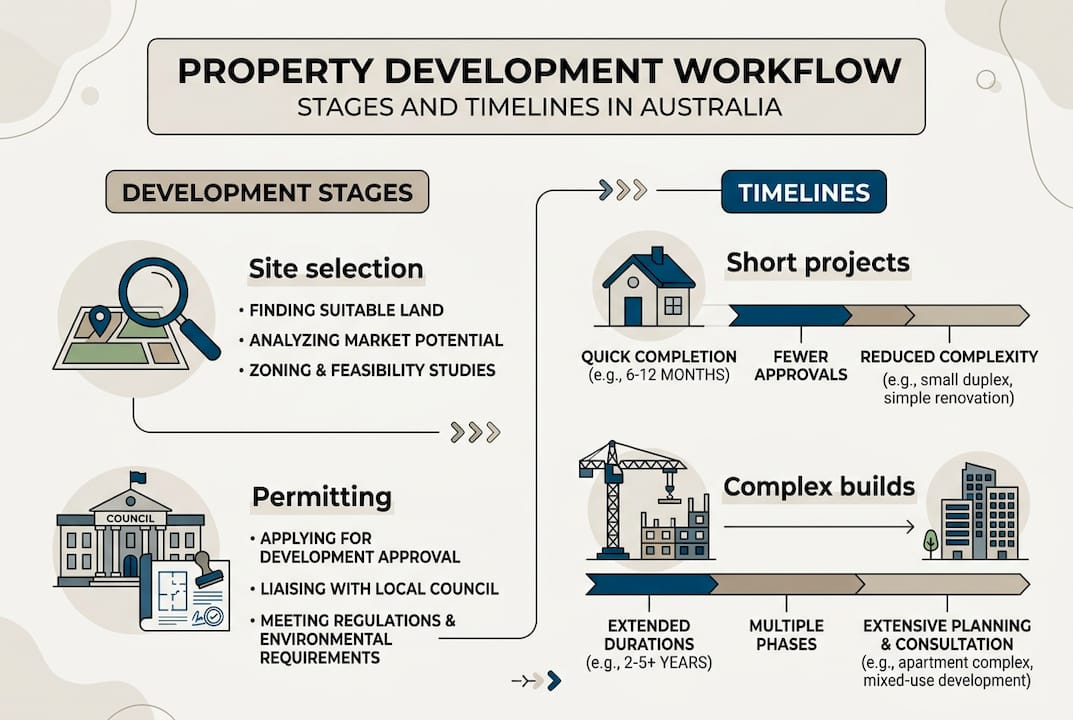
Property development follows a structured journey that transforms raw land or underutilised properties into profitable assets. Understanding each stage helps you anticipate challenges and allocate resources effectively.
The development process includes 7 to 9 stages that guide your project from concept to completion. Each phase demands specific expertise and careful coordination.
- Site selection and acquisition: Identify suitable land or properties based on location, zoning, and development potential.
- Feasibility analysis: Calculate projected costs, returns, and market demand to determine project viability.
- Due diligence: Conduct thorough investigations including soil tests, title searches, and environmental assessments.
- Design and planning: Engage architects and planners to create detailed plans that maximise value while meeting regulations.
- Approvals and permits: Navigate council requirements and obtain necessary development consents.
- Finance arrangement: Secure construction loans and ensure adequate cash flow throughout the build.
- Construction management: Oversee builders, contractors, and trades to deliver quality outcomes on schedule.
- Marketing and sales: Position your completed project to attract buyers or tenants at optimal prices.
- Settlement and handover: Finalise legal transfers and ensure all documentation is complete.
| Development stage | Primary purpose | Typical duration |
|---|---|---|
| Site selection | Identify optimal location and property | 2 to 4 weeks |
| Feasibility study | Validate financial viability | 1 to 2 weeks |
| Due diligence | Uncover risks and constraints | 4 to 8 weeks |
| Design and planning | Create compliant, marketable designs | 8 to 16 weeks |
| Approvals | Obtain council and regulatory permits | 12 to 24 weeks |
| Finance | Secure funding and cash flow | 4 to 8 weeks |
| Construction | Build to specifications and quality standards | 20 to 52 weeks |
| Marketing and sales | Generate buyer interest and transactions | 8 to 20 weeks |
| Settlement | Complete legal and financial transfers | 2 to 6 weeks |
Timelines vary significantly based on project scale, location, and complexity. A simple granny flat might complete in 6 months, while a multi-unit development could span 2 years or more.
Pro Tip: Invest heavily in feasibility studies and due diligence before committing capital. Discovering zoning restrictions or contaminated soil after purchase can derail your entire project and drain your budget. Thorough upfront research prevents expensive surprises.
Understanding this workflow helps you recognise where bottlenecks occur and which professionals you’ll need at each stage. Our property buying guide for Australian first-timers offers complementary insights for building your foundation knowledge.
Comparing property development with passive property investment
Property development and passive investment represent fundamentally different approaches to building wealth through real estate. Each suits different risk profiles, time availability, and financial goals.

Passive property investment typically involves purchasing established homes or apartments to generate rental income. You rely on market appreciation and tenant payments while maintaining the property. Development requires active involvement with higher control over outcomes but demands substantially more time and expertise.
| Factor | Property development | Passive investment |
|---|---|---|
| Time commitment | High, requires active project management | Low, primarily maintenance and tenant management |
| Control over outcome | Direct influence on design, quality, and timing | Limited to property selection and maintenance |
| Risk level | Higher due to construction, approval, and market variables | Lower, primarily market and tenant risks |
| Potential returns | 15% to 30%+ through value creation | 4% to 8% via rental yield and appreciation |
| Required expertise | Extensive knowledge of construction, regulations, and project management | Basic property and tenant management skills |
| Liquidity | Low during development, higher after completion | Moderate, can sell but takes time |
| Initial capital | Variable, can leverage equity creatively | Typically requires deposit plus costs |
Development becomes particularly attractive when you possess specific advantages or circumstances:
- You have access to underutilised land or properties with development potential
- Your professional background includes construction, architecture, or project management
- You can dedicate significant time to overseeing the project
- You seek higher returns and accept corresponding risks
- You want to create specific property types not readily available in your target market
Our resources on maximising NDIS housing returns and property long-term growth rates help you evaluate different investment pathways.
Property development operates like running a business rather than holding an asset. You’re creating value through transformation, not simply benefiting from market movements. This fundamental difference demands business acumen, financial discipline, and continuous learning to succeed consistently.
Pro Tip: Start with granny flats or subdivisions to build practical skills before attempting larger projects. These smaller developments teach essential lessons about approvals, construction management, and budgeting while limiting your downside risk. Success here builds confidence and capability for more ambitious ventures.
Exploring types of property investments for yields provides additional context for positioning development within your broader portfolio strategy.
Managing risks and pitfalls in property development
Property development carries inherent risks that can quickly erode profits or create significant losses if not managed proactively. Understanding these challenges and implementing protective strategies separates successful developers from those who struggle.
Many developments fail due to unknowns that could have been anticipated with proper education and planning. Development functions like running a business, demanding strategic thinking rather than passive oversight.
Key risk categories that threaten development projects:
- Market risk: Demand or prices shift unfavourably between project start and completion
- Financial risk: Cost overruns, funding shortfalls, or unexpected expenses exceed budgets
- Approval risk: Council rejections, extended timelines, or restrictive conditions limit project viability
- Construction risk: Builder insolvency, quality issues, or delays disrupt schedules and budgets
- Legal risk: Disputes with neighbours, contractors, or authorities create costly complications
- Environmental risk: Contamination, flooding, or protected species halt or constrain development
Successful developers implement systematic risk mitigation strategies:
- Obtain comprehensive education through courses, mentoring, or partnerships with experienced developers
- Maintain financial buffers of 15% to 25% above projected costs for contingencies
- Engage qualified professionals including solicitors, accountants, and project managers early
- Conduct exhaustive due diligence covering legal, physical, and market factors
- Secure fixed-price building contracts with reputable, insured builders
- Monitor cash flow meticulously and maintain open communication with lenders
- Build contingency plans for common scenarios like approval delays or cost increases
- Start with smaller, less complex projects to develop skills before scaling up
Pro Tip: Always maintain financial buffers beyond your initial budget projections. Unexpected costs emerge in virtually every development, from rock excavation to upgraded services. Having reserves prevents forced sales, rushed decisions, or project abandonment when challenges arise. This discipline protects your investment and maintains your options.
Our guides on NDIS property investment strategies and NDIS investment property insights demonstrate how specialised knowledge reduces risk in niche development markets.
The difference between successful and failed developments often comes down to preparation rather than luck. Developers who invest time learning, planning thoroughly, and building professional networks consistently achieve better outcomes than those who rush in chasing quick profits.
Getting started with property development in Australia
Transitioning from property investor to property developer requires deliberate preparation and strategic first steps. Building your capabilities gradually reduces risk while establishing the foundation for larger projects.
Begin your development journey with these essential preparations:
- Invest in education: Complete property development courses, attend workshops, and learn from experienced developers through mentoring relationships or partnerships.
- Assess your finances: Calculate available equity, borrowing capacity, and cash reserves to determine realistic project scales.
- Build your professional network: Identify and interview potential architects, builders, solicitors, accountants, and project managers before you need them.
- Research your target market: Study local supply, demand, buyer preferences, and price points to identify viable development opportunities.
- Start small and local: Choose your first project within 30 minutes of home in an area you understand well.
Ideal first development projects for building skills:
- Granny flat on existing property: Minimal approval complexity with strong rental demand in many markets
- Cosmetic renovation and subdivision: Improve an existing dwelling while subdividing the block for separate sale
- Knock-down rebuild: Replace an old house with a modern design that maximises site potential
- Duplex development: Create two dwellings on a single block, balancing complexity with return potential
Key professionals to engage throughout your development:
- Town planner: Navigates zoning regulations and maximises approval likelihood
- Architect or building designer: Creates functional, attractive designs that meet codes and market preferences
- Quantity surveyor: Provides accurate cost estimates and ongoing budget monitoring
- Solicitor: Handles contracts, due diligence, and legal compliance
- Accountant: Structures ownership, manages tax implications, and tracks project finances
- Project manager: Coordinates trades, monitors quality, and keeps construction on schedule
- Mortgage broker: Secures appropriate development finance and manages lender relationships
Leveraging existing property equity provides a powerful pathway into development. You can access funds for deposits, holding costs, or even full project funding depending on your equity position. Our Australian property investment guide explains equity strategies in detail.
Understanding property tax benefits Australia offers helps optimise your development structure for maximum after-tax returns. Consider how GST, capital gains, and depreciation affect your specific situation.
Set realistic expectations for your first project. You’ll make mistakes and encounter unexpected challenges. View these as tuition fees for your development education rather than failures. Each project builds knowledge and confidence for the next.
For those building retirement wealth, exploring how to grow SMSF wealth with property reveals additional development opportunities within self-managed superannuation structures.
Discover expert support for your property development journey
Navigating property development successfully requires more than theoretical knowledge. You need strategic guidance tailored to your specific circumstances, goals, and risk tolerance.
At Elite Wealth Creators, we help aspiring developers and investors identify opportunities that align with their wealth-building objectives. Our personalised approach connects you with off-market properties, development sites, and strategic insights that accelerate your journey from concept to completion. Whether you’re exploring your first granny flat or planning a more substantial project, expert guidance reduces costly mistakes and builds confidence.
Our property investing insights demonstrate how strategic thinking transforms ordinary investments into wealth-building engines. We specialise in helping clients leverage existing equity, structure deals creatively, and access opportunities others miss.
For those building portfolios within superannuation, understanding SMSF investment property benefits opens additional development pathways with significant tax advantages.
Pro Tip: Engage trusted advisors early in your development journey, even before identifying specific projects. This foundation relationship ensures you receive objective guidance when opportunities arise, preventing rushed decisions driven by excitement rather than analysis. The right advisor accelerates your learning curve and helps you avoid expensive beginner mistakes.
Discover how we help clients unlock financial freedom with property through strategic development and investment approaches tailored to Australian market conditions.
Frequently asked questions
What is property development and how is it different from property investment?
Property development involves actively improving or building properties to create value and generate profit through transformation. You’re changing the physical asset through construction, renovation, or subdivision. Property investment typically means purchasing existing properties to earn rental income and benefit from market appreciation passively. Development requires hands-on management and business skills, while investment focuses on asset selection and tenant management.
What are common risks in property development and how can I manage them?
Major risks include cost overruns, market changes during construction, approval delays, and builder issues. Managing these threats requires comprehensive education before starting, realistic financial planning with substantial buffers, engaging qualified professionals early, and conducting thorough due diligence. Successful developers maintain contingency funds of 15% to 25% above projected costs and build relationships with reliable contractors. Starting with smaller projects helps you develop risk management skills before attempting larger, more complex developments.
How can a beginner start property development safely?
Begin with small-scale projects like granny flats or subdivisions that limit downside risk while teaching essential skills. Invest heavily in education through courses, mentoring, or partnerships with experienced developers before committing capital. Engage trusted professionals including solicitors, accountants, and project managers from the start. Choose your first project in an area you know well, ideally close to home where you can monitor progress easily. Learn continuously from each project and scale up gradually as your expertise and confidence grow.