

TL;DR:
- Setting clear, documented investment goals transforms vague desires into measurable targets, guiding disciplined wealth-building. Properly aligned goals reduce stress, prevent emotional decisions, and ensure appropriate risk management across different time horizons. Regularly reviewing and adjusting these goals fosters long-term success, while avoiding common pitfalls maximizes portfolio effectiveness.
Most investors know they want “more money” or “financial freedom” someday. But vague intentions like these are precisely why so many portfolios underperform. Understanding why set investment goals is the difference between purposeful wealth-building and expensive guesswork. Without a defined target, you are reacting to headlines, chasing trends, and making emotional decisions that quietly erode your wealth. This article cuts through the noise to show you what investment goals actually do, how to build them properly, and why structured goal-setting is the foundation every serious investor needs in 2026.
Table of Contents
- Key takeaways
- Why investment goals matter
- Goals, stress, and better decisions
- Time horizons, risk, and your portfolio mix
- How to set and manage your investment goals
- Common pitfalls to avoid
- My perspective: goals changed everything
- Start building wealth with Elitewealthcreators
- FAQ
Key takeaways
| Point | Details |
|---|---|
| Goals turn wishes into targets | Documented goals like saving $50,000 by a set date replace vague hopes with measurable milestones. |
| SMART goals reduce costly mistakes | Specific, time-bound goals guide your risk tolerance and asset allocation before markets move. |
| Time horizons shape your portfolio | Short-term goals need stable, liquid assets; long-term goals can absorb growth-oriented risk. |
| Separate goals, separate strategies | Combining multiple goals in one portfolio risks misallocated contributions and inappropriate risk exposure. |
| Regular reviews keep goals on track | Adjusting contributions and strategy as life changes prevents you from drifting off course. |
Why investment goals matter
At their core, investment goals are financial milestones tied to a specific purpose, dollar amount, and timeframe. Not “I want to grow my savings,” but “I want $500,000 in property equity by age 55 to fund early retirement.” That shift from vague to specific is where everything changes.
Think of your portfolio as a vehicle. Without a destination programmed in, you might drive well and still end up nowhere useful. Clear, documented goals act like GPS for your portfolio, improving follow-through and dramatically reducing the likelihood of abandoning your strategy mid-route.
Here is what investment goals actually do for you:
- Give your money a job. Every dollar in your portfolio should be working toward something specific, whether that is a deposit on an investment property, retirement income, or your children’s education.
- Create a measuring stick. Without a goal, you cannot know if you are on track. With one, you can measure progress monthly, quarterly, or annually and adjust if you fall behind.
- Protect your behaviour. Markets move. Prices drop. News cycles create panic. Investors with no goals are the first to sell at the wrong time. Goals give you a reason to stay the course.
- Guide your risk decisions. SMART goals matched to timelines tell you exactly how much risk is appropriate, removing guesswork from asset allocation.
The importance of investment goals goes beyond numbers on a spreadsheet. They create the psychological framework that keeps you invested, disciplined, and moving forward even when the market tests your resolve.
Goals, stress, and better decisions
Here is something most financial articles skip over. Investing without goals does not just produce poor returns. It produces anxiety. When you do not know what your money is for, every market swing feels personal and threatening. A 10% correction becomes a crisis. A flat quarter becomes a failure.
Clear goals reduce that stress by giving context to volatility. If you know your property investment is a 20-year wealth-building vehicle, a short-term dip in the market carries no real weight. Your goal has not changed. Your timeline has not changed. The noise is just noise.
The data on this is striking. Missing the best 5 market days between 1988 and 2024 reduced long-term returns by 37%. That is the cost of panic selling, which is almost always triggered by a lack of clear purpose. Investors who know why they are in the market stay in the market.
“The investor’s chief problem, and even his worst enemy, is likely to be himself.” — Benjamin Graham
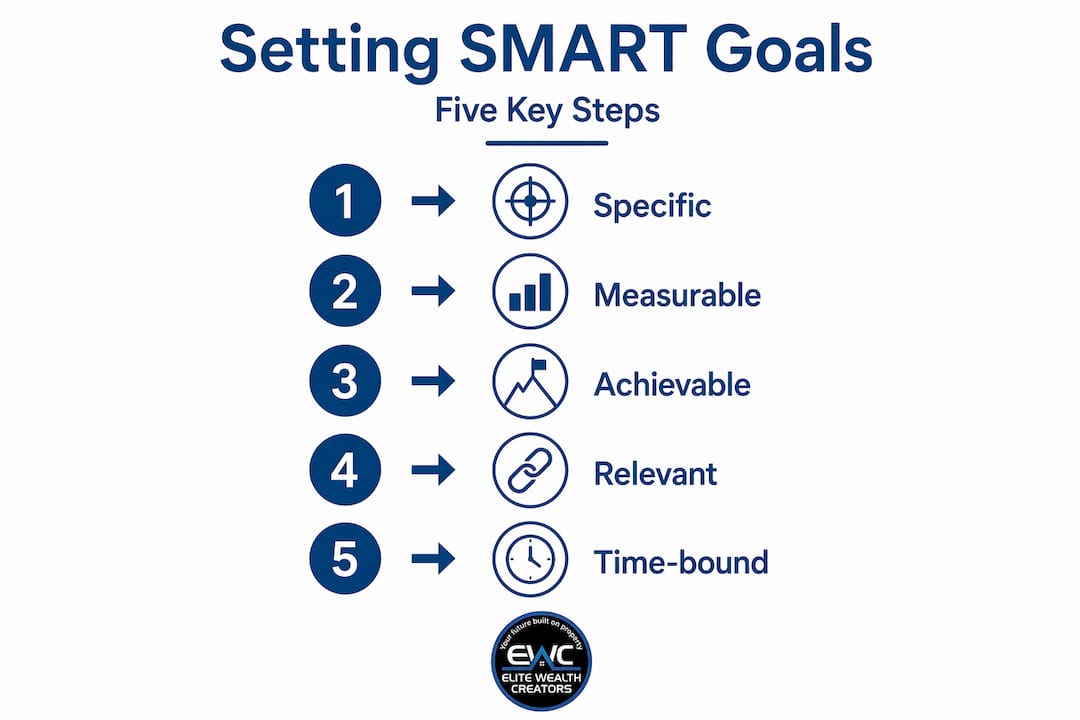
SMART goals (Specific, Measurable, Achievable, Relevant, Time-bound) solve this at the structural level. When you define exactly what you are working toward, you pre-commit to a strategy that does not bend under emotional pressure. Near-term goals naturally restrict higher-risk plays because the cost of losing capital is too high with a short timeline. Long-term goals give you the freedom to absorb volatility in exchange for greater growth.
Pro Tip: Write your investment goal on paper and attach a “why” to it. “Retire at 60 to spend more time with family” is a far stronger anchor against panic selling than a raw dollar figure alone.
Time horizons, risk, and your portfolio mix
Not all goals are created equal, and treating them the same is one of the most expensive mistakes investors make. A goal you need to fund in two years demands an entirely different approach than one you are building toward over 25 years.

Here is how to think about aligning your goals with the right investment approach:
| Goal type | Timeframe | Risk level | Suitable assets |
|---|---|---|---|
| Short-term | Under 3 years | Low | Cash, term deposits, high-grade bonds |
| Medium-term | 3 to 7 years | Moderate | Balanced funds, diversified property |
| Long-term | 7+ years | Higher | Growth property, diversified equity ETFs, SMSF assets |
Short-term goals require stable, liquid assets because you cannot afford to absorb a downturn with a two-year horizon. Putting money earmarked for a property deposit next year into a volatile growth asset is not bold investing. It is misallocated risk.
Long-term goals, on the other hand, benefit from growth-oriented assets precisely because time smooths out volatility. Planning for at least 3 to 5 years on any investment goal gives you the runway to ride out downturns rather than crystallise losses at the worst moment.
The deeper point here is that your investing approach should differ by timeline. This is why separating goals into distinct strategies is so powerful. Your retirement portfolio should not be managed the same way as the fund you are building for a renovation in three years. They have different rules, different risk tolerances, and different definitions of success.
Pro Tip: If you have three or more active goals, consider creating separate investment accounts or pots for each. This prevents you from accidentally drawing down long-term wealth to cover short-term needs, and makes progress tracking far cleaner.
How to set and manage your investment goals
Knowing why goal-setting matters is one thing. Doing it well is another. Here is a practical framework for setting and managing investment goals that actually hold up over time.
-
Define each goal using SMART criteria. Be specific about the dollar amount, the purpose, and the deadline. “Save $80,000 for an investment property deposit by December 2028” is a SMART goal. “Grow my savings” is not.
-
Write your goals down. Writing goals down operationalises your planning. It forces you to commit to a number and a date, both of which drive real decisions about risk and contribution levels. Goals that live only in your head rarely survive the first market correction.
-
Prioritise your goals. Not all goals are equally urgent or important. Rank them. An emergency fund or near-term deposit goal should take priority over speculative long-term growth plays.
-
Match each goal to an appropriate investment strategy. Use the time horizon table above as a guide. Separate portfolios or sub-accounts per goal prevent misallocated risk and keep your thinking clear.
-
Track progress regularly. Review each goal at least every six months. Are your contributions on pace? Has your income changed? Has the property market shifted your deposit target? Measuring progress and adjusting contributions when you fall behind is what separates disciplined investors from hopeful ones.
-
Adjust for life changes. A new job, a growing family, or a change in income all affect your investment capacity and priorities. Build flexibility into your plan by scheduling an annual review where you reassess goals against your current circumstances.
The process of understanding why you are investing and how that shapes your asset allocation is not a one-time exercise. It is an ongoing discipline that compounds over time.
Common pitfalls to avoid
Even investors who commit to goal-setting can undermine themselves with avoidable mistakes. These are the most common ones worth watching for:
- Keeping goals vague. “I want to be wealthy” is not a goal. Without a specific number and deadline, there is no way to measure progress or make informed decisions about risk.
- Lumping all goals into one strategy. Modelling only one goal when you have multiple risks misallocated contributions and exposes near-term funds to inappropriate volatility.
- Ignoring liquidity needs. Locking short-term capital into illiquid assets because of the potential upside is a classic error. A property or ETF you cannot sell quickly should not hold money you might need within 12 months.
- Chasing market trends. Abandoning a disciplined goal-based strategy to follow whatever is performing well right now is how investors buy high and sell low repeatedly.
- Never revisiting your goals. Life changes. A goal set three years ago may no longer reflect your priorities, income, or risk capacity. Static goals become irrelevant goals.
These mistakes are not signs of incompetence. They are predictable patterns that emerge when investors skip the foundational step of clear, written, prioritised goal-setting. The fix is always the same: get specific, get it on paper, and review it regularly.
My perspective: goals changed everything
I have watched investors lose real money not because they chose the wrong property or picked the wrong fund. They lost money because they had no framework for making decisions under pressure.
Without goals, every market dip becomes a reason to question the entire strategy. I have seen people sell quality assets at the bottom of a cycle simply because they had no written plan that said, “This is a 15-year hold. Short-term drops are expected and acceptable.” That one sentence, tied to a documented goal, would have saved them tens of thousands of dollars.
What I have also seen is what happens when people commit to structured goal-setting. The analysis paralysis dissolves. The emotional reactions to market noise quiet down. Decisions become easier because the framework already made the hard calls before the market moved.
The best part is that goals evolve. As your income grows, as you acquire more assets, as your family situation changes, your goals sharpen. The process of revisiting them is not a sign that you got it wrong the first time. It is evidence that you are managing your wealth with genuine intention.
Treat investment planning not as a product to buy but as a practice to build. The investors who consistently build long-term wealth are not the ones who picked the best assets. They are the ones who showed up with a plan, stuck to it, and adjusted it with intelligence rather than emotion.
— Nick
Start building wealth with Elitewealthcreators
Understanding the importance of investment goals is the first step. Translating that understanding into a portfolio that actually performs is where most investors need support, and that is exactly where Elitewealthcreators comes in.
At Elitewealthcreators, every strategy we build starts with your goals. Whether you are targeting your first investment property, building a high-yield portfolio, or optimising an SMSF to maximise long-term returns, we match your objectives to real opportunities in the Australian market. Our property investing insights give you the strategic edge others are still searching for.
We also offer exclusive access to off-market properties, instant liquidity solutions of up to $100,000, and SMSF compliance support so you are never exposed to unnecessary risk. If you are ready to stop watching the market and start acting with precision, explore how we can engineer your financial freedom. We limit new client onboarding each month to protect the quality of our service. Spots are filling fast.
FAQ
Why set investment goals before choosing assets?
Goals define your timeline, risk tolerance, and required return, which are the three inputs that determine which assets belong in your portfolio. Choosing assets without goals is guessing.
What makes an investment goal SMART?
A SMART investment goal is Specific, Measurable, Achievable, Relevant, and Time-bound. For example, saving $60,000 for a property deposit by June 2028 meets all five criteria.
How often should I review my investment goals?
Review your goals at least every six months and after any major life change such as a new job, salary increase, or change in family circumstances. Markets and life move faster than annual reviews can capture.
Can I have multiple investment goals at once?
Yes, and you should. Most investors have overlapping goals across different timeframes. The key is to separate investments by goal to avoid applying long-term risk tolerance to money you need in the near term.
What happens if I invest without clear goals?
Investing without clear goals typically leads to emotional decision-making, misallocated risk, and poor long-term returns. Research shows that investors who panic-sell miss the market’s best recovery days, which significantly erodes wealth over time.