

TL;DR:
- Many Australian investors mistake relying solely on gross rental yield when making property decisions, overlooking comprehensive cost considerations.
- Accurately calculating both gross and net yields, including all relevant expenses, is essential for meaningful property performance analysis and comparison.
Many Australian investors make their first major property mistake before they even sign a contract. They glance at a gross rental yield figure, assume it tells the whole story, and base their acquisition decision on an incomplete picture. The reality is that rental yield, when calculated correctly and interpreted in full context, is one of the most powerful diagnostic tools in your investment toolkit. This guide walks you through exactly how to calculate both gross and net yield, which costs belong in your formula, the traps that cost investors real money, and how to use yield figures to make sound, confident decisions in the Australian property market.
Table of Contents
- What is rental yield and why does it matter?
- How to calculate gross and net rental yield
- Common mistakes and how to avoid them
- Comparing properties: consistency is key
- Australian-specific yield tactics and next steps
- The uncomfortable truth about rental yield no one tells you
- Optimise your investment strategy with expert support
- Frequently asked questions
Key Takeaways
| Point | Details |
|---|---|
| Gross vs net yield | Gross yield shows income before costs; net yield reveals your true return after expenses. |
| Consistent comparison matters | Always use the same expense definitions and property values when comparing yields. |
| Australian-specific steps | Account for vacancy, tax, and local expenses unique to the Australian market. |
| Common yield mistakes | Avoid double-counting vacancy and check what costs are included in ‘net yield’. |
| Yield isn’t everything | Balance rental yield with long-term capital growth and investment risk for smart decisions. |
What is rental yield and why does it matter?
Rental yield is the annual return generated by a property relative to its value, expressed as a percentage. It gives you a way to measure how hard your capital is working. Think of it as the performance gauge on your investment vehicle: a clear readout of whether the asset is generating income efficiently or sitting idle.
There are two versions every investor must understand.
Gross yield is the simpler figure. It divides annual rental income by the property’s purchase price (or current market value) and multiplies by 100. No costs are deducted. It is useful for quick, side-by-side comparisons between properties.
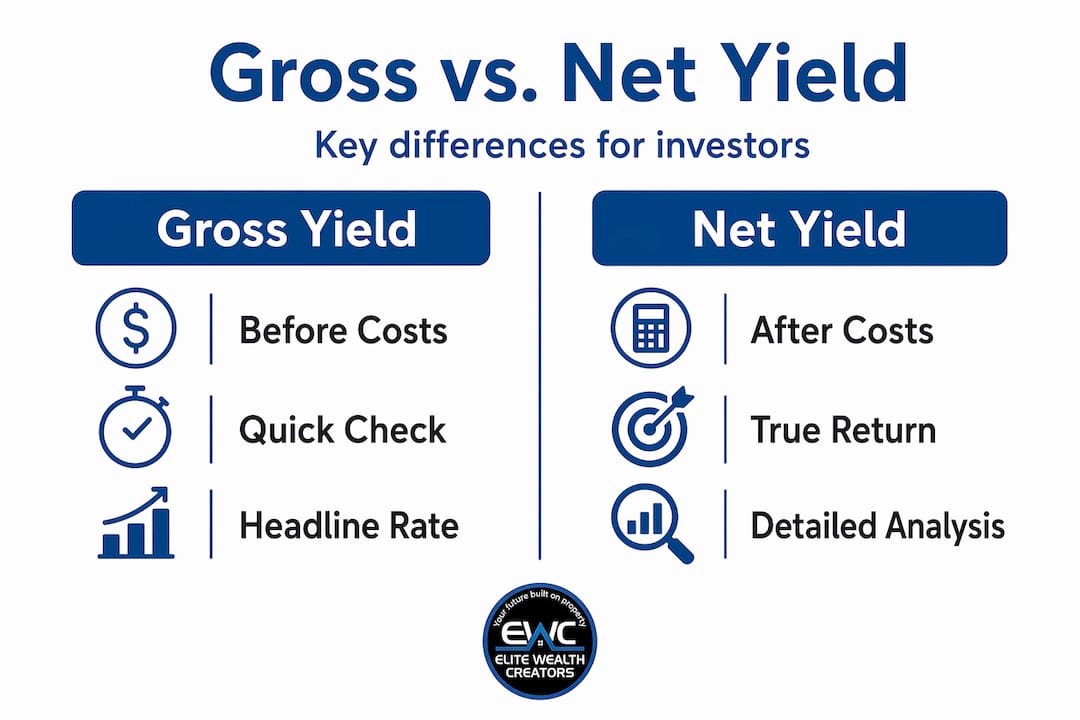
Net yield goes deeper. It subtracts all ongoing ownership costs from the annual rent before dividing by property value. This figure is far closer to your actual return. However, as one practical guide notes, “net yield is not uniquely defined — different investors include different costs (and some may exclude finance costs), so you must match what was included when comparing deals.” This is why two investors can look at the same property and report entirely different net yields without either of them being wrong.
Knowing your yield helps you decide whether to buy, hold, or sell. It shapes your cash flow modelling, guides your financing decisions, and reveals whether a property is genuinely earning its place in your portfolio. Understanding high-yield property types across different Australian markets gives you even more context for interpreting these numbers.
Key benefits of calculating rental yield accurately:
- Enables like-for-like comparison across different properties and locations
- Reveals whether rental income covers holding costs or creates a shortfall
- Supports informed decisions about refinancing or selling underperforming assets
- Helps you communicate clearly with lenders, accountants, and advisers
- Provides a measurable benchmark for portfolio performance reviews
“Rental yield is not just a number. It is a lens through which you see whether your property is genuinely building wealth or quietly eroding it.”
How to calculate gross and net rental yield
Now that we see why defining yield matters, let us break down exactly how to perform the key calculations, including all relevant costs.
The gross yield formula is straightforward:
Gross Yield (%) = (Annual Rent ÷ Property Value) × 100
The net yield formula adds one critical step:
Net Yield (%) = ((Annual Rent − Annual Costs) ÷ Property Value) × 100
As NAB’s property guide recommends for first-time Australian investors: “compute gross yield first for quick comparisons, then compute net yield using a transparent cost set.” This two-step approach keeps your analysis structured and auditable.
Step-by-step: calculating your net yield
- Determine annual rental income. Multiply weekly rent by 52. For a property earning $550 per week, annual gross rent is $28,600.
- List all annual ownership costs. This is the step most investors rush or underestimate. Include council rates, water rates, strata levies (if applicable), landlord insurance, property management fees (typically 7 to 10 per cent of rent in Australia), routine maintenance allowance, and a vacancy allowance.
- Subtract total annual costs from annual rent. If total costs equal $8,000, your net annual income is $20,600.
- Divide net income by property value. For a property purchased at $620,000: $20,600 ÷ $620,000 = 0.0332.
- Multiply by 100 to express as a percentage. Net yield = 3.32%.
Gross vs net yield: a comparison
| Metric | Gross yield | Net yield |
|---|---|---|
| Costs deducted? | No | Yes |
| Best used for | Quick comparisons | Actual return analysis |
| Typical result | Higher percentage | Lower percentage |
| Recommended for decisions? | First pass only | Always |
| Risk of misleading you | High if used alone | Low with full cost set |
For a $620,000 property returning $550 per week, gross yield is 4.61% and net yield is 3.32%. That 1.29 percentage point gap represents real money leaving your account every year.

Pro Tip: Document every cost you include in your net yield calculation and keep that list consistent. When you review your portfolio or compare new acquisitions, you will always be measuring like for like. This simple habit protects you from comparing a “clean” net yield to a heavily loaded one and drawing the wrong conclusion.
Developing expert rental income strategies alongside accurate yield calculation is the most direct path to portfolio performance, while proper rental appraisal ensures you are not leaving income on the table from the start.
Common mistakes and how to avoid them
Even with careful formulas, it is easy to make costly mistakes. Here is what to avoid.
The most frequent error is accepting someone else’s net yield figure without knowing what it contains. A vendor, agent, or listing platform might present a net yield that excludes management fees, or one that includes mortgage repayments. Neither approach is wrong per se, but they are not interchangeable. Always interrogate the inputs before trusting the output.
A closely related trap involves vacancy. As this practical yield guide clearly states: “If you use an annualised rent figure, you should allow for vacancy either by reducing expected rent or by subtracting a vacancy allowance, but not double-counting.” In practice, this means you either use 50 weeks of rent instead of 52, or you use 52 weeks of rent and then subtract a cost equivalent to two weeks’ rent. Do both, and you have inflated your costs and understated your yield.
“The yield figure you trust most should be the one you built yourself, using a cost list you defined and can defend.”
Avoidable mistakes that cost investors money:
- Using purchase price for one property and current market value for another, then comparing them
- Omitting strata levies or body corporate fees for apartments
- Forgetting to include a maintenance allowance (a standard figure is one to two per cent of property value annually)
- Relying on a gross yield comparison when making a final acquisition decision
- Mixing pre-tax and post-tax income figures in the same calculation
Pro Tip: Create a standardised net yield checklist with 8 to 10 line items before you analyse any property. Run every candidate through the same checklist. This small discipline will save you from expensive inconsistencies and make your portfolio reviews genuinely useful.
Understanding vacancy rates and their impact across different Australian suburbs gives you the data you need to set a realistic allowance rather than guessing. Pair that with solid cash flow maximisation habits and your yield calculations become a true planning instrument.
Comparing properties: consistency is key
To make smart investment choices, comparing like with like is critical. Here is how consistent calculation reveals true performance.
When you place two properties side by side and find one appears to yield significantly more than the other, it is worth pausing. The gap might be real. But it might also reflect different denominators, different cost inclusions, or different vacancy assumptions. As this yield comparison framework explains: “When comparing two properties, ensure both yields use the same denominator (purchase price vs current value) and the same definition of net expenses; otherwise you can misread which property truly performs better.”
This is not an edge case. It is a structural problem in the way yield is commonly reported and discussed. International property markets face similar challenges, and global yield comparison data shows that yield figures without standardised definitions are notoriously difficult to interpret accurately.
Property comparison table
| Variable | Property A | Property B (inconsistent) | Property B (corrected) |
|---|---|---|---|
| Purchase price | $550,000 | $550,000 | $550,000 |
| Denominator used | Purchase price | Current value ($620,000) | Purchase price |
| Annual rent | $26,400 | $27,040 | $27,040 |
| Annual costs included | Full cost set | Rates only | Full cost set |
| Reported net yield | 3.8% | 4.6% | 3.5% |
| True comparable yield | 3.8% | 3.5% | 3.5% |
In this example, Property B initially appears to outperform Property A by 0.8 percentage points. Once you standardise the denominator and apply the same cost set, Property A is actually the stronger performer. That is not a minor rounding error. At a $550,000 price point, a 0.8 per cent yield gap represents roughly $4,400 in apparent annual income that does not actually exist.
Staying grounded in core property investment principles helps you build comparison habits that protect your decision-making from these distortions.
Australian-specific yield tactics and next steps
With consistent methods in mind, let us translate knowledge into action with steps tailored for the Australian property market.
Australian property investment comes with a specific set of rules and tax advantages that directly influence how you should interpret yield. Negative gearing allows you to offset a rental shortfall against other income, which means a lower net yield is not automatically disqualifying if capital growth prospects are strong. Depreciation schedules on qualifying properties can materially improve after-tax cash flow without changing your nominal yield at all. These are powerful levers that most simplified yield calculators simply ignore.
Capital gains tax (CGT) discounts for assets held longer than twelve months also affect the real-world return profile of any property. A property with a modest yield but significant long-term capital growth may outperform a higher-yielding asset in a stagnant or declining market. Yield is the income side of the equation; capital appreciation is the wealth-building side. Both must feature in your analysis.
Steps every Australian investor should take after mastering yield:
- Calculate both gross and net yield using a standardised cost list before advancing any acquisition.
- Obtain a formal rental appraisal from a local property manager to validate your income assumptions.
- Review your depreciation entitlements with a quantity surveyor. New builds and recently renovated properties can generate significant deductions.
- Understand local vacancy rates for the suburb and property type you are targeting. A 5% vacancy rate changes your net yield meaningfully.
- Factor in the tax position. Speak to your accountant about how negative gearing, depreciation, and CGT interact with your specific income level.
- Revisit your yield calculations annually. Rents change, expenses shift, and market values move. A yield that made sense three years ago may now look very different.
Maximising your property tax deductions is one of the most accessible ways to improve your effective yield without changing the property itself. Exploring rental guarantee structures is another strategy worth examining if vacancy risk in your target market is elevated.
The uncomfortable truth about rental yield no one tells you
Before taking final action, consider what most guides do not say about the real meaning of yield.
Here is something we have observed consistently across hundreds of property decisions: investors who chase the highest yield often take on the most risk without realising it. Regional towns with 7 or 8 per cent gross yields can look extraordinary on paper. But those numbers frequently reflect depressed property values, thin rental demand, limited tenant pools, and virtually no capital growth outlook. A high yield in a declining or illiquid market can mean your property loses more in value than it ever earns in rent.
The uncomfortable truth is that yield is a snapshot, not a forecast. It tells you what the property earns relative to its price today. It says nothing about where rents are heading, what the vacancy trend looks like, or whether the asset will be worth more or less in ten years. Savvy investors use yield as a filter, not a verdict.
We have also seen investors ignore perfectly sound 4 per cent net yields in high-growth corridors because a regional alternative showed 6 per cent gross. Five years later, the 4 per cent property had grown substantially in value and supported a refinancing that funded a second acquisition. The 6 per cent property had barely moved in price and required expensive maintenance that eroded the income advantage entirely.
The rentvesting approach is one framework that lets you pursue yield in strong rental markets while maintaining flexibility about where you live. It is a strategy that benefits directly from accurate yield thinking, rather than being seduced by headline numbers.
Balance yield with capital growth potential, tax position, local demand dynamics, and your own liquidity needs. That combination, not yield alone, is what builds durable financial freedom.
Optimise your investment strategy with expert support
If you are ready to take your understanding further and turn knowledge into real results, we have solutions and expertise to help. At Elite Wealth Creators, we work with Australian property investors at every stage, from first acquisition through to multi-property portfolio optimisation. Our team combines precise cash flow modelling with access to off-market opportunities specifically selected to match your wealth strategy. We offer structured guidance on ownership options, financing pathways including deferred interest arrangements through our Homepay Advantage, and instant liquidity of up to $100,000 from existing investment properties. Explore our full library of property investment insights or take the first step toward unlocking your property wealth with a tailored consultation today.
Frequently asked questions
What is the main difference between gross yield and net yield?
Gross yield is calculated before any costs, while net yield subtracts expenses like rates, insurance, and management fees to show your true return. As noted in this practical guide, “net yield is not uniquely defined — different investors include different costs,” so always confirm what has been included before comparing figures.
How do I factor in vacancy when calculating rental yield?
Deduct a standard vacancy allowance from annual rent or reduce the expected rent directly, but never count it both ways. The rule is clear: allow for vacancy “either by reducing expected rent or by subtracting a vacancy allowance, but not double-counting.”
Which expenses should I include in net yield for Australian property?
Include council rates, water rates, insurance, maintenance, property management fees, and a vacancy allowance. As this guide confirms, “net yield is not uniquely defined — different investors include different costs,” so document your list clearly and apply it consistently.
Why do yields differ between properties that seem similar?
Differences in expense calculation or using purchase price versus current value affect the outcome. Always compare using the same approach, since using the same denominator and the same definition of net expenses is essential to avoid misreading which property truly performs better.
Is a higher rental yield always better?
A high yield can signal a greater income return but often carries more risk, including lower capital growth potential and higher vacancy exposure. Experienced investors balance yield with location fundamentals, capital growth outlook, and tax position rather than optimising for yield alone.
Recommended
- Maximise rental income: Expert strategies for Australian investors | Elite Wealth Creators
- Explore types of property investments for high yields | Elite Wealth Creators
- Rental property management tips to maximise returns | Elite Wealth Creators
- How rentvesting builds wealth faster in Australia | Elite Wealth Creators