

Many Australian investors believe rental guarantees eliminate all risk from property investment, but this misconception can lead to costly mistakes. Rental guarantees do provide valuable protection against vacancy and tenant default, yet they come with trade-offs that demand careful consideration. Understanding how these arrangements work, their benefits and limitations, and how they fit within current market conditions empowers you to make informed decisions. This guide unpacks everything you need to know about rental guarantees, from contractual mechanics to practical evaluation strategies, helping you determine whether they align with your investment goals.
Table of Contents
- What Is A Rental Guarantee And How Does It Work?
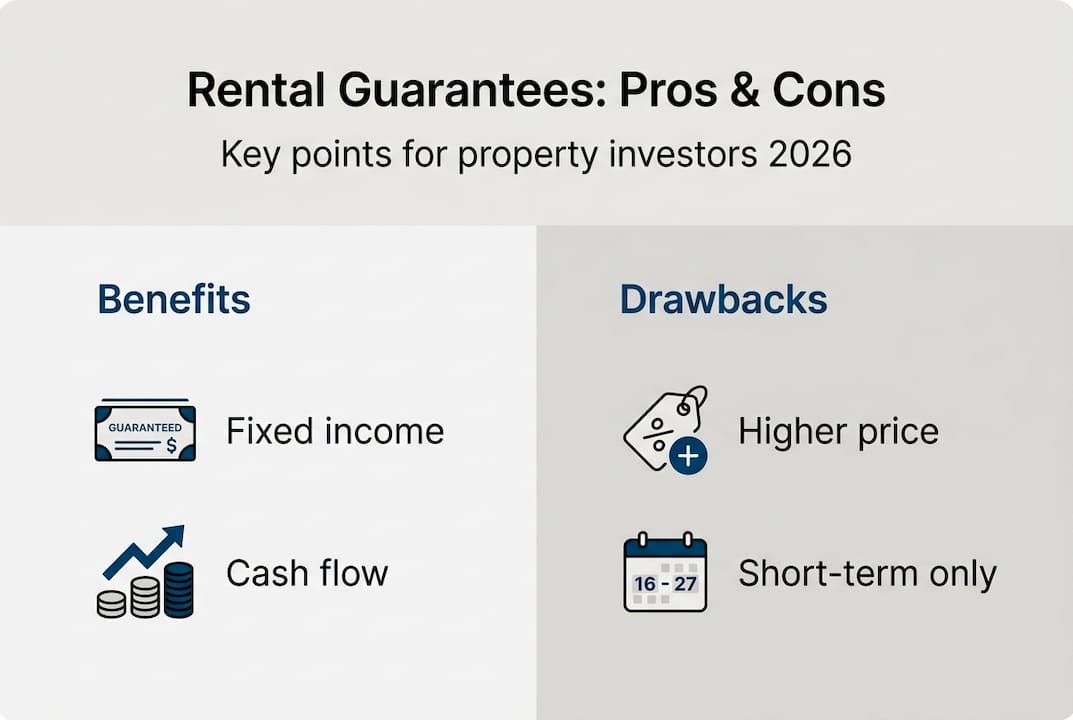
- Benefits And Drawbacks Of Rental Guarantees For Investors
- Rental Guarantees In The Context Of Australian Market Conditions
- How To Evaluate And Use Rental Guarantees Effectively
- Explore Expert Property Investment Guidance With Elite Wealth Creators
- Frequently Asked Questions
Key takeaways
| Point | Details |
|---|---|
| Fixed income assurance | Rental guarantees provide predetermined rental income for a set period regardless of vacancy or tenant default |
| Higher purchase premium | Properties with guarantees typically cost more upfront, with the guarantee expense built into the purchase price |
| Market context matters | Effectiveness depends heavily on local vacancy rates and whether guaranteed rent matches market growth |
| Contract scrutiny essential | Terms vary widely and require thorough review of guarantor stability, duration, and exit conditions |
| Strategic fit required | Best suited for risk-averse investors prioritising cash flow stability over maximum yield growth |
What is a rental guarantee and how does it work?
A rental guarantee in Australian property investment is primarily a contractual agreement ensuring fixed rental income for a specified period, even if vacant or tenant defaults. This arrangement typically involves a developer, property manager, or third-party company promising to pay you a predetermined rental amount regardless of actual tenancy status. The guarantee period commonly spans one to three years, though some agreements extend up to ten years for specific developments.
Rental guarantees are most prevalent in off-the-plan apartments and newly constructed properties, where developers use them as marketing tools to attract investors. The contract specifies the exact rental amount, payment frequency, and duration, creating predictable cash flow that simplifies budgeting and mortgage servicing. For investors concerned about essential rental property tips for Aussie investors, these guarantees address two primary risks: vacancy periods where no tenant occupies the property, and rental arrears where tenants fail to pay.
The mechanics work straightforwardly. You purchase the property, and the guarantor commits to paying the agreed rental amount directly to you or your mortgage lender throughout the guarantee period. If the property remains vacant or a tenant defaults, you still receive the guaranteed payment. Once the guarantee expires, you assume full responsibility for finding tenants and managing vacancy risks like any standard investment property.
Key features of rental guarantee contracts include:
- Fixed rental amounts that may not adjust for market rent increases
- Specified guarantee periods with clear start and end dates
- Conditions governing property management and tenant selection during the guarantee
- Clauses addressing early termination scenarios and breach consequences
- Requirements for property maintenance and compliance standards
Understanding these contractual elements helps you assess whether a rental guarantee genuinely enhances your investment strategy or simply masks underlying property weaknesses. The appeal lies in certainty, but that certainty comes at a cost embedded in the property price and potentially in foregone opportunities.
Benefits and drawbacks of rental guarantees for investors
Rental guarantees offer distinct advantages that appeal particularly to newer investors or those prioritising stability. The primary benefit is eliminating vacancy risk during the guarantee period, which translates to consistent income for mortgage repayments and living expenses. This predictability aids financial planning and reduces the stress associated with finding tenants in competitive or uncertain markets. For investors entering unfamiliar locations or property types, guarantees provide a buffer period to understand local market dynamics without immediate financial pressure.
Rental guarantees deliver several pros and cons that investors must weigh carefully. The stable cash flow supports borrowing capacity by demonstrating reliable income to lenders, potentially improving loan terms. New investors gain peace of mind knowing their investment generates returns from day one, reducing the learning curve associated with property management. Guarantees also protect against tenant default risks, where occupants fail to pay rent, shifting that burden to the guarantor.
However, significant drawbacks accompany these benefits. Properties with rental guarantees typically carry inflated purchase prices, with the guarantee cost embedded in the sale price rather than presented transparently. This premium can range from five to fifteen percent above comparable properties without guarantees, immediately reducing your equity position. The fixed rental amount caps your upside potential, meaning if market rents surge during strong demand periods, you miss out on higher returns that comparable investors capture.

Contract terms often impose restrictions that limit flexibility. Many guarantees prohibit selling the property or changing property managers during the guarantee period without penalties. These clauses can trap you in underperforming investments if market conditions shift unfavourably. Additionally, properties requiring guarantees to attract buyers may signal underlying issues such as poor location, oversupply concerns, or questionable build quality that justify investor caution.
Consider these disadvantages:
- Higher initial purchase price reduces capital growth potential and equity
- Fixed rent prevents benefiting from strong rental market growth
- Contractual restrictions limit exit strategies and management choices
- Properties may underperform market averages once guarantees expire
- Guarantor financial instability could void agreements unexpectedly
Pro Tip: Before committing to a property with a rental guarantee, calculate the total premium you are paying for that guarantee and compare it against potential vacancy costs in the local market. If vacancy rates are historically low, the guarantee may cost more than the risk it mitigates.
Balancing these factors requires honest assessment of your risk tolerance, investment timeline, and market knowledge. Rental guarantees suit specific scenarios but rarely represent optimal value for experienced investors targeting maximise your rental cash flow or property investment success through market-driven strategies.
Rental guarantees in the context of Australian market conditions
Australian rental markets in 2026 exhibit remarkably tight conditions that fundamentally alter the value proposition of rental guarantees. National vacancy rates were between 1.0 to 1.3 percent in 2025 with some cities like Hobart and Perth below 0.7 percent, making rental guarantees more about vacancy risk mitigation than regular income enhancement. These historically low vacancy rates mean properties in most capital cities experience minimal void periods, reducing the frequency with which guarantees would actually provide value.
The table below illustrates vacancy rates across major Australian cities, highlighting the varying levels of natural market security:
| City | Vacancy Rate 2025 | Market Condition |
|---|---|---|
| Hobart | 0.6% | Extremely tight |
| Perth | 0.7% | Extremely tight |
| Sydney | 1.2% | Very tight |
| Melbourne | 1.4% | Tight |
In markets with such low vacancy rates, the practical benefit of a rental guarantee diminishes significantly. Properties in high-demand areas naturally attract tenants quickly, often with multiple applicants competing for each listing. Paying a premium for a guarantee in these conditions means subsidising protection against an event with very low probability. The guarantee cost embedded in your purchase price may exceed the total financial impact of occasional vacancies over several years.
In tight markets with low vacancy, natural demand may outperform fixed rental guarantees long term, emphasising due diligence when considering guarantees. Market rent growth in strong-demand areas frequently outpaces the fixed rental amounts specified in guarantee contracts. For example, if market rents increase by eight percent annually while your guarantee locks you into the original rate, you forfeit substantial income that compounds over the guarantee period. This opportunity cost can exceed the value of vacancy protection, particularly in growth corridors experiencing population influx or infrastructure development.
Rental guarantees prove most valuable in softer markets with higher vacancy rates or in emerging areas where tenant demand remains unproven. Regional centres undergoing development or suburbs with oversupply concerns present scenarios where guarantees genuinely mitigate tangible risks. However, these same conditions should prompt deeper questions about the property’s long-term viability and capital growth prospects.
Pro Tip: Research historical vacancy rates for the specific suburb where you are considering a property with a rental guarantee. If the area consistently maintains vacancy below two percent, the guarantee likely costs more than the risk justifies, and you should negotiate a lower purchase price instead.
Understanding current market dynamics helps you contextualise rental guarantees within your broader investment strategy. Rather than viewing them as universally beneficial, assess whether the specific market conditions warrant the premium you pay. For insights into strategic property selection, explore investment strategy FAQs that address market timing and risk management.
How to evaluate and use rental guarantees effectively
Evaluating rental guarantee offers requires systematic analysis of contract terms, market conditions, and alignment with your investment objectives. Investors should scrutinise contract terms, compare guaranteed rents with market rents, and consider combining guarantees with insurance for broader risk protection. Follow this structured approach to assess whether a rental guarantee enhances or undermines your investment:
-
Review the complete contract thoroughly, identifying all terms, conditions, and obligations for both parties. Pay particular attention to clauses governing early termination, property management requirements, and circumstances that void the guarantee. Engage a property lawyer to explain complex provisions and identify potential risks.
-
Compare the guaranteed rental amount against current market rents for similar properties in the same location. Obtain rental appraisals from multiple agents to establish realistic market rates. Calculate the percentage difference between guaranteed and market rates, and project how this gap might evolve if market rents increase during the guarantee period.
-
Investigate the financial stability and reputation of the guarantor. Research the company’s trading history, financial statements if available, and track record with previous guarantee agreements. A guarantee from an unstable entity provides no real protection if the guarantor enters administration before fulfilling obligations.
-
Assess how the fixed rental income fits your mortgage serviceability and cash flow requirements. Determine whether the guarantee period covers your highest-risk phase, such as the first years of ownership when equity is lowest. Consider whether the stability justifies the premium price or if alternative properties offer better risk-adjusted returns.
-
Evaluate combining the rental guarantee with landlord insurance that covers tenant default and property damage. This layered approach provides comprehensive protection but adds cost. Calculate total insurance and guarantee expenses to ensure they do not erode returns below acceptable thresholds.
-
Analyse the property’s fundamentals independent of the guarantee. Strong properties in high-demand locations with solid capital growth prospects rarely require guarantees to attract investors. If a guarantee seems necessary to make the investment viable, question whether the underlying asset justifies purchase at any price.
For investors focused on property investing insights, rental guarantees should complement rather than substitute sound due diligence. They work best as risk management tools for specific scenarios rather than primary decision drivers. Avoid properties where the guarantee masks fundamental weaknesses such as poor location, oversupply, or questionable construction quality.
Consider your investment timeline and exit strategy. If you plan to hold the property long term, the guarantee period represents only a small fraction of your ownership. Prioritise properties with strong capital growth potential and rental demand that extends beyond the guarantee expiry. Short-term investors should scrutinise how the guarantee affects resale value and whether buyers will discount the property once protection ends.
Explore smart property finance options that optimise your borrowing structure and cash flow management. Rental guarantees may improve initial serviceability, but sustainable investment success requires properties that perform based on market fundamentals rather than contractual protections. Use guarantees strategically when they genuinely reduce risk at reasonable cost, but never let them override critical assessment of location, demand drivers, and growth potential.
Explore expert property investment guidance with Elite Wealth Creators
Navigating rental guarantees and broader property investment decisions benefits from expert guidance tailored to Australian market conditions. Elite Wealth Creators specialises in engineering financial freedom through strategic property selection, exclusive opportunities, and innovative financing solutions that standard agencies cannot match. Whether you are evaluating properties with rental guarantees or seeking high-yield alternatives, our team provides the strategic edge you need to thrive.
Our property investing insights help you identify opportunities that align with your wealth-building goals, moving beyond surface-level guarantees to properties with genuine long-term potential. For investors optimising self-managed super funds, discover SMSF investment property benefits that maximise tax advantages and retirement wealth. We also connect you with smart property finance options including our exclusive Homepay Advantage, enabling you to build your portfolio with deferred interest payments that preserve cash flow exactly where you need it. Your vision deserves expertise that unlocks unlimited potential.
Frequently asked questions
What types of properties typically come with rental guarantees?
Rental guarantees are most commonly offered with off-the-plan apartments and newly constructed developments, particularly in areas where developers seek to attract investors to untested markets. Established or older properties rarely include guarantees, as their rental performance is already proven through historical data. The prevalence in new developments reflects developers using guarantees as marketing tools rather than indicators of strong investment fundamentals.
Can rental guarantees protect against long-term market downturns?
Rental guarantees provide short to medium-term fixed income but offer no protection against property value declines or extended market downturns. They address rental income stability during the guarantee period but do not safeguard your capital investment if property prices fall. Investors should not confuse income guarantees with capital protection, as these represent entirely separate risk categories requiring different mitigation strategies.
Are rental guarantees regulated under Australian property law?
Rental guarantees generally operate as unregulated contractual agreements between private parties, with terms varying widely between providers and developments. No specific Australian property legislation governs guarantee standards, enforcement, or provider qualifications. Investors must conduct thorough due diligence, prefer reputable providers with proven track records, and obtain independent legal advice before signing any guarantee contract to protect their interests.
How do rental guarantees affect property resale flexibility?
Most rental guarantee contracts include restrictive clauses that limit your ability to sell the property or change management arrangements during the guarantee period without penalties or guarantor consent. These restrictions reduce flexibility and may complicate exit strategies if market conditions shift or personal circumstances change. Potential buyers may also discount properties with active guarantees, viewing them as signals of underlying weakness that required developer incentives to attract initial investors.