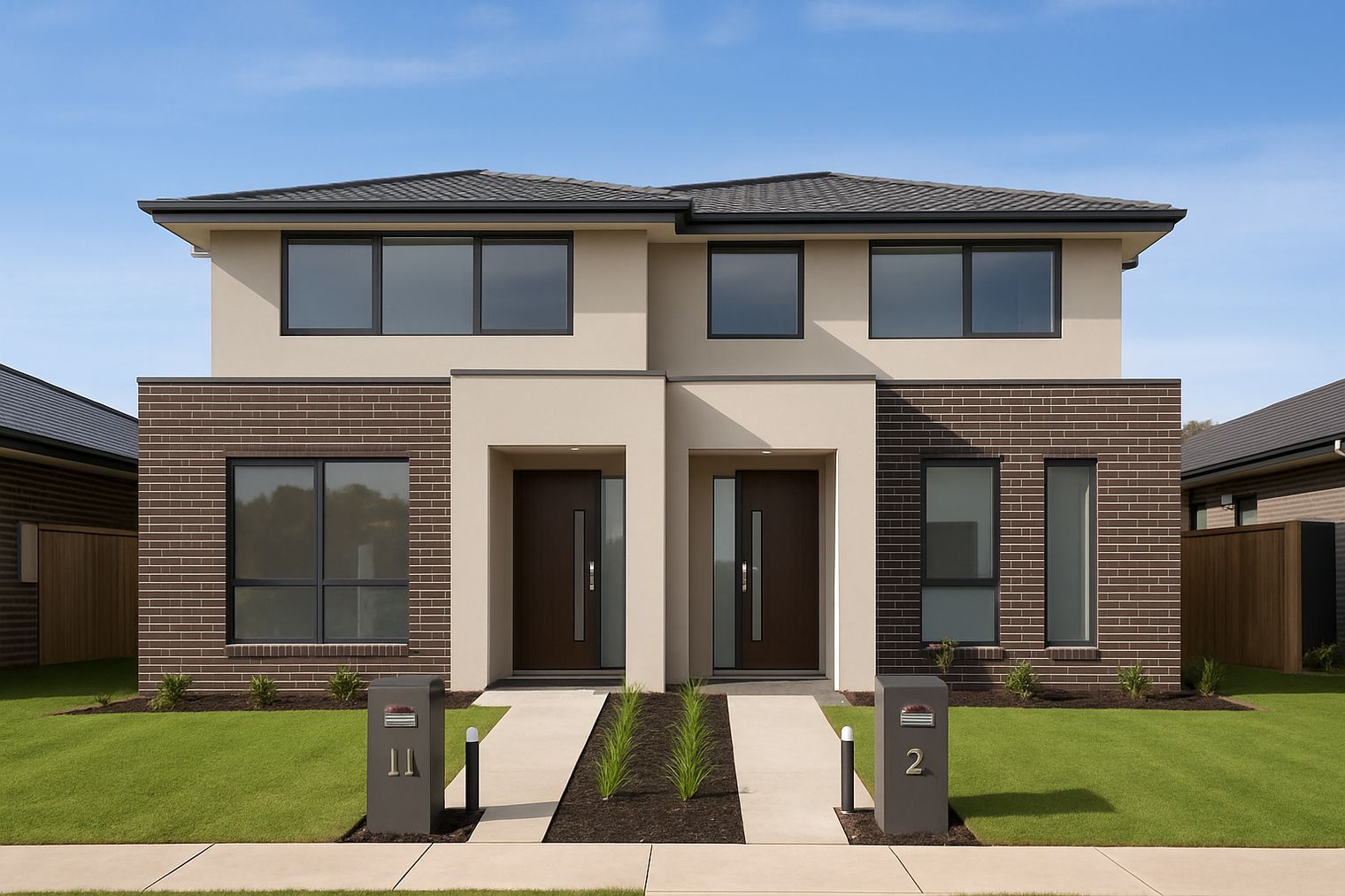
You've found a site with enough land to fit two dwellings. The numbers look reasonable on paper. Before the excitement runs too far ahead, the approvals process deserves a clear-eyed look, because missing a step, or taking them in the wrong order, can stop a project dead or cost a significant amount to unwind.
This post covers the main approvals a duplex-and-subdivide project requires, how they differ across states, and what the rules mean for investors considering this strategy inside or outside superannuation.
The Two Approval Tracks (and Why Sequence Matters)
At the broadest level, a duplex-and-subdivide project needs two distinct approvals: one for the build, one for the title split. They are related but not the same thing, and councils or certifiers assess them separately.
In New South Wales, duplex approval runs on two main pathways: a Development Application (DA) lodged with the local council, or a Complying Development Certificate (CDC) issued by a private certifier under the State Environmental Planning Policy (Exempt and Complying Development Codes). The CDC route is faster, but it only applies if your site and design meet every relevant standard. CDC eligibility depends on zoning, lot size, and site constraints, not all properties qualify, even if the design meets development standards.
For a duplex CDC in NSW, if your site ticks every numerical control in SEPP (Exempt and Complying) 2024, a private certifier can issue approval inside 20 days. Key thresholds to check include a maximum building height of 9 metres for a duplex, an FSR of 0.6:1 for R2 zones (subject to local LEP caps), minimum setbacks of 4.5 m primary and 3 m rear, and a minimum lot width of 12 metres.
Following Stage 1 housing reforms in July 2024, Stage 2 reforms took effect on 28 February 2025, introducing new non-discretionary development standards for duplexes and expanding their permissibility in R2 zones within designated low and mid-rise housing areas. If your duplex meets these standards, local councils cannot refuse your application based on their existing LEP or DCP controls, even if their current zoning rules suggest otherwise.
In Victoria, under Amendment VC288, which took effect on 16 October 2025, certain dual occupancy proposals, two dwellings on one lot in eligible residential zones, excluding Low Density Residential Zones, can use VicSmart if they meet all relevant planning controls and are not affected by conflicting overlays. Under VicSmart assessment, decisions can be made in as little as 10 business days, with no public advertising and far less planning uncertainty. Your design still must meet key ResCode standards such as height limits, setbacks, garden area, overlooking and overshadowing controls.
If you want separate Torrens titles for each dwelling, you also need a subdivision permit. In Victoria, two-lot subdivisions where a valid permit exists for up to two dwellings and key conditions are met can also be processed through VicSmart.
What Councils and Certifiers Actually Check
Regardless of state, the approvals process will examine several things that trip up first-time developers.
- Zoning and permitted use. The land must be zoned to allow dual occupancy or multi-dwelling housing. In NSW, even if your site is in an R2 zone, you must confirm that "dual occupancy" is permitted with consent, not prohibited, under your local LEP.
- Lot size and dimensions. Minimum areas and frontage widths differ by state and council. In NSW, for lots between 200 m² and 300 m², the lot must be more than 7 m wide at the building line; for lots larger than 300 m², the width must be between 7 m and 10 m under the new rules, otherwise previous controls apply. Always check your specific council's Local Environmental Plan alongside state codes.
- Infrastructure and servicing. Developers are expected to submit detailed servicing reports at the Subdivision Works Certificate stage, provide evidence of stormwater and traffic impact mitigation, and obtain early utility sign-offs from relevant providers.
- Overlays. Heritage conservation, bushfire-prone, and flood-prone sites face additional constraints. The DA pathway applies when a site sits in a heritage conservation area, bushfire-prone zone, flood-prone area, or has other site-specific complications.
After construction, a Subdivision Certificate (NSW) or a certified plan of subdivision (Victoria) is required before Land Registry will register the new titles. This is the step that produces two separately sellable or mortgageable lots.
The SMSF Angle: A Significant Rule Change
Investors who hold or are considering a duplex-and-subdivide strategy through an SMSF should be aware of a major legal change.
The Treasury Laws Amendment (Tax Reform No. 1) Act 2026 received Royal Assent on 26 June 2026, and the new rules apply to LRBA arrangements entered into on or after 10 August 2026. Under the new rules, an LRBA can only be used to acquire real property if the property is business real property.
In practical terms, this means an SMSF can no longer borrow under a new LRBA to purchase residential property, including a residential duplex, from 10 August 2026. Transitional relief turns on the exchange of a binding contract before 10 August. Anyone with a contract exchanged before that date should discuss their position promptly with an SMSF specialist accountant, because the ATO has indicated further guidance is being developed.
Even for arrangements that pre-date the new rules, a separate constraint has always existed around subdivision. If a house is replaced by duplexes and the land is subdivided into two titles, the asset's characteristics change significantly and it is no longer a single acquirable asset because the duplexes can be sold separately. This arrangement would not be allowed while borrowings are still outstanding under the LRBA. Per BT Professional's summary of ATO ruling SMSFR 2012/1, subdivision under a live LRBA has long been considered non-compliant. The LRBA must be fully paid out and the asset transferred to the fund before that kind of structural change occurs.
Key point for SMSF trustees: Subdivision and duplex development on an LRBA-financed property is not permitted while the loan is outstanding. And from 10 August 2026, new LRBAs for residential property are no longer permitted at all. Confirm the current position with an SMSF specialist accountant before structuring anything.
A Worked Scenario (Illustrative Only)
Consider a hypothetical Melbourne investor, call her Priya, who owns a 700 m² block in a General Residential Zone, fully paid off, held in her own name outside superannuation. She wants to build two side-by-side dwellings and subdivide into two Torrens titles.
Step 1, Planning permit for dual occupancy. Priya's town planner lodges under VicSmart via Amendment VC288. The site has no overlays and the design complies with ResCode. A decision comes back within 10 business days.
Step 2, Building permit. A registered building surveyor issues a building permit against the approved plans. Construction starts.
Step 3, Subdivision permit. Priya's surveyor prepares a plan of subdivision, lodged and processed alongside or shortly after the planning permit. Once construction reaches practical completion and a Certificate of Occupancy is issued, the surveyor certifies the plan.
Step 4, Title registration. Land Use Victoria registers the two new titles. Priya now owns two separately titled properties, which she can sell, hold for income, or use as security for further finance, each with its own council rates and valuation.
Total elapsed time from planning lodgement to new titles: typically 12 to 24 months depending on build time, certifier and surveyor capacity, and any council queries. These are illustrative timeframes only and do not account for site-specific complications.
On the income side, each dwelling would generate its own rental income stream. An independent rental appraisal from a licensed property manager in the local area is the right way to assess realistic yields and vacancy risks for any specific site. No income outcome is guaranteed.
What to Do Next
If you're weighing up a duplex-and-subdivide strategy, here are three concrete steps worth taking before committing to a site.
- Commission a planning feasibility check. A town planner or planning consultant can confirm the zoning, applicable code (CDC, VicSmart, or DA), minimum lot sizes, and any overlays before you spend money on design. This is usually a modest upfront cost relative to the risk it removes.
- Talk to a broker experienced in development finance. Construction lending for a duplex has different conditions from a standard residential mortgage, including drawdown schedules tied to construction stages, valuation requirements, and, if the end-game is to hold both dwellings, refinancing at practical completion. The broker you use should be familiar with how lenders assess dual-occupancy projects in your state.
- If superannuation is part of the picture, speak to an SMSF specialist accountant now. Given the LRBA rule change that took effect via Royal Assent on 26 June 2026, the landscape for residential property borrowing inside super has changed materially. An SMSF specialist accountant and a financial adviser licensed to provide SMSF advice are the right people to assess what, if any, options remain and whether an existing structure remains compliant.
For a broader view of how EWC approaches investment property sourcing and finance coordination, visit /services or book a free call to talk through your situation.
General information only, not personal financial advice. Speak with a licensed adviser before acting.