

TL;DR:
- Tighter regulations and DTI limits make multi-property finance more complex for Australian investors.
- Accurate documentation and portfolio management are essential to improve approval chances.
- Building lender diversity and understanding borrowing capacity are key for portfolio growth.
Buying your first investment property feels manageable. Buying your second, third, or fourth? That’s where many Australian investors hit an unexpected wall. Tighter lending standards, stricter debt-to-income assessments, and APRA’s updated regulations in 2026 have made multi-property finance a genuinely complex undertaking. But complexity doesn’t mean impossibility. This guide walks you through the lending rules you need to understand, the documents you must prepare, a clear step-by-step process to follow, and the critical mistakes that derail even experienced investors. If you’re serious about building a property portfolio for long-term wealth, this is your practical roadmap.
Table of Contents
- Understanding lending rules for multiple property finance
- Key requirements and documents for multi-property loans
- Step-by-step process to finance more than one property
- Common mistakes and how to avoid loan rejections
- Why mastering lending limits matters more than chasing rates
- How Elite Wealth Creators can help you build your portfolio
- Frequently asked questions
Key Takeaways
| Point | Details |
|---|---|
| DTI limits are real | From 2026, lenders can only fund up to 20% of new loans at a DTI of 6x your income or greater, making portfolio planning essential. |
| Preparation is key | Having all documents, valuations, and a well-managed portfolio increases your chances of approval for multi-property loans. |
| Structure unlocks borrowing power | Strategically using multiple lenders and avoiding cross-collateralisation can help maintain your borrowing capacity as you grow. |
| Mistakes are costly | Simple errors or omitted debts may lead to immediate rejection, so detail and accuracy matter more than ever. |
| Ongoing optimisation matters | Proactively revisiting your finance and portfolio strategy lets you take advantage of regulatory or market changes over time. |
Understanding lending rules for multiple property finance
Before you approach any lender about your next acquisition, you need to understand the regulatory environment shaping every decision they make. The Australian Prudential Regulation Authority (APRA) has significantly tightened its oversight of residential mortgage lending, and these changes directly affect how much you can borrow across a growing portfolio.
What is DTI and why does it matter?
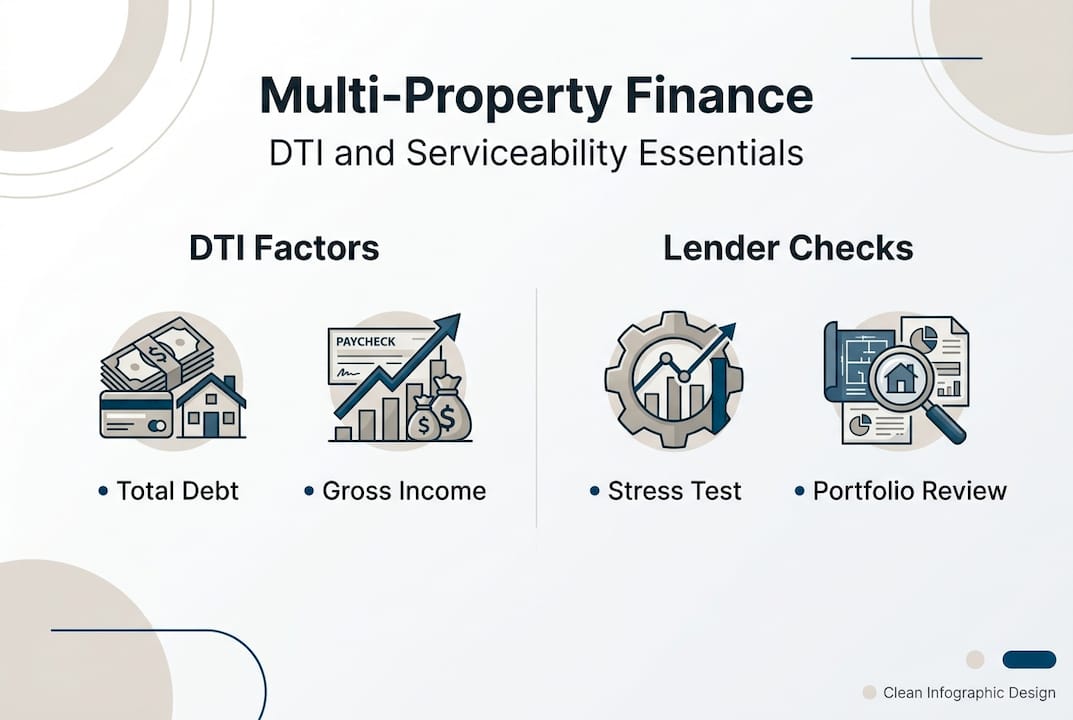
Debt-to-income ratio (DTI) is the total amount you owe across all debts divided by your gross annual income. It’s the single most important metric lenders use to assess whether you can sustain additional borrowing. Under APRA’s current framework, new investment loans at DTI ≥6x are restricted, with authorised deposit-taking institutions (ADIs) permitted to fund only up to 20% of new residential mortgage lending at that threshold. In plain terms, if your total debts are already six times your income, most lenders will decline further applications outright.
Serviceability assessments add another layer. Lenders don’t just check your current repayments. They stress-test your entire portfolio at a higher interest rate, typically 3% above the loan rate, to confirm you could still meet obligations if rates rose sharply. As APRA’s guidance confirms, lenders must apply robust stress-testing and prudent origination practices across all residential mortgage lending. This means every property you already own is factored into the assessment of your next loan.
What counts and what doesn’t
Not every loan type feeds into the DTI calculation equally. Construction loans and bridging finance are sometimes assessed differently, depending on the lender’s internal policies. It’s worth exploring innovative finance strategies that may sit outside the standard DTI framework and give you additional flexibility.
| Metric | Single property | Multiple properties |
|---|---|---|
| DTI threshold | Often ≤6x | Strictly ≤6x across portfolio |
| LVR limit | Up to 80% (standard) | May tighten with each addition |
| Stress test rate | Loan rate +3% | Applied across all loans |
| Rental income counted | 80% of rental income | Portfolio-wide rental assessment |
Pro Tip: Start tracking your overall DTI now, before you speak to a lender. Add up every debt (mortgages, car loans, credit cards, HECS) and divide by your gross income. If you’re already above 5x, your borrowing ceiling is closer than you think.
Key requirements and documents for multi-property loans
With lending rules in mind, here’s what you’ll need at hand to give your loan applications the best chance of approval.
Lenders assessing a multi-property application aren’t just looking at your next purchase. They’re reviewing your entire financial picture. As APRA’s framework makes clear, security valuation and evidence-based origination are foundational requirements for any residential mortgage approval. Every property in your portfolio becomes part of the evidence.
Core documentation you’ll need
- Recent payslips or tax returns (last two years for self-employed investors)
- Rental statements for all existing investment properties
- A complete asset and liability statement covering all debts
- Current property valuations for each asset in your portfolio
- Bank statements showing genuine savings and cash flow patterns
- Loan statements for all existing mortgages
- Lease agreements confirming current rental income
A complete finance documentation checklist can help you stay organised before you approach lenders, reducing delays and improving your application’s credibility.
Single vs multi-property loan requirements
| Requirement | Single property loan | Multi-property loan |
|---|---|---|
| Income evidence | Payslips or tax return | 2 years tax returns preferred |
| Rental income | Not always required | Mandatory for all properties |
| Asset/liability statement | Basic | Detailed, portfolio-wide |
| Property valuation | One property | All properties in portfolio |
| Cash flow modelling | Rarely requested | Often required |
Lenders also scrutinise portfolio performance, not just individual properties. A vacancy rate above 10% across your holdings, or a pattern of negative cash flow without clear equity growth, can raise concerns. Accurate, up-to-date valuations are equally critical. An outdated valuation can understate your equity position and reduce your available borrowing power significantly.

Pro Tip: Ask your accountant to prepare an annual portfolio summary that consolidates income, expenses, equity, and liabilities across all properties. Arriving at a lender meeting with this document already prepared signals professionalism and accelerates the approval process.
Step-by-step process to finance more than one property
Once you’re prepared, follow this practical pathway to secure financing for additional properties.
-
Assess your borrowing power and set clear goals. Calculate your current DTI, review your existing equity, and define your investment objectives. Know whether you’re targeting cash flow, capital growth, or both, as this shapes which loan products suit you best.
-
Select lenders and products that support multi-property strategies. Not all lenders treat portfolio investors equally. Some have internal policies that cap the number of investment loans they’ll hold for one borrower. Research lenders who actively support portfolio growth and compare their serviceability policies, not just their advertised rates.
-
Access equity and structure finance efficiently. Equity in existing properties is often the most accessible source of capital for your next acquisition. However, avoid cross-collateralisation, which is the practice of using multiple properties as security for a single loan. While it may seem convenient, it ties your entire portfolio to one lender’s decisions and complicates future sales or refinancing. Explore structuring SMSF investments as an alternative vehicle if your circumstances allow.
-
Prepare and submit complete loan applications. Incomplete applications are a leading cause of delays and rejections. Compile every document before lodging, and ensure all income, liabilities, and property details are accurately disclosed. As APRA’s guidance confirms, lenders apply stress testing across your full portfolio during assessment, so transparency is essential.
-
Review loan offers carefully before signing. Compare interest rates, offset account features, repayment flexibility, and any restrictions on future borrowing. A slightly higher rate with greater flexibility can be worth more than a cheaper loan that locks you in.
-
Manage your portfolio proactively as it grows. Revisit your DTI and serviceability position at least annually. As rental income grows and properties appreciate, your borrowing capacity may improve. Stay across ways to finance multiple properties so you’re always aware of new options.
Pro Tip: Stagger your loan applications across multiple lenders rather than submitting everything at once. Each application generates a credit enquiry, and multiple enquiries in a short window can lower your credit score and raise red flags with lenders.
Common mistakes and how to avoid loan rejections
Now that you know the steps, it’s just as important to avoid common mistakes that can halt your progress.
Even well-prepared investors make errors that trigger automatic declines. Here are the most frequent pitfalls and how to sidestep them.
-
Not tracking DTI across all liabilities. Many investors forget to include personal loans, credit card limits (not just balances), or HECS debt. Lenders count the full credit limit on cards, not just what you owe. This can push your DTI above the threshold without warning.
-
Overstating or inconsistently reporting income. Rental income must be verifiable and consistent. Claiming projected rents rather than actual receipts, or failing to account for vacancy periods, creates discrepancies that undermine your application.
-
Repeated documentation errors. Submitting outdated valuations, missing rental statements, or mismatched figures between your tax return and loan application are common triggers for rejection. Every figure must reconcile.
-
Over-relying on a single lender. When one bank holds all your loans, you’re entirely subject to their internal DTI policies. As serviceability criteria and stress-tests tighten, a single lender can quickly become a bottleneck. Diversifying across lenders is a structural safeguard, not just a strategy.
-
Ignoring concentration risk. Holding multiple properties in the same suburb or asset class amplifies your exposure to localised downturns. Lenders notice this and may apply additional scrutiny.
‘Every additional property increases overall risk exposure. Even small errors in documentation or missed debts can be the difference between approval and rejection.’
The fix for each of these mistakes is the same: preparation, accuracy, and professional advice. Reviewing your avoiding common finance errors approach before each application can save you months of delays.
Why mastering lending limits matters more than chasing rates
Here’s something most articles won’t tell you: the investors who build the largest portfolios aren’t the ones who found the cheapest rate. They’re the ones who understood their borrowing capacity and protected it deliberately.
When you’re starting out, a 0.2% rate difference feels significant. But once you’re managing three or four properties, your real constraint isn’t the rate. It’s whether you can borrow at all. DTI limits and serviceability assessments become the actual handbrake on your growth, and no amount of rate shopping fixes a DTI problem.
The smarter approach is to build flexibility into your portfolio structure from the beginning. Use multiple lenders. Choose loan products that preserve your borrowing headroom. Keep your credit profile clean and your documentation current. Thinking beyond interest rates means anticipating regulatory shifts before they constrain you, not reacting to them after the fact.
When you’re proactive about serviceability, you gain more options as the lending environment evolves. That’s the real competitive advantage in multi-property investing.
How Elite Wealth Creators can help you build your portfolio
If you’re ready to get proactive about building your wealth through multiple properties, expert support can make all the difference. At Elite Wealth Creators, we work with property investors across Australia to map out borrowing potential, optimise finance structures, and identify opportunities that align with your long-term goals. From DTI analysis and loan comparisons to SMSF and NDIS investment strategies, our team provides the strategic edge that turns a good portfolio into a great one. We also offer tailored equity release plans to help you access capital without disrupting your existing holdings. Explore our property investing insights and discover how our equity investment strategies can work for your situation.
Frequently asked questions
How many investment properties can I realistically finance under current APRA rules?
Most investors are constrained by the DTI cap at ≥6x income and serviceability stress tests, so the practical limit varies by income level and existing debt. Planning conservatively around a 6x DTI ceiling will help you anticipate when your borrowing runway is approaching its end.
What documents do I need to finance a second or third property?
You’ll need payslips or two years of tax returns, a detailed asset and liability statement, rental income records, and current property valuations for all holdings. As APRA’s guidance confirms, documented proof and security valuation are non-negotiable requirements for multi-property lending.
Is it better to use one lender or several for multiple property loans?
Using multiple lenders improves your overall borrowing potential and reduces the risk of hitting a single bank’s internal DTI cap. A multi-lender strategy also gives you more negotiating leverage and protects your portfolio if one lender tightens its policies.
What’s the main reason multi-property finance applications are rejected?
The most common causes are exceeding DTI limits, inadequate proof of income, and incomplete disclosure of existing debts. APRA’s framework means DTI and serviceability stress tests are the most consistent technical roadblocks investors face during multi-property applications.
Recommended
- Maximise Equity with Real Estate | Elite Wealth Creators
- 5 innovative ways to finance property in Australia 2026 | Elite Wealth Creators
- Property Investing Insights | Elite Wealth Creators
- Equity for Property Investing & Wealth | Elite Wealth
- Essential real estate investment tips for LA & OC success