

TL;DR:
- Effective risk management in property transforms passive assets into strategic growth vehicles that protect returns during market shifts. It involves diligent due diligence, regular risk register reviews, liquidity buffers, and expert legal and insurance safeguards. Proactive risk practices provide investors with a competitive edge by enabling confident, informed decision-making amid uncertainties.
Most property buyers and investors focus intensely on finding the right deal, securing finance, and watching capital grow. What quietly costs them money, time, and opportunity is the role of risk management in property — and how poorly it’s understood. Risk management isn’t a defensive measure reserved for large corporations or seasoned fund managers. It’s the difference between a portfolio that compounds wealth and one that bleeds value during a market shift, a tenant dispute, or an unexpected structural failure. This article gives you the practical blueprint to understand, apply, and maintain real estate risk management practices that protect your returns.
Table of Contents
- Key takeaways
- The role of risk management in property
- Core risk management strategies for investors
- Building a living risk register for your portfolio
- High-impact risks that catch investors off guard
- Risk management for buyers, investors, and SMSF trustees
- My honest take on risk and competitive edge
- How Elitewealthcreators gives you the risk management edge
- FAQ
Key takeaways
| Point | Details |
|---|---|
| Risk management is strategic, not defensive | Proactive risk management transforms property from a passive asset into a controlled wealth vehicle. |
| Due diligence is your first line of defence | Market research, environmental checks, and legal review prevent costly surprises before settlement. |
| A risk register keeps your portfolio honest | Quarterly reviews of a living risk register allow you to track, prioritise, and act on threats in real time. |
| Liquidity buffers prevent panic decisions | Cash reserves give you the capacity to act during market stress without being forced into a bad sale. |
| Expert guidance closes the knowledge gap | Professional support removes analysis paralysis and gives buyers and investors a measurable edge. |
The role of risk management in property
Property investment carries inherent risk. The question is never whether risk exists. The question is whether you’re managing it or letting it manage you.
At its core, risk management in the property context means identifying threats to your investment’s value or income, assessing how likely and severe those threats are, and taking deliberate steps to reduce or transfer them. Professional risk management transforms real estate assets from passive holdings into actively managed instruments for growth. That shift in thinking changes everything.
Property investors face risks across several distinct categories:
- Physical risks: Structural deterioration, fire damage, pest infestation, and the increasing threat of climate events
- Financial risks: Rising interest rates, vacancy periods, cash flow shortfalls, and overleveraging
- Legal risks: Regulatory non-compliance, inadequate lease agreements, and disputes with tenants or contractors
- Market risks: Shifts in supply and demand, property value declines, and oversupply in growth corridors
- Environmental risks: Flood zones, contamination, and proximity to industrial hazards
When these risks go unmanaged, the impact on returns is direct and measurable. A single compliance failure can result in fines, litigation, and loss of tax advantages. A structural issue missed during due diligence can wipe out years of rental income in one repair bill.
The importance of risk management has shifted from a purely defensive position to a genuine strategic advantage, enhancing property valuation and earnings durability for investors who act proactively. That’s not a subtle distinction. It’s the gap between investors who build wealth and those who simply hold property.

Core risk management strategies for investors
Knowing the risks is only half the work. The other half is applying proven strategies to reduce their impact. Here are the foundational approaches every buyer and investor should have in place.
-
Conduct thorough due diligence. Before any acquisition, verify the property’s physical condition, title history, zoning restrictions, and rental history. Environmental due diligence, including Phase I and Phase II environmental site assessments, identifies contamination or flooding risks early enough to adjust your offer or walk away entirely.
-
Optimise your insurance coverage. Insurance is not a box-ticking exercise. Properties with low catastrophe exposure and strong loss prevention measures can attract insurance rate reductions of up to 50%. That’s a material cost saving that compounds over a portfolio.
-
Diversify your portfolio deliberately. Diversification across economic and legal areas reduces systemic risk and increases resilience across market cycles. Geographic spread, asset class variety, and tenant type diversification each reduce your exposure to any single point of failure.
-
Build and maintain liquidity reserves. Liquidity is the safety anchor that prevents panic sales and enables opportunity capture during market stress. A minimum of three to six months of holding costs as a cash reserve is considered a responsible baseline for most portfolios.
-
Protect yourself with watertight legal structures. This includes well-drafted lease agreements, appropriate ownership structures such as trusts or company titles, and clear contractor agreements that assign liability correctly.
-
Screen tenants carefully and maintain properties systematically. Tenant selection is one of the most underrated property management risk controls available. A rigorous screening process reduces vacancy, arrears, and property damage simultaneously.
Pro Tip: Verify that every contractor working on your property carries adequate workers compensation and liability insurance. Risk transfer through contractor coverage shifts the financial burden away from you in the event of an on-site accident or claim.
Building a living risk register for your portfolio
Most investors know what could go wrong. Very few write it down, assign responsibility for it, and review it regularly. That’s the practical gap a risk register closes.
A risk register is a living document that captures every identified risk across your portfolio, scores it by likelihood and potential impact, records the mitigation strategy in place, and tracks who is responsible for managing it. Best practice calls for quarterly reviews to ensure the register adapts to shifting market conditions, new legislation, and changes within each property.
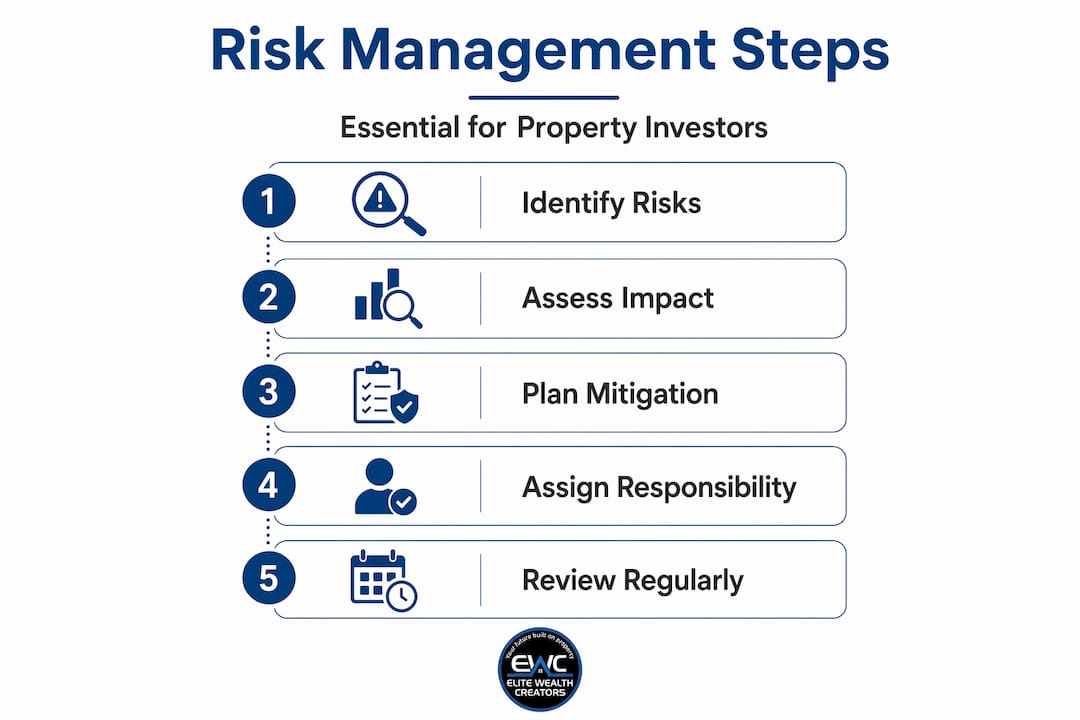
Here’s an example structure you can apply immediately:
| Risk | Likelihood | Impact | Mitigation | Responsible party | Review date |
|---|---|---|---|---|---|
| Tenant default | Medium | High | Tenant screening, rent guarantee insurance | Property manager | Quarterly |
| Structural deterioration | Low | High | Annual building inspections | Owner/builder | Annually |
| Interest rate increase | High | Medium | Fixed rate portion, cash buffer | Mortgage broker | Bi-annually |
| Regulatory change | Medium | High | Legal review, compliance monitoring | Solicitor | Quarterly |
| Climate event damage | Low | Very high | Adequate insurance, location review | Owner/insurer | Annually |
The power of this tool is in its consistency, not its creation. A risk register written once and never revisited is just a document. A risk register reviewed quarterly becomes a decision-making asset.
Pro Tip: Integrate your risk register review into a scheduled portfolio performance meeting. Treat it the same way you treat a rental yield report. Regular attention keeps your risk exposure visible and your responses deliberate.
High-impact risks that catch investors off guard
Some risks are widely acknowledged. Others quietly accumulate until they become a crisis. These are the categories most likely to cause genuine financial damage if left unaddressed.
Climate and physical asset risk
Climate-related property damage is no longer a rare event. In 2024, 27 climate-related events in the US each caused damages exceeding one billion dollars. Australian investors face analogous exposure through bushfire corridors, flood-prone zones, and coastal erosion. Understanding your property’s physical exposure is not optional. It should inform your purchase decision, your insurance coverage, and your ongoing maintenance strategy.
Compliance and regulatory risk
Non-compliance with regulations covering fair housing, building codes, and landlord obligations can result in fines, litigation, and the loss of tax advantages. For SMSF trustees, the compliance stakes are even higher. A single breach can trigger an ATO audit and jeopardise the entire fund’s tax-concessional status.
Market and interest rate shifts
Interest rate movements affect both your borrowing costs and the pool of buyers or renters you can attract. Investors who carry insufficient liquidity buffers during rate cycles are often forced into selling at the worst possible time.
Operational risks
- Contractors working without adequate insurance create direct liability for property owners
- Deferred maintenance creates compounding repair costs that erode net yields
- Cybersecurity vulnerabilities in digital property management systems expose tenant data and attract regulatory penalties
- Poor documentation of lease terms and property condition reports increases dispute exposure
Addressing these risks proactively, particularly through insurance structures and legal safeguards, creates measurable cost savings and portfolio stability. The impact of risk management on property performance is most visible precisely when markets turn uncertain. That’s when preparation pays.
Risk management for buyers, investors, and SMSF trustees
Risk management looks different depending on where you sit in the property market. Here’s how to apply it based on your specific position.
For property buyers:
- Understand auction risk by setting a hard upper limit before bidding and factoring in all acquisition costs
- Avoid the sunk cost trap of over-researching without acting. Every auction you leave empty-handed is a deposit working against your financial timeline
- Use a property investment mistakes checklist to identify the blind spots most buyers miss before signing a contract
For property investors building a portfolio:
- Mastering market volatility requires knowing which growth corridors carry genuine long-term demand, not just short-cycle hype
- Structure your portfolio with clear risk tolerance parameters. Define the maximum vacancy rate, debt service ratio, and capital loss you can absorb before financial stress sets in
- Review your risk register and insurance policies whenever you add a new asset
For SMSF trustees:
- The compliance minefield is real and unforgiving. Maintain a compliance calendar covering annual audits, trustee obligations, and ATO reporting deadlines
- Regulatory compliance failures in an SMSF context can result in the fund losing its complying status, triggering severe tax penalties on the entire fund balance
- Work with advisers who specialise in SMSF property structures, not generalists who learn compliance as they go
A warning sign of risk neglect is making investment decisions based on optimism alone, without documented analysis. If you cannot articulate the top three risks in your current portfolio and what you’re doing about each one, your risk management process has a gap.
My honest take on risk and competitive edge
I’ve worked with investors across every stage of portfolio development, and the pattern I see most consistently is this: the investors who build lasting wealth are not the ones who take the most risk. They’re the ones who understand their risk exposure clearly enough to act with confidence when others hesitate.
Most investors treat risk management as something they’ll get to later, after they’ve built a few assets. What I’ve learned is that this thinking costs them more than they realise. A missed inspection report becomes a six-figure structural repair. A poorly worded lease becomes a twelve-month dispute. A weak cash buffer becomes a forced sale at the bottom of a cycle.
Risk management as a competitive advantage is not a theory. I’ve seen it in practice. Investors who document their risks, review them regularly, and respond quickly to changes don’t just avoid losses. They move faster than the market because their decisions are based on clarity, not hope.
My advice: stop treating risk management as paperwork. Treat it as intelligence. The better your risk picture, the better your investment decisions. And if you’re spending more time in research paralysis than in deliberate action, that’s a risk in itself. The market doesn’t wait.
— Nick
How Elitewealthcreators gives you the risk management edge
At Elitewealthcreators, we work with a deliberately limited number of new clients each month. Not for exclusivity, but because quality strategy demands real attention. If you’re a buyer, investor, or SMSF trustee who is tired of watching deals pass while you’re still weighing the risks, this is your signal to act.
Our team brings specialised knowledge in smart property investment across residential, commercial, and SMSF structures. We combine off-market access, cash flow modelling, and real compliance expertise to help you make decisions grounded in data, not anxiety. For SMSF trustees, our SMSF property investment guidance removes the compliance guesswork entirely. Spots for new clients are filling quickly. Ready to stop watching and start acting?
FAQ
What is risk management in property investment?
Risk management in property investment is the process of identifying, assessing, and mitigating threats to a property’s value or income. It covers physical, financial, legal, market, and environmental risks and should be reviewed regularly as part of ongoing portfolio oversight.
How does risk management protect property returns?
By addressing risks before they become costly problems, investors protect their rental income, avoid unplanned expenses, and maintain access to capital when opportunities arise. Liquidity reserves in particular protect investors from being forced into panic decisions during market downturns.
What is a property risk register and how often should I review it?
A risk register is a living document that tracks each identified risk, its likelihood and impact, the mitigation strategy, and the person responsible. Best practice is quarterly reviews to keep the register aligned with changing market conditions and property circumstances.
How does risk management apply to SMSF property investment?
SMSF trustees face heightened compliance obligations, where a single breach can trigger an ATO audit and jeopardise the fund’s tax status. Effective risk management for SMSF trustees includes maintaining a compliance calendar, working with specialist advisers, and reviewing trustee obligations annually.
Can good risk management reduce insurance costs?
Yes. Properties with strong loss prevention measures and low exposure to climate or catastrophe risk can attract insurance rate reductions of up to 50%, making risk management directly profitable rather than just protective.