

TL;DR:
- Choosing a property location based on emotion or hype often leads to poor long-term returns.
- A disciplined, data-backed process focusing on fundamentals like demand, infrastructure, and growth metrics ensures better investment outcomes.
Choosing the wrong property location is one of the most costly mistakes an Australian investor or first-time buyer can make, and it happens more often than you might expect. Many people select a suburb based on gut feeling, family opinion, or a headline they read over breakfast, then wonder years later why their portfolio has stagnated while others have surged ahead. This guide gives you a practical, data-backed roadmap to identify locations with genuine, sustained growth potential, strong rental demand, and the fundamentals that protect your wealth over the long term. Whether you are building your first portfolio or acquiring your second investment property, the steps ahead will change how you think about location forever.
Table of Contents
- Understand why location matters for property growth
- Gather your location data and shortlist suburbs
- Evaluate regional, urban, and outer suburbs: What suits your goals?
- Common mistakes to avoid when choosing a property location
- Check your top picks: The final due diligence
- The crucial mindset shift most buyers miss
- Take the next step to secure your wealth with the right location
- Frequently asked questions
Key Takeaways
| Point | Details |
|---|---|
| Location drives returns | Choosing the right suburb is the most important factor for both capital growth and rental demand. |
| Use checklists and data | Standardised research removes emotion and helps compare suburbs on real results, not hype. |
| Match location to goals | Regional, urban, or outer suburbs all have pros and cons—align these with your investment strategy and risk profile. |
| Avoid common traps | Don’t chase fads or buy on emotion—set long-term growth as your priority. |
| Thorough due diligence | Final checks on demand, infrastructure, and growth protect your investment from surprises. |
Understand why location matters for property growth
Location is not just one of many factors in property investment. It is the single biggest driver of both capital growth and rental yield, often outweighing the condition of the building itself. A well-located property in a suburb with rising demand will typically outperform a brand-new build in a poorly chosen area every single time.
Capital growth refers to the increase in your property’s value over time, while yield measures the annual rental income as a percentage of the property’s value. Both are heavily influenced by where the property sits. Understanding capital growth basics is the first step towards building a portfolio that genuinely works for you. Location shapes how vacancy rates and portfolio growth interact over time, directly affecting your cash flow and long-term returns.
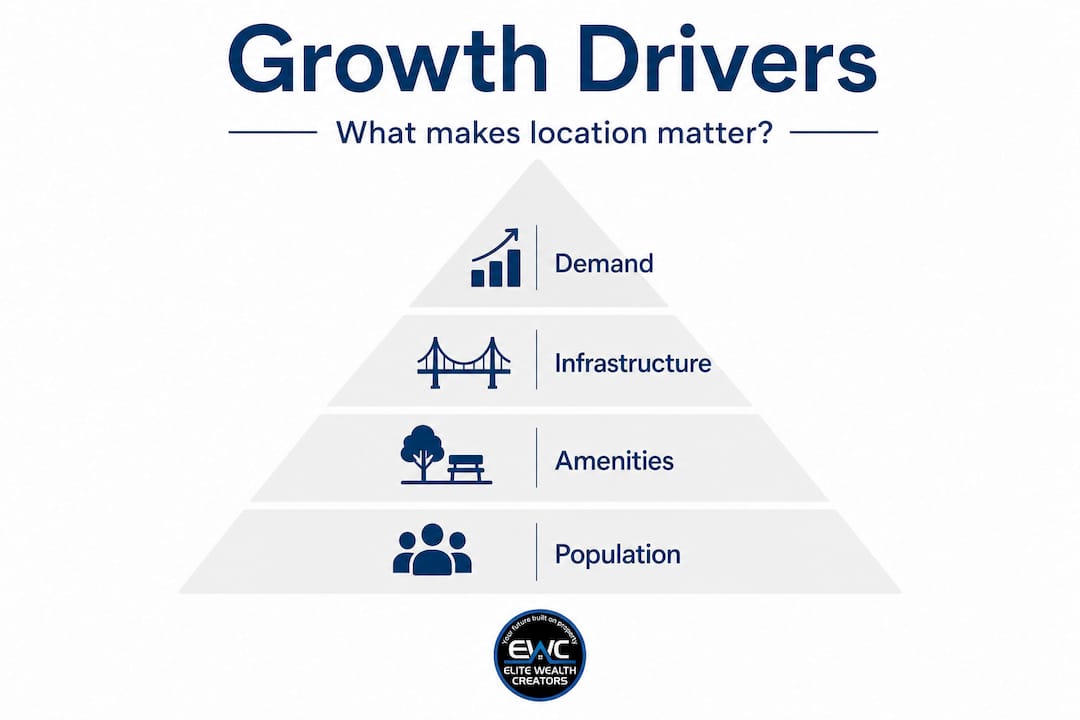
Consider the difference between two properties purchased at the same price point. One sits in an inner suburban corridor close to hospitals, universities, and major transport links. The other is in an outer fringe area with limited amenities and no confirmed infrastructure pipeline. Over a ten-year period, the inner property is far more likely to deliver consistent capital appreciation, even if the outer property offers a slightly higher initial yield.
Data matters for every buyer, not just sophisticated investors. The numbers tell a story that emotion simply cannot.
Here is a snapshot of how location metrics compare across different market types:
| Metric | Inner urban | Middle ring | Outer suburban | Regional |
|---|---|---|---|---|
| Average capital growth (10yr) | 7.5% p.a. | 6.2% p.a. | 5.1% p.a. | 4.8% p.a. |
| Gross rental yield | 3.0% | 3.8% | 4.5% | 5.2% |
| Vacancy rate (approx.) | 0.8% | 1.1% | 1.6% | 2.1% |
| Supply risk | Low | Medium | Medium-High | High |
Key location factors to assess before committing:
- Proximity to employment hubs and major transport corridors
- Quality and capacity of nearby schools and childcare
- Access to healthcare, retail centres, and lifestyle amenities
- Council infrastructure investment and zoning plans
- Current and projected population growth in the area
- Supply pipeline and approved development applications
- Historical 10-year price growth, not just recent 12-month spikes
Market signal worth noting: Tight national vacancy near 1% signals landlord markets in most Australian capitals, meaning rental demand is outstripping supply and giving well-located property owners genuine pricing power.
Gather your location data and shortlist suburbs
Once you understand which factors drive value, the next step is practical data gathering to target your efforts. This is where discipline separates serious investors from those who end up chasing hype.
Your research should draw from multiple sources, including CoreLogic, the Australian Bureau of Statistics for population data, state planning department websites for infrastructure pipelines, and local council development registers. Cross-reference recent median price movements with vacancy rates, days on market, and auction clearance rates to build a complete picture.
Property location checklists are an effective tool for standardising your suburb assessments. When you use the same checklist for every suburb, you make it much easier to compare options objectively and remove the emotional bias that derails so many buyers.
Suburb checklists that remove emotion are strongly favoured by experienced investors, who consistently prefer steady 10-year growth over short-term price spikes that can reverse quickly.
Here is how a typical three-suburb comparison might look in practice:
| Criteria | Suburb A (inner) | Suburb B (middle) | Suburb C (outer) |
|---|---|---|---|
| Median house price | $950,000 | $720,000 | $580,000 |
| 10yr growth p.a. | 7.8% | 6.0% | 4.5% |
| Gross yield | 3.1% | 4.0% | 4.8% |
| Vacancy rate | 0.7% | 1.3% | 2.0% |
| Infrastructure pipeline | Strong | Moderate | Limited |
| Population growth | High | Moderate | Low-Moderate |
Steps to build your suburb shortlist:
- Define your investment goals clearly, whether capital growth, cash flow, or a balance of both.
- Set a budget range that accounts for stamp duty, legal fees, and a cash flow buffer.
- Identify at least five candidate suburbs using data from CoreLogic, SQM Research, or similar platforms.
- Score each suburb against your standardised checklist, rating each factor from one to five.
- Eliminate any suburb with a vacancy rate above 3%, limited infrastructure commitment, or declining population projections.
- Narrow your list to three suburbs and conduct deeper research into each.
- Cross-check your findings with a property due diligence checklist before making any commitment.
Pro Tip: Print your checklist and physically score each suburb before discussing it with anyone else. This locks in your objective assessment before outside opinions can cloud your thinking.
Evaluate regional, urban, and outer suburbs: What suits your goals?
With your shortlist in hand, you will need to match your goals to different location types for the best outcome. Not every location type suits every investor, and understanding this distinction can save you from years of underperformance.

The Grattan Institute’s 2025 report on housing highlights that undersupply in inner and middle ring suburbs is actively driving demand toward fringe and regional areas, particularly as affordability constraints push buyers further out. This trend is real, but it does not automatically make outer and regional locations the better choice for every investor.
Pros and cons by location type:
Inner urban:
- Pros: Strongest long-term capital growth, established amenity, low vacancy, high tenant demand
- Cons: Lower yields, higher entry price, limited land content
Middle ring suburban:
- Pros: Balance of yield and growth, good amenity, improving infrastructure
- Cons: Moderate entry cost, some supply risk in certain corridors
Outer suburban:
- Pros: Greater affordability, higher initial yields, strong demand in undersupplied pockets
- Cons: Greater commute distances, fewer established amenities, higher supply risk
Regional:
- Pros: Highest gross yields in many cases, lower purchase price, diversification across markets
- Cons: Thinner tenant pools, slower capital growth historically, economic concentration risk
If your primary goal is long-term wealth building through capital growth, established residential property in urban areas consistently outperforms other categories. If cash flow is your immediate priority, regional and outer suburban markets can complement an existing urban portfolio rather than replace it.
Reviewing 2026 property trends confirms that infrastructure spending in specific outer suburban corridors is beginning to close the gap on yield versus growth trade-offs, but you must investigate each case individually.
Pro Tip: Always check local council websites and state government planning portals for approved and proposed infrastructure projects. A new train station or hospital precinct can dramatically shift a suburb’s growth trajectory within five years.
Quick stat to keep in mind: Gross rental yields in regional Queensland and regional Victoria currently average between 5.5% and 6.8%, compared to 3.0% to 3.5% in capital city inner rings. However, the ten-year capital growth differential remains significant, often exceeding 2.5% per annum in favour of inner urban markets.
Common mistakes to avoid when choosing a property location
Now that you know what to look for, make sure you are not falling into these common pitfalls. These mistakes are not rare. They are the norm for buyers who skip the research phase.
The most frequent location errors investors make:
- Choosing based on emotion. Buying a suburb because you grew up nearby or because it feels familiar is one of the fastest ways to underperform. Sentiment is not a growth driver.
- Chasing so-called hotspots. A suburb that appears in three consecutive news articles as the next big thing is almost always already priced in. You are buying at the top of short-term speculation, not the start of sustainable growth.
- Ignoring the infrastructure pipeline. A suburb with no government or private investment planned is likely to stagnate. Always confirm what is actually approved, not just proposed.
- Relying on sales agent hype. An agent’s job is to sell the property in front of them. Their suburb narrative is marketing, not research.
- Neglecting rental demand signals. Capital growth means little if your property sits vacant for months each year. Always check vacancy rates, days on market for rentals, and median weekly rents before committing.
A critical reality check: Outer suburban outperformance driven by the affordability crisis is a genuine trend in certain markets, but it remains an edge case carrying higher risk from longer commutes and less established amenity. Treat it as an opportunity that requires significantly more due diligence, not a simple alternative to inner suburban investing.
Sustainable long-term growth returns consistently come from markets with enduring fundamentals, not from one-cycle performers. When you feel the urge to buy quickly because a suburb is “moving fast,” return to your checklist. That checklist is your best defence against fear-of-missing-out decisions that lock in regret rather than returns.
Understanding property listing types and how properties come to market also helps you recognise when you are being positioned to pay a premium you do not need to pay.
Check your top picks: The final due diligence
After shortlisting, doing thorough checks means no nasty surprises after settlement. This is the stage where many buyers rush, and it is precisely where the most costly errors occur.
Your final suburb verification checklist:
- Confirm current vacancy rates using SQM Research or similar data platforms
- Review all approved and proposed development applications through the local council portal
- Analyse the last 12 months of sales data in the suburb, focusing on price trends and days on market
- Identify any planned infrastructure projects within a 3-kilometre radius
- Check for flood, bushfire, or contamination overlays through state planning maps
- Speak directly with local property managers about tenant demand and average time to lease
- Review the suburb’s rental price trend over three and five years, not just the most recent quarter
Working through your due diligence steps in a structured sequence ensures nothing falls through the cracks before you commit your capital.
Pro Tip: Visit your shortlisted suburb at different times of the day and on different days of the week. A suburb that feels vibrant on a Saturday morning can tell a very different story on a Tuesday afternoon or a Friday evening. Talk to local business owners, visit the nearest train station, and walk the streets. Physical observation adds a dimension that no data set can fully replace.
The crucial mindset shift most buyers miss
Step back and consider the bigger picture of location selection. Most buyers, even experienced ones, still approach property with a prediction mindset. They ask, “Which suburb is about to go up?” This is the wrong question entirely.
The investors who build genuine, lasting wealth are not the ones who correctly predict the next hotspot. They are the ones who build a repeatable process, apply it consistently, and let compounding do the heavy lifting. They use process-driven checklists not because they lack confidence, but because they respect how easy it is to be wrong when emotion is involved.
Here is what years of supporting Australian investors has taught us: the buyers who outperform over a decade are almost never the ones who made the boldest calls. They are the ones who avoided the biggest mistakes. Staying out of a poor location is just as valuable as picking a great one.
The principle that endures: Using suburb checklists to remove emotion and preferring steady 10-year growth over short-term spikes is not a conservative approach. It is the approach that consistently delivers superior outcomes when measured across full property cycles.
The uncomfortable truth is that chasing headlines feels exciting and doing the checklist work feels tedious. But the financial outcomes are clear. Disciplined, unemotional shortlisting and rigorous verification beats speculative hotspot buying in the overwhelming majority of cases. Focus on the process, not the prediction, and your results will reflect it.
Take the next step to secure your wealth with the right location
Ready to turn insight into action? At Elite Wealth Creators, we work with Australian investors and first-time buyers every day to apply exactly this kind of disciplined, data-backed approach to location selection. You do not have to navigate the research, shortlisting, and due diligence process alone. Our team provides the strategic guidance, off-market access, and tailored advice to help you invest smart for property growth with confidence. Whether you are buying your first home or expanding a portfolio, we help you unlock property wealth through proven processes rather than guesswork. Reach out to our team today to access your first strategy session and discover how the right location, chosen the right way, can redefine your financial future.
Frequently asked questions
What is the most important factor when choosing a property location in Australia?
The key factor is finding a location with ongoing population growth, access to amenities, and tight rental demand, all of which drive both capital appreciation and rental returns. Vacancy near 1% nationally confirms that well-located properties in most capitals currently favour landlords significantly.
How do I compare two suburbs for property investing?
Compare recent price growth, rental yields, local infrastructure plans, and population trends using a standardised suburb checklist for each candidate. Suburb checklists removing emotion with a preference for steady 10-year growth over spikes will consistently lead you to stronger decisions.
Are regional or urban locations better for investing?
Regional areas often offer higher yields, while urban areas provide stronger long-term capital growth and lower overall risk; the best strategy is to diversify based on your personal goals and time horizon. Regional areas for higher yields can complement a metro-focused portfolio rather than compete with it.
What is a common mistake when picking a property location?
Many buyers chase so-called hotspots or purchase based on emotion rather than applying research and due diligence checklists. Outer suburbs outperforming inner due to affordability pressures is real in some markets, but carries materially higher risk that buyers often underestimate.
How can I avoid making a poor property location choice?
Use standardised suburb checklists, compare verified data across multiple indicators, and avoid fear-of-missing-out decisions that bypass your research process. Suburb checklists over short-term spikes remain the single most reliable approach to consistent, long-term property wealth in Australia.