

TL;DR:
- Australian tax savings for home buyers include grants, stamp duty relief, and deposit schemes.
- Property investors can claim ongoing deductions like loan interest, depreciation, and management fees.
- Regular review of eligibility and strategies maximizes long-term wealth building.
Thousands of dollars in tax savings go unclaimed every year by Australian home buyers and property investors who simply don’t know what’s available to them. Whether you’re purchasing your first home or growing a rental portfolio, the Australian tax system offers a layered set of concessions, schemes, and deductions that can dramatically reduce your costs. The difference between a buyer who plans strategically and one who doesn’t can easily run into tens of thousands of dollars over a single transaction. This guide walks you through every major tax strategy available in 2026, from government grants and stamp duty relief to negative gearing and depreciation schedules, so you can move forward with clarity and confidence.
Table of Contents
- Understanding your tax landscape as a home buyer
- Unlocking government grants and concessions
- Using the First Home Super Saver Scheme (FHSSS) for deposit tax savings
- Tax deductions and negative gearing for property investors
- Advanced tax tips and common mistakes to avoid
- Our perspective: Tax strategies most home buyers miss
- Next steps: Achieve more with expert tax and property guidance
- Frequently asked questions
Key Takeaways
| Point | Details |
|---|---|
| Know your category | First home buyers and investors have very different tax opportunities and strategies in Australia. |
| Maximise grants and concessions | Research all state and federal schemes, as these can unlock tens of thousands in up-front savings. |
| Use the FHSSS for deposits | The First Home Super Saver Scheme provides a tax-friendly way to build a deposit faster with a government offset. |
| Claim all legal deductions | Investors should take advantage of all deductible expenses, negative gearing, and depreciation to reduce taxable income. |
| Avoid common tax errors | Proper record-keeping and understanding ATO rules prevent costly mistakes on your home ownership journey. |
Understanding your tax landscape as a home buyer
With the importance of tax savings established, it’s crucial to first understand which category you belong to and what’s available to you. The Australian tax environment treats first home buyers (FHBs) and property investors very differently, and confusing the two is one of the most expensive mistakes you can make.
For FHBs, the focus is on upfront concessions: stamp duty exemptions or reductions, government grants, and deposit-saving schemes. These are one-off benefits tied to your first purchase. For investors, the advantages are ongoing: deductions against rental income, depreciation schedules, and the ability to offset losses against other taxable income. As the Parliamentary Budget Office confirms, FHBs receive one-off concessions while investors access ongoing deductions and loss offsets, with no tax deductions available on a principal residence.
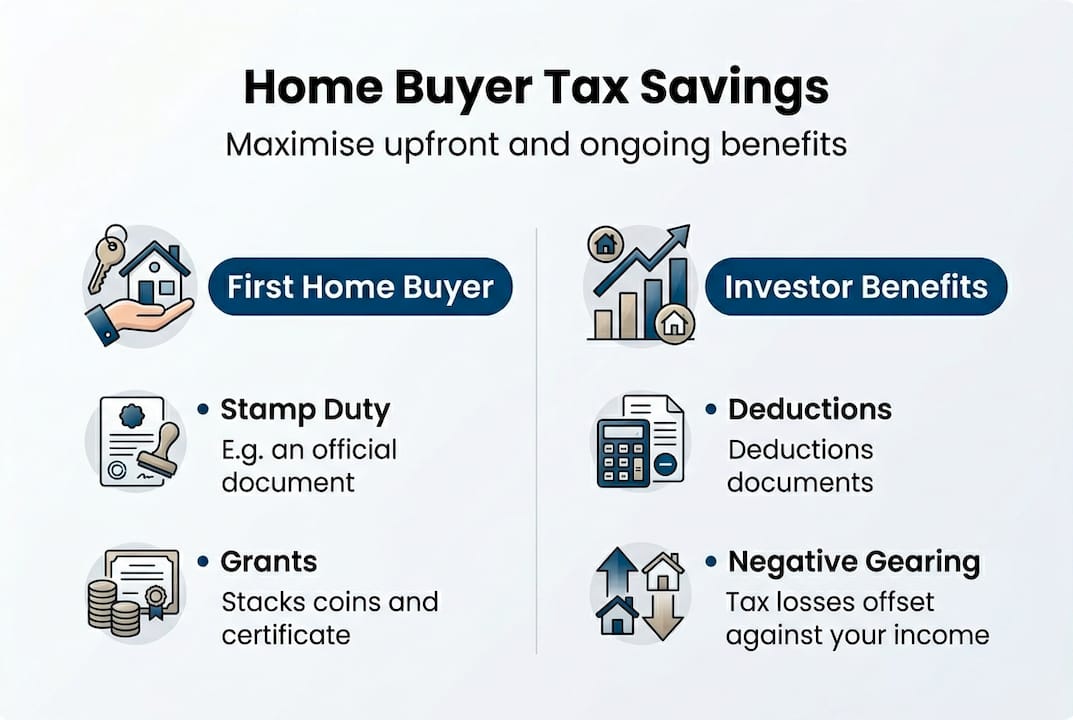
Understanding this distinction shapes your entire approach to asset acquisition. A first home buyer who tries to claim ongoing investment deductions on their owner-occupied property will face ATO scrutiny. Equally, an investor who overlooks depreciation schedules is leaving significant money on the table each year.
| Tax benefit | First home buyers | Property investors |
|---|---|---|
| Stamp duty concession/exemption | Yes, upfront | Generally not applicable |
| Government grants (e.g., FHOG) | Yes | No |
| FHSSS deposit savings | Yes | No |
| Negative gearing | No | Yes |
| Depreciation deductions | No | Yes |
| Loan interest deductibility | No (principal residence) | Yes (investment property) |
Common misconceptions to clear up:
- Owner-occupiers cannot claim mortgage interest as a tax deduction
- Renovating your home before selling does not automatically create a tax deduction
- Stamp duty paid on your principal residence is not deductible
- The 50% capital gains tax (CGT) discount applies to investors, not owner-occupiers selling within 12 months
- Grants and concessions are not automatic; you must apply and meet eligibility criteria
Combined upfront savings from grants and stamp duty relief can reach up to $60,000 for eligible first home buyers, making it essential to understand property buying essentials before you sign anything. The FHSSS government fact sheet is also a reliable starting point for understanding what’s currently on offer.
Unlocking government grants and concessions
Once you know the big picture, zero in on the upfront government support you can access. State and territory governments each administer their own first home buyer programmes, which means your location directly determines how much you can save.
Stamp duty concessions for first home buyers vary significantly by state, and thresholds shift regularly. Staying current is not optional; it’s financial discipline.
| State/Territory | Grant amount | Stamp duty concession threshold |
|---|---|---|
| NSW | Up to $10,000 | Full exemption up to $800,000 |
| VIC | Up to $10,000 (regional $20,000) | Concession up to $750,000 |
| QLD | Up to $30,000 | Concession up to $700,000 |
| WA | Up to $10,000 | Concession up to $600,000 |
| SA | Up to $15,000 | Stamp duty abolished for eligible buyers |
| TAS | Up to $10,000 | 50% concession available |
| ACT | No grant | Stamp duty abolished for eligible buyers |
Here’s how to approach the process methodically:
- Confirm your eligibility. Check that you have never owned residential property in Australia, are an Australian citizen or permanent resident, and intend to live in the property.
- Identify your state’s current thresholds. Property values above the threshold may still attract partial concessions rather than full exemptions.
- Calculate your potential savings. Use your state revenue office’s online calculator to model stamp duty with and without the concession.
- Lodge your application at settlement. Most grants and concessions are applied through your conveyancer or solicitor at the time of purchase.
- Review live-in requirements. Most states require you to occupy the property as your principal place of residence for a minimum of six to twelve months.
First home buyer grants and grant eligibility and duty changes are updated regularly, so it pays to verify current rules. Buyers in Victoria should review stamp duty concessions specifically, while those in South Australia benefit from stamp duty abolished for eligible purchases. If your deposit is limited, the 5 per cent deposit scheme has already helped over 285,000 buyers enter the market.
As myGov confirms, first-time buyers should prioritise grants and stamp duty savings upfront, which can total up to $60,000 combined, before layering in the FHSSS.
Pro Tip: Apply as early as possible in the purchasing process. Grant thresholds and eligibility rules can change with each state budget, and locking in your application early protects you from mid-process policy shifts.
Using the First Home Super Saver Scheme (FHSSS) for deposit tax savings
Alongside grants, the FHSSS offers a unique way to speed up your deposit tax-effectively. Rather than saving in a standard bank account where interest is taxed at your marginal rate, you contribute to your superannuation fund and benefit from the concessional 15% tax rate on those contributions.

Under the current rules, eligible buyers can withdraw up to $50,000 in voluntary super contributions plus associated earnings for use as a home deposit, with significant tax advantages compared to conventional savings.
Here’s how to use it step by step:
- Make voluntary concessional contributions to your super fund above the compulsory employer amount, up to the annual concessional cap.
- Track your FHSSS eligible contributions separately; not all super contributions count.
- Apply to the ATO for a determination before signing a contract, to confirm how much you can release.
- Request a release once your determination is approved; funds are typically paid within 15 business days.
- Use the released funds for your deposit within 12 months of the release date, or apply for a 12-month extension.
- Meet the occupancy requirement by moving into the property within 12 months of settlement and living there for at least six months.
Important: You must not have previously owned property in Australia to be eligible for the FHSSS. This includes investment properties, not just homes you’ve lived in. Check your eligibility carefully before contributing.
You can check your FHSSS eligibility explained and review the myGov eligibility checklist to confirm your situation before contributing.
Pro Tip: Spread your voluntary contributions across two financial years rather than making a lump sum in one. This approach maximises the amount you can release and can further reduce your taxable income across multiple years.
Tax deductions and negative gearing for property investors
For buyers considering property investment, ongoing tax benefits can add up to major yearly savings. The Australian tax system rewards investors who hold income-producing properties with a broad range of deductible expenses, many of which are overlooked until an accountant points them out.
According to ATO guidance on rental expenses, investors can claim immediate deductions on loan interest (the largest single deduction, but only the investment portion), council rates, land tax, insurance premiums, property management fees (typically 7 to 12% of rent), repairs and maintenance, and advertising costs.
Key deductible expenses for investors:
- Loan interest on the investment portion of your mortgage
- Property management and letting fees
- Council rates, water rates, and land tax
- Landlord insurance and building insurance
- Repairs and maintenance (not improvements)
- Depreciation on plant and equipment
- Quantity surveyor fees for depreciation schedules
- Travel expenses (limited; check current ATO rules)
| Deduction type | Typical annual range | Tax saving (37% marginal rate) |
|---|---|---|
| Loan interest | $15,000 to $30,000 | $5,550 to $11,100 |
| Depreciation (non-cash) | $3,000 to $10,000 | $1,110 to $3,700 |
| Property management | $2,000 to $5,000 | $740 to $1,850 |
| Repairs and maintenance | $1,000 to $4,000 | $370 to $1,480 |
| Insurance and rates | $2,000 to $4,000 | $740 to $1,480 |
Negative gearing occurs when your total deductible expenses exceed your rental income. That net loss is offset against your other taxable income, reducing your overall tax bill. Investors who use depreciation schedules often generate $3,000 to $10,000 per year in non-cash deductions, and the benefit is amplified at higher marginal tax rates.
Explore property deduction strategies in detail and review our ATO deduction record-keeping guide to ensure your claims are watertight.
Pro Tip: Only claim the investment portion of interest on mixed-use loans. If you redrew funds for personal use, that portion is not deductible. Keep a clear paper trail from day one.
Advanced tax tips and common mistakes to avoid
Even with solid foundations, smart buyers and investors avoid common tax missteps that can cost them dearly. Many of these errors are not obvious until the ATO raises a query, by which point the financial and administrative cost is already significant.
Here are five mistakes that regularly catch out Australian property owners:
- Claiming interest on redrawn funds used personally. As ATO interest expense guidance makes clear, mixed-use loans require apportionment; redrawing for private purposes makes that portion non-deductible.
- Confusing repairs with improvements. Replacing a broken tap is a repair and immediately deductible. Installing a new kitchen is an improvement and must be capitalised and depreciated over time.
- Claiming depreciation on second-hand assets post-2017. Since May 2017, investors purchasing existing properties can no longer claim depreciation on previously used plant and equipment.
- Missing prepaid expense rules. Prepaid expenses such as insurance or interest paid in advance are deductible, but only within specific ATO limits for the period they relate to.
- Failing to maintain records. The ATO requires you to keep rental income and expense records for five years. Poor record-keeping is the single biggest reason valid claims are disallowed.
“The ATO actively reviews rental property claims. Mixed-use loan apportionment, depreciation on second-hand assets acquired after 9 May 2017, and incorrectly classified improvements are among the most common audit triggers.”
A proposed mortgage interest deductibility scheme for first home buyers has been discussed in policy circles but is not yet enacted as law for 2026. Do not factor it into your planning until it becomes legislation. For a thorough overview of all these rules, the full property investment guide covers each scenario in practical detail.
Our perspective: Tax strategies most home buyers miss
Most buyers we work with arrive focused entirely on grants and upfront savings. That’s understandable. A $10,000 grant feels immediate and tangible. But in our experience, the buyers who build genuine long-term wealth are the ones who treat tax planning as an ongoing discipline, not a one-time checklist item.
Here’s the counter-intuitive truth: your eligibility status and the concessions available to you can change from year to year. State governments adjust thresholds, new schemes are introduced, and your own financial circumstances evolve. Reviewing your position annually, not just at purchase, is one of the most underrated habits in property wealth-building.
For investors, the compounding effect of disciplined record-keeping and a well-maintained depreciation schedule often outweighs the initial grant savings over a five-year horizon. A $7,000 annual depreciation deduction at a 37% marginal rate saves $2,590 every single year. That’s $12,950 over five years from a non-cash deduction alone.
We encourage every client to revisit their first home buyer eligibility and investment structure at least once per financial year. The tax landscape rewards those who stay engaged, not those who set and forget.
Next steps: Achieve more with expert tax and property guidance
To get the most out of these strategies, take the next step with tailored support. At Elite Wealth Creators, we combine deep property market knowledge with financial strategy to help you build a plan that works beyond the purchase date. Whether you’re navigating your first grant application, structuring a rental portfolio for maximum deductibility, or exploring property investing insights to grow your wealth systematically, our team is ready to guide you.
Explore how to unlock wealth with property or discover the advantages of SMSF property strategies for long-term portfolio growth. Reach out today to start your personalised strategy session and make every dollar of your property purchase work harder for you.

Frequently asked questions
What tax benefits do first home buyers get in Australia?
First home buyers can access government grants, reduced or waived stamp duty, and the FHSSS to save for a deposit at a concessional tax rate. Stamp duty concessions and FHSSS benefits vary by state and are subject to property value thresholds.
How does negative gearing work for property investors?
Negative gearing allows investors to offset a rental property’s net loss against their other taxable income, reducing the total tax they owe for that financial year. Investors maximise this by combining it with depreciation schedules for the greatest annual benefit.
Is the mortgage interest on my home deductible?
Mortgage interest on your principal residence is not tax-deductible under current Australian law, but it is fully deductible when the property is used to generate rental income.
Can I claim deductions on repairs and improvements?
Repairs and maintenance are immediately deductible in the year they occur, but capital improvements must be depreciated over their effective life rather than claimed upfront.