

Buying your first home in Australia feels overwhelming when total upfront costs often exceed your deposit by over 30%. Government schemes in 2026 offer pathways with lower deposits, yet many buyers underestimate hidden expenses and lending restrictions that reshape borrowing capacity. This guide equips you with a clear budgeting framework covering all costs, government assistance, lending rules, and actionable savings strategies to confidently enter the property market.
Table of Contents
- Understanding All Costs Beyond The Deposit
- Leveraging Government Assistance And Grants In 2026
- Key Lending Rules And Their Impact On Borrowing Capacity
- Creating A Practical Budget: Saving And Borrowing Strategies
- Common Budgeting Pitfalls And How To Avoid Them
- Expected Outcomes And Timeline Benchmarks For Budget Planning Success
- How Elite Wealth Creators Can Help You Plan Your Property Budget
- Frequently Asked Questions
Key takeaways
| Point | Details |
|---|---|
| Total upfront costs | Upfront expenses often exceed the deposit by up to 30%, including stamp duty, LMI, legal fees, and inspections. |
| Government assistance | Schemes like Help to Buy reduce deposit needs but increase monthly repayments due to shared equity arrangements. |
| Lending restrictions | APRA limits debt-to-income ratios above 6 times income to under 20% of new loans in 2026, affecting borrowing capacity. |
| Automated saving | Automating transfers into high-interest accounts builds deposits consistently and improves purchase readiness. |
| Common pitfalls | Underestimating ongoing costs and ignoring lending changes leads to budget shortfalls and loan approval challenges. |
Understanding all costs beyond the deposit
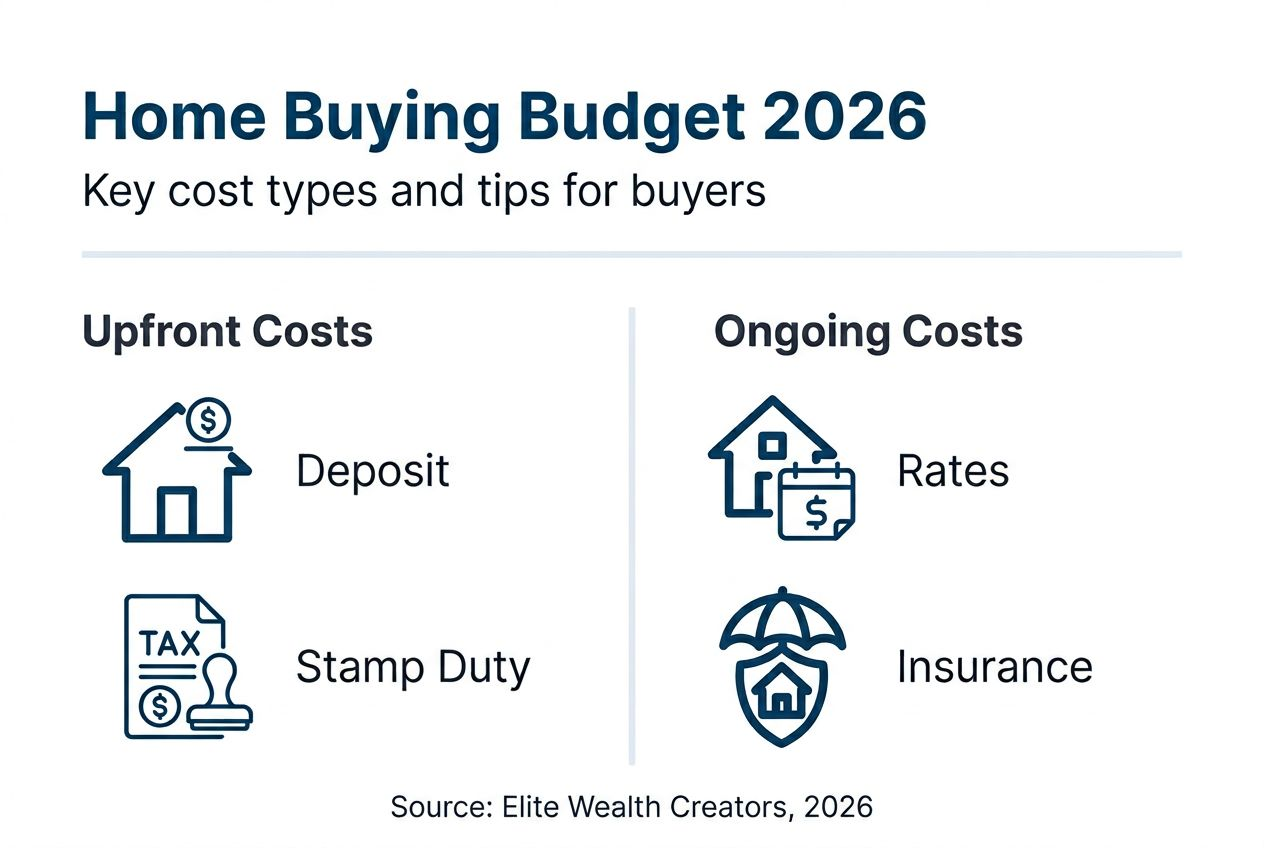
Many first home buyers focus solely on saving the deposit, yet the full cost picture extends far beyond that initial lump sum. Stamp duty remains the largest upfront cost beyond the deposit, varying widely by Australian state, with first home buyer concessions significantly reducing this cost in 2026. In New South Wales, for example, concessions can eliminate stamp duty entirely for properties under certain price thresholds, while Victoria and Queensland offer similar relief.
Lenders Mortgage Insurance (LMI) applies when your deposit sits below 20% of the property value. Typical LMI costs for a $600,000 property vary significantly depending on deposit size, ranging between $8,000 to $35,000 in 2026. This single expense can derail budgets if not anticipated early.
Additional upfront costs include:
- Legal and conveyancing fees: $1,200 to $2,500 depending on property complexity
- Building and pest inspections: $400 to $800 for thorough assessments
- Loan application and establishment fees: $300 to $1,000 depending on lender
- Removalist and relocation costs: $500 to $2,000 based on distance and volume
Ongoing ownership costs demand monthly budget allocation. Council rates, water and sewerage charges, strata fees for units, building insurance, and utilities add substantial recurring expenses. Energy costs can be managed with strategic upgrades like home solar panels that reduce bills by up to 70%.
Pro Tip: Use state-specific stamp duty calculators and add a buffer of 5% to 7% above the purchase price to cover hidden costs. This buffer prevents last minute scrambling for additional funds and keeps your property buying journey on track.
| Cost Category | Typical Range | When Due |
|---|---|---|
| Stamp duty (NSW, concession applied) | $0 to $25,000 | Settlement |
| Lenders Mortgage Insurance | $8,000 to $35,000 | Loan approval |
| Legal/conveyancing | $1,200 to $2,500 | Settlement |
| Inspections | $400 to $800 | Pre-purchase |
| Ongoing monthly costs | $400 to $800 | Monthly |
Understanding these expenses early allows you to target the right popular Australian home choices within your true budget capacity.
Leveraging government assistance and grants in 2026
Government schemes in 2026 offer substantial support for first home buyers, yet each comes with specific trade-offs that affect your long-term financial picture. The Help to Buy scheme provides up to 40% government equity contribution, dramatically reducing the deposit you need upfront. However, shared equity schemes reduce upfront deposits but increase monthly repayments, a trade-off that buyers must understand for effective cash flow management.
The First Home Guarantee allows eligible buyers to enter the market with just a 5% deposit, avoiding LMI entirely through a government guarantee. The Family Home Guarantee targets single parents with dependants, offering similar benefits with tailored eligibility criteria. Both schemes have strict income and property price caps that vary by location.
Increased property price caps in government schemes such as Sydney’s first home buyer cap rising from $950,000 to $1.3 million in 2026 provide greater access to housing markets amid record price levels. Melbourne’s cap increased from $800,000 to $1.1 million, while Brisbane’s rose from $700,000 to $950,000. These adjustments reflect the reality of Australian property markets and expand the range of homes within reach.
Key considerations when evaluating schemes:
- Eligibility: Income thresholds, residency requirements, and first home status verification
- Price caps: Maximum property values vary significantly by city and region
- Equity share: Government ownership percentage affects future sale proceeds and refinancing options
- Repayment structure: Monthly costs increase when government equity share is factored into total loan
| Scheme | Deposit Required | Government Contribution | Price Cap (Sydney) | Monthly Repayment Impact |
|---|---|---|---|---|
| Help to Buy | 2% to 5% | Up to 40% equity | $1,300,000 | Higher due to equity share |
| First Home Guarantee | 5% | LMI waiver | $1,300,000 | Standard mortgage terms |
| Family Home Guarantee | 2% | LMI waiver | $1,300,000 | Standard mortgage terms |
Understanding these schemes allows you to choose the right pathway based on your savings capacity and comfort with ongoing repayment obligations. First home buyer grants and assistance resources provide detailed comparisons to match your situation. Strategic use of these programmes accelerates market entry while maintaining financial stability when aligned with your budget reality. Consult first home buyers guidance to evaluate which scheme best suits your circumstances.
Key lending rules and their impact on borrowing capacity
Lending rules in 2026 directly shape how much you can borrow, regardless of how much you’ve saved. APRA introduced new lending rules limiting banks to less than 20% of new home loans to borrowers with debt-to-income ratios above six times, tightening borrower capacity across the board. This regulatory shift means a household earning $120,000 annually faces a maximum borrowing limit around $720,000 for most mainstream lenders.

Your debt-to-income ratio compares total annual debt repayments against gross annual income. Lenders calculate this by adding up all existing debts including credit cards, personal loans, car loans, and the proposed mortgage, then dividing by your yearly income. A ratio above 6 triggers stricter scrutiny or outright rejection.
Beyond the ratio cap, lenders assess:
- Income stability: Permanent employment favoured over casual or contract roles
- Savings history: Consistent deposit accumulation demonstrates financial discipline
- Credit score: Any defaults, late payments, or high credit utilisation reduces borrowing power
- Living expenses: Banks apply minimum living cost benchmarks regardless of your actual spending
These factors combine to determine your serviceability, the lender’s confidence in your ability to maintain repayments through interest rate changes and life events. Lending criteria directly impact cash flow management and property affordability.
Pro Tip: Consult a mortgage broker early in your planning process to model different scenarios based on your income, existing debts, and savings. Brokers access multiple lenders and identify which institutions offer the most favourable terms for your profile, preventing wasted applications and credit score damage.
Practical steps to optimise borrowing capacity:
- Pay down high-interest debts like credit cards before applying
- Close unused credit accounts to reduce potential debt calculations
- Avoid changing jobs within six months of loan application
- Maintain at least three months of savings beyond your deposit as a buffer
Understanding these lending boundaries early allows you to set realistic property price targets and adjust your savings strategy accordingly. Ignoring these rules leads to disappointing pre-approval outcomes and delays market entry.
Creating a practical budget: saving and borrowing strategies
Building a viable home buying budget requires clear targets, disciplined execution, and flexibility to adapt as conditions change. Start by defining your property price range based on the total upfront costs and borrowing capacity discussed earlier. This target drives your savings goal.
Automating savings into a dedicated account is a common and effective strategy to build a home deposit over time, favoured by many Australian first home buyers in 2026. Set up automatic transfers immediately after each pay cycle into a high-interest savings account with no monthly fees. This removes the temptation to spend and compounds growth through consistent contributions.
A step-by-step saving and loan preparation plan:
- Calculate your total upfront cost target including deposit, stamp duty, LMI if applicable, legal fees, and inspections
- Divide the target by your realistic monthly savings capacity to establish a timeline
- Open a dedicated savings account with competitive interest rates and zero fees
- Automate transfers on payday to prioritise savings before discretionary spending
- Track progress monthly and adjust contributions if income or expenses change
- Apply for home loan pre-approval once you reach 80% of your deposit target
Pre-approval provides concrete borrowing capacity figures and strengthens your negotiating position with sellers. It typically requires recent payslips, bank statements, tax returns, and identification documents. Most lenders issue pre-approval within two to three weeks.
Maximise savings through targeted spending adjustments:
- Reduce subscription services and memberships you rarely use
- Negotiate better rates on insurance, utilities, and phone plans
- Limit dining out and entertainment to budget-friendly options
- Consider side income opportunities to boost monthly contributions
Balancing savings with quality of life prevents burnout and maintains motivation. Small, consistent changes compound significantly over months. Achieving financial security involves sustainable habits rather than extreme deprivation.
Pro Tip: Review your budget quarterly and adjust savings targets if lending rules change, interest rates shift, or property prices move. Flexibility ensures your plan remains aligned with market reality and prevents frustration from outdated assumptions.
Combining automated saving with proactive loan preparation creates a powerful pathway to homeownership. Your discipline in execution directly determines how quickly you move from planning to purchasing.
Common budgeting pitfalls and how to avoid them
Even well-intentioned buyers fall into predictable traps that derail their property purchase plans. Recognising these mistakes early allows you to course-correct before they cause serious damage.
Many buyers underestimate ongoing and hidden costs, leading to financial stress after purchase. Focusing solely on the deposit blinds you to the reality of stamp duty, LMI, inspections, and legal fees that collectively add tens of thousands to your upfront requirement. Post-purchase, council rates, insurance, utilities, and maintenance create recurring expenses that strain unprepared budgets.
Ignoring changes in lending criteria creates over-borrowing risks. Assuming you can borrow based on outdated serviceability calculators or pre-2026 rules leads to rejected applications and wasted time. The debt-to-income ratio cap fundamentally changed borrowing capacity, yet many buyers plan using old assumptions.
Misunderstanding government grants as free money generates repayment surprises. Shared equity schemes like Help to Buy reduce upfront costs but increase monthly obligations. When you sell or refinance, you must repay the government’s equity share based on current property value, which can exceed the original contribution if prices rise.
Failing to automate savings or plan for contingencies stalls deposit growth. Relying on willpower alone to transfer funds into savings each month creates inconsistency. Without emergency buffers, unexpected expenses like car repairs or medical bills force you to raid your deposit fund, resetting progress.
Common mistakes to avoid:
- Underestimating total upfront costs by 20% or more
- Applying for loans without understanding current debt-to-income restrictions
- Treating government equity contributions as non-repayable grants
- Manually managing savings instead of automating the process
- Failing to maintain a separate emergency fund beyond the deposit
“Plan with a buffer of at least 3% to 7% of the property price for hidden costs and unexpected expenses. This margin prevents last minute financial scrambling and protects your purchase timeline.”
Regularly updating your budget based on actual spending patterns and market conditions keeps your plan grounded in reality. Review bank statements monthly to identify spending leaks and redirect funds to savings. When lending rules or grant eligibility change, adjust your borrowing and deposit targets immediately.
Avoiding these pitfalls requires active management rather than setting a plan once and forgetting it. Your vigilance directly impacts whether you successfully purchase or face repeated disappointments.
Expected outcomes and timeline benchmarks for budget planning success
Setting realistic expectations for your home buying timeline prevents frustration and helps you measure progress effectively. Saving for a deposit with automated budgeting typically spans 3 to 6 months for buyers with stable income and disciplined spending habits, though individual timelines vary based on target property price and current financial position.
Pre-approval processes usually take a few weeks once you’ve assembled complete documentation. Lenders require recent payslips, bank statements covering three to six months, tax returns, employment verification, and identification. Incomplete applications extend this timeline significantly, so prepare documents thoroughly before submitting.
Success metrics include:
- Reaching your deposit target within your planned timeline
- Maintaining debt-to-income ratios below 6 to maximise borrowing capacity
- Securing pre-approval with competitive interest rates and favourable terms
- Closing on a property within budget without requiring additional borrowing
Post-purchase, monthly cash flow changes substantially. Mortgage repayments, council rates, insurance, and utilities replace rent but often at higher total cost. Budget for this increase before purchasing to avoid financial stress in the first year of ownership.
| Milestone | Typical Timeframe | Key Actions |
|---|---|---|
| Savings initiation | Month 1 | Set target, open account, automate transfers |
| Deposit accumulation | Months 2 to 6 | Consistent saving, expense reduction, income optimisation |
| Pre-approval application | Month 5 to 6 | Gather documents, submit application, receive approval |
| Property search and offer | Months 6 to 8 | Inspect properties, negotiate, make offers |
| Settlement | Month 8 to 10 | Final inspections, loan drawdown, ownership transfer |
Benefits of disciplined planning extend beyond homeownership. Buyers who follow structured budgets and maintain financial buffers avoid refinancing stress, reduce loan default risk, and build equity faster. Upgrade investments like solar panels that cut bills by 70% and add 4.1% home value become achievable when your budget includes room for improvements.
Your timeline accelerates or extends based on market conditions, income changes, and unexpected expenses. Flexibility in your plan accommodates these variables while maintaining forward momentum. Celebrate milestones like reaching 50% of your deposit target or receiving pre-approval to maintain motivation through the months of saving and planning.
Realistic expectations grounded in your actual financial capacity prevent disappointment and keep you focused on achievable goals. Each benchmark you reach builds confidence and moves you closer to successful property ownership.
How Elite Wealth Creators can help you plan your property budget
Navigating the complexities of property budgeting, government schemes, and lending restrictions becomes significantly easier with experienced guidance. Elite Wealth Creators specialises in tailoring budget strategies to your unique financial situation, helping you maximise borrowing capacity while maintaining healthy cash flow.
Our team understands the nuances of 2026 lending rules, government assistance programmes, and hidden cost management. We connect you with off-market opportunities that align with your budget and long-term wealth goals. Whether you’re pursuing property investing insights for portfolio growth or seeking your first home, our advisors provide clarity and actionable steps.
Expert support transforms your budgeting efforts from guesswork into precision planning. We help you avoid common pitfalls, optimise savings strategies, and secure pre-approval with favourable terms. Our approach focuses on achieving financial security through sustainable property decisions aligned with your capacity.
For investors exploring diverse strategies, we offer guidance on SMSF investment property benefits that leverage tax advantages and build retirement wealth. Your property budget planning deserves the same strategic attention as your investment decisions, and our team delivers both.
Frequently asked questions
What costs should first home buyers expect beyond the deposit?
Beyond your deposit, expect stamp duty which varies by state but often represents the largest upfront cost, with concessions available for first home buyers. Lenders Mortgage Insurance applies if your deposit sits below 20%, potentially costing $8,000 to $35,000. Legal and conveyancing fees, building and pest inspections, and loan establishment fees add several thousand dollars more. Ongoing costs include council rates, utilities, insurance, and maintenance that require monthly budget allocation.
How do government grants affect my mortgage repayments?
Government shared equity schemes like Help to Buy reduce your required deposit but increase monthly repayments because the government holds an equity share in your property. While you pay less upfront, your ongoing mortgage costs rise compared to a traditional loan. When you sell or refinance, you must repay the government’s equity share based on current property value, which can exceed the original contribution if prices increase.
What is a debt-to-income ratio and why does it matter for my home loan?
Your debt-to-income ratio compares total annual debt repayments against gross annual income. APRA limits banks so that under 20% of new loans can exceed a ratio of 6 times income in 2026. This restriction directly caps your borrowing capacity regardless of deposit size. Maintaining a ratio below 6 significantly improves loan approval chances and demonstrates financial stability to lenders assessing your application.
How long does it take to save and get pre-approval for a home loan?
Saving for a deposit typically requires 3 to 6 months with disciplined automated budgeting, though timelines vary based on income, target property price, and current financial commitments. Once you’ve accumulated sufficient deposit, pre-approval generally takes two to three weeks after submitting complete documentation including payslips, bank statements, tax returns, and identification. Incomplete applications extend this process considerably, so prepare thoroughly before applying.
Recommended
- 7 Steps to a Smart First Home Buyer Checklist | Elite Wealth Creators
- Step by step property buying guide for Australian first-timers 2026 | Elite Wealth Creators
- Buying Property: Tips for First-Home Buyers & Investors | Elite Wealth Creators
- Stamp Duty Concessions for First Home Buyers | Elite Wealth Creators
- Building A Budget: A Guide to Sourcing Funds for Expansion