

Professional rental appraisals can boost your rental income by up to 10% compared to guessing rent, yet many Australian investors still rely on outdated methods or automated tools that often miss critical market nuances. Understanding how to leverage accurate rental appraisals transforms property management from guesswork into a strategic advantage, ensuring you capture every dollar of potential income while staying compliant with tenancy laws.
Table of Contents
- Understanding Rental Appraisal
- Key Factors Influencing Rental Appraisals In Australia
- Common Misconceptions About Rental Appraisals
- Comparing Rental Appraisal Methods
- Regulatory And Legal Considerations In Australian Rental Appraisals
- Practical Application Of Rental Appraisals For Investors
- Case Studies Demonstrating Rental Appraisal Impact
- Discover Expert Property Investment Solutions
- Frequently Asked Questions
Key takeaways
| Point | Details |
|---|---|
| Rental appraisals estimate achievable income | Professional assessments use market data and comparable properties to determine optimal rent pricing. |
| Location dominates rental value | Geographic factors account for approximately 60% of rental value variance across Australian markets. |
| Professional appraisals outperform automated tools | Expert assessments reduce income mispricing by 5-10%, while automated tools carry ±15% error margins. |
| Legal compliance shapes rent increases | State-specific tenancy laws dictate notice periods and maximum increase frequencies for rental adjustments. |
| Regular updates maximise returns | Annual appraisals or post-market shifts help investors avoid underpricing and optimise cash flow. |
Understanding rental appraisal
A rental appraisal estimates the achievable weekly or monthly rental income your property can command in the current market. Unlike property sale valuations that determine purchase price, rental appraisals focus exclusively on income potential by analysing recent comparable rentals, current tenant demand, and property-specific features.
The appraisal process involves several key components:
- Examining recently leased properties in your suburb with similar characteristics
- Adjusting for your property’s unique condition, features, and presentation
- Factoring in current market dynamics, including vacancy rates and seasonal trends
- Considering legal constraints that might cap rental increases
- Providing a rental range rather than a single fixed figure
Professional rental appraisals provide accurate, legally compliant rent suggestions aligned with market trends, giving you confidence to set competitive rates without leaving money on the table. This strategic tool helps you balance maximising income against maintaining tenant appeal and occupancy rates.
For investors building portfolios, understanding rental appraisal fundamentals prevents common pricing mistakes that can cost thousands annually. The right appraisal approach informs not just current rent setting but also renovation priorities and property selection strategies that target high-yield opportunities.
Key factors influencing rental appraisals in Australia
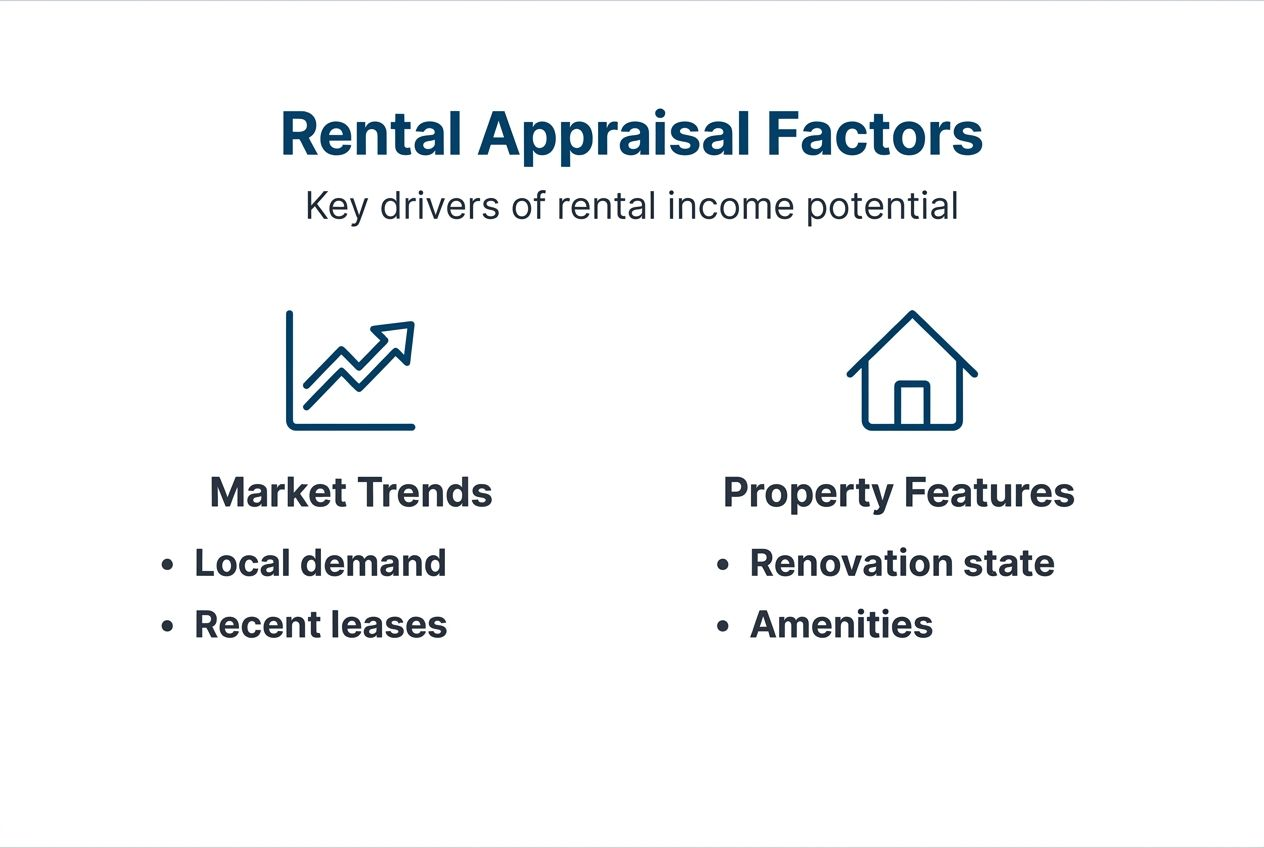
Location remains the dominant factor in determining rental values, accounting for roughly 60% of variance between properties. Properties in inner-city Melbourne or Sydney command premiums driven by employment hubs, transport access, and lifestyle amenities, while regional markets like those experiencing outback rental price surges reflect unique supply-demand dynamics.
Beyond location, several property-specific factors shape appraisal outcomes:
- Property condition and presentation: Well-maintained homes with modern kitchens, bathrooms, and fresh paint attract 10-15% rental premiums over dated equivalents.
- Features and inclusions: Air conditioning, secure parking, outdoor space, and pet-friendly policies increasingly influence tenant willingness to pay.
- Market timing and seasonality: Rental demand peaks during university intake periods and traditional moving seasons, creating windows for optimal rent increases.
- Local supply dynamics: New apartment developments can temporarily depress rental rates, while low vacancy areas support stronger pricing power.
- Tenant demographics: Family-oriented suburbs prioritise school zones and safety, while young professional areas value nightlife and transport.
Understanding these factors helps you interpret appraisal reports strategically rather than accepting figures at face value. An appraiser might suggest $650 weekly based on comparable properties, but if your home offers superior finishes or a rare garage, you might justify $680 with proper positioning.
Savvy investors use appraisal insights to identify improvement opportunities that deliver disproportionate rental returns. Adding split-system air conditioning for $4,000 might lift weekly rent by $20, generating 26% annual return on that specific investment before considering broader property appreciation.
For tailored guidance on maximising rental performance across different property types, explore our essential rental property tips designed specifically for Australian investors.
Common misconceptions about rental appraisals
Many investors treat rental appraisals as guaranteed income figures rather than market-based estimates. An appraisal suggesting $500 weekly means properties like yours typically achieve that rate, not that every tenant will pay it immediately. Market conditions, tenant negotiation skills, and property presentation all influence actual outcomes.
Other widespread misconceptions include:
- Automated tools match professional accuracy: Online rental estimators provide quick ballpark figures but lack the nuanced judgment that captures property condition, recent renovations, or hyperlocal market shifts.
- One appraisal lasts indefinitely: Rental markets shift quarterly in dynamic areas, and annual appraisals are minimum best practice to avoid leaving money unclaimed.
- Higher appraisals always mean higher rents: Pushing rent to the absolute maximum can increase vacancy periods and tenant turnover costs that eliminate the extra income.
- Appraisals ignore legal limits: Professional appraisers factor in rent control laws and required notice periods, but investors still must verify compliance independently.
- All appraisers deliver equal quality: Experience with your specific property type and suburb matters enormously in appraisal accuracy.
Pro Tip: Request appraisals from two agents to cross-reference figures and identify any outliers. If one suggests $450 weekly and another $520, investigate which comparable properties each used and whether they accurately reflect your property’s condition.
Misinterpreting appraisal results can trigger legal disputes if you increase rent beyond allowable limits or fail to provide proper notice. Conversely, accepting conservative appraisals without question might cost you 5-8% of potential income annually, compounding lost returns over your investment timeline.
The best approach treats appraisals as informed starting points for strategic rent-setting discussions, not final answers. Combine appraisal data with your understanding of tenant priorities, local demand patterns, and property differentiation to optimise pricing decisions.
Comparing rental appraisal methods
Investors can choose between professional property manager appraisals, automated online valuation tools, and self-assessment approaches. Each method carries distinct accuracy levels, costs, and suitability depending on investment complexity and risk tolerance.
| Method | Accuracy | Cost | Best For | Limitations |
|---|---|---|---|---|
| Professional appraisal | ±5% typically | Free from agents | Complex properties, portfolio investors | Requires scheduling, potential bias if seeking management |
| Automated online tools | ±15% error margin | Free to $50 | Quick estimates, simple properties | Misses condition factors, local nuances |
| Landlord self-assessment | ±20% or higher | Free | Experienced investors only | High risk of bias, lacks market data |
| Independent valuer report | ±3-5% | $200-400 | High-value properties, disputes | Expensive for routine checks |
Professional appraisals from experienced property managers reduce rental income mispricing by 5-10% compared to automated alternatives. They incorporate on-site property inspections, current condition assessment, and firsthand knowledge of tenant feedback on similar listings. This human judgment captures factors like street appeal, noise levels, and neighbourhood character that algorithms miss.
Automated online rental valuation tools process historical rental data and property characteristics through algorithms, delivering instant results. While convenient for preliminary research, their ±15% error margins can translate to $50-100 weekly mispricing on typical properties, costing thousands annually.
Pro Tip: Use automated tools for initial portfolio screening, then obtain professional appraisals for properties you’re actively marketing or considering purchasing. This two-stage approach balances efficiency with accuracy where it matters most.
For portfolio investors managing multiple properties, establishing relationships with skilled property managers who understand your investment strategy delivers compounding benefits. Their appraisals improve as they learn your properties and priorities, while their tenant networks can fill vacancies faster when you implement rent adjustments.
Regulatory and legal considerations in Australian rental appraisals
Australian tenancy laws significantly impact how investors can apply rental appraisal findings. Legal restrictions such as rent control laws or tenancy agreements in some states cap how much rent can increase following an appraisal, regardless of market support for higher rates.
Key regulatory factors affecting rental appraisal application include:
- State-specific notice periods: Victoria requires 60 days’ notice for rent increases, while Queensland mandates two months for periodic leases.
- Frequency limitations: Most states restrict rent increases to once every 12 months during ongoing tenancies, preventing opportunistic mid-lease adjustments.
- Fixed-term lease protections: Rent typically cannot increase during fixed-term agreements unless explicitly stated in the original lease.
- Dispute resolution processes: Tenants can challenge excessive increases through tribunals, requiring landlords to justify appraisal-based adjustments.
- COVID-19 legacy rules: Some temporary protections evolved into permanent tenant safeguards affecting increase timing and amounts.
Ignoring these legal frameworks can invalidate rent increases entirely, forcing refunds and damaging landlord-tenant relationships. Even with a professional appraisal supporting a $100 weekly increase, attempting it without proper notice or during prohibited periods creates legal liability.
Smart investors incorporate regulatory constraints into their appraisal strategy from the start. If your lease renews in three months and an appraisal suggests a significant increase is justified, planning the timing ensures you provide required notice without creating gaps in rental income.
For properties in highly regulated markets, the gap between theoretical market rent and legally achievable rent can be substantial. Factor this reality into acquisition decisions, recognising that advertised rental yields might overstate practical returns once compliance requirements apply.
Understanding the intersection between appraisal recommendations and legal limits separates sophisticated investors from those facing tribunal disputes and tenant turnover costs.
Practical application of rental appraisals for investors
Strategic investors treat rental appraisals as recurring portfolio management tools rather than one-off exercises. Implementing a systematic approach maximises the value extracted from each appraisal while minimising time investment.
Follow this proven sequence to optimise appraisal benefits:
- Schedule annual appraisals at least 90 days before lease renewal dates, allowing time to plan improvements or negotiate terms.
- Request detailed comparable data showing which specific properties informed the appraisal range and how yours differs.
- Cross-reference with market trends using vacancy rate data and median rent movements to validate appraisal reasonableness.
- Identify improvement opportunities where modest investments could shift your property into a higher rental bracket.
- Plan increase timing around tenant satisfaction peaks and market demand cycles to minimise vacancy risk.
- Document justification thoroughly for any increases, including appraisal reports and market evidence to support tribunal defence if needed.
Pro Tip: Commission appraisals immediately after completing renovations or property improvements, even if lease renewal is distant. The updated baseline helps you quantify improvement ROI and plan future enhancement priorities.
Combining appraisal insights with proactive tenant management strengthens outcomes. If an appraisal supports a $50 weekly increase but your tenant has been exemplary, consider implementing $30 now with clear communication about market rates. This balanced approach often retains quality tenants while still capturing meaningful income growth.
For investors building portfolios, integrate appraisal data into acquisition analysis. Properties with appraisal values significantly above asking rent indicate potential for immediate yield improvement, while those at market ceiling might signal limited growth runway. Our rental tips for Australian investors explore these strategic applications in greater depth.
Regular appraisal reviews also inform portfolio rebalancing decisions. Properties consistently appraising below portfolio average might warrant disposition to fund acquisitions in higher-growth markets, optimising overall returns.
Case studies demonstrating rental appraisal impact
Real-world examples illustrate the tangible financial benefits of professional rental appraisals versus alternative approaches. These case studies demonstrate both the income gains possible and the risks of inadequate appraisal processes.
| Property Type | Initial Rent | Appraisal Method | Recommended Rent | Outcome | Annual Impact |
|---|---|---|---|---|---|
| Melbourne 2BR apartment | $420/week | Automated tool | $450/week | Tenant left after increase | Lost $2,080 (vacancy costs) |
| Melbourne 2BR apartment | $420/week | Professional appraisal | $465/week | Gradual increase accepted | Gained $2,340 |
| Brisbane house | $550/week | Landlord guess | $550/week | No increase attempted | Lost $4,160 (market was $630) |
| Sydney townhouse | $680/week | Professional appraisal | $735/week | Implemented with improvements | Gained $2,860 |
| Adelaide unit | $320/week | Professional appraisal | $315/week | Reduced rent to retain tenant | Saved $3,120 (avoided vacancy) |
The Melbourne apartment comparison reveals how method choice impacts outcomes. The automated tool suggested a modest increase that proved achievable in theory but ignored the specific property’s tenant profile and competition. The professional appraisal recommended a slightly higher figure but included staging suggestions and timing advice that facilitated tenant acceptance.

More striking is the Brisbane house where the landlord’s conservative self-assessment cost $4,160 annually by missing significant market appreciation. Professional appraisal would have identified comparable properties achieving $630 weekly, supporting a justified increase that still left the property competitively priced.
The Sydney townhouse demonstrates strategic appraisal application. Rather than simply increasing rent, the investor used appraisal insights to identify which improvements would justify premium pricing. A $3,000 landscaping investment and fresh exterior paint supported the $55 weekly increase, delivering immediate 49% return on improvement costs.
Most interesting is the Adelaide unit where the appraisal actually recommended a slight decrease. The investor initially resisted, but the appraiser’s market analysis showed oversupply in that building’s segment. Implementing the modest reduction retained an excellent tenant, avoiding the $3,120 typical cost of vacancy, advertising, and potential rent-free periods.
These examples validate the importance of professional appraisals not just for maximising income but for making informed strategic decisions that balance yield optimisation with tenancy stability. Investors exploring specialised opportunities like NDIS housing investments particularly benefit from expert appraisal guidance given unique pricing dynamics in that sector.
Discover expert property investment solutions
Applying rental appraisal insights effectively requires more than data; it demands strategic thinking about portfolio positioning, market timing, and property selection. Elite Wealth Creators specialises in helping Australian investors translate market knowledge into tangible wealth outcomes through tailored investment strategies.
Our property investing insights connect rental appraisal principles with acquisition strategies, helping you identify properties with hidden income potential before competitors recognise the opportunity. We don’t just analyse current yields; we engineer future returns through precision property selection and strategic enhancement planning.
For investors leveraging self-managed super funds, our expertise in SMSF investment property benefits ensures you maximise rental returns while navigating complex compliance requirements. Understanding how rental appraisals interact with SMSF regulations prevents costly mistakes and optimises tax-effective wealth accumulation.
Whether you’re building your first investment property or expanding an established portfolio, our team provides the strategic edge you need. We transform rental appraisal data into actionable intelligence that drives measurable results. Discover how to unlock wealth with property by partnering with experts who engineer financial freedom, not just property transactions.
Frequently asked questions
What is a rental appraisal?
A rental appraisal is a professional assessment estimating the weekly or monthly rental income your property can achieve in current market conditions. It analyses comparable recently leased properties, your property’s condition and features, local demand patterns, and relevant legal constraints to provide an informed rental range.
How often should I update my rental appraisal?
Update rental appraisals at least annually, or whenever significant market shifts occur, such as new infrastructure announcements, interest rate changes, or major supply increases in your area. Also commission fresh appraisals after completing renovations or property improvements to capture their income impact accurately.
What’s the difference between rental appraisal and property valuation?
Rental appraisals estimate achievable rental income and focus on tenant demand and comparable rental data, while property valuations determine sale price based on comparable sales, replacement cost, and investment return calculations. Rental appraisals inform ongoing management decisions, whereas valuations support purchase, sale, or refinancing activities.
Can I increase rent by the full appraisal amount immediately?
Not always. State tenancy laws dictate minimum notice periods, typically 60 days, and restrict increase frequency to once per 12 months. Additionally, increases must be reasonable and justified by market conditions, not just appraisal figures. Tribunals can overturn excessive increases even with supporting appraisals.
Should I use free online rental estimators or pay for professional appraisals?
Online estimators work for preliminary research but carry ±15% error margins that can cost thousands annually in mispricing. Professional appraisals from experienced property managers provide ±5% accuracy and include condition assessment, legal compliance guidance, and strategic timing advice worth far more than their zero cost when obtained from agents.