

TL;DR:
- LVR indicates what percentage of a property’s value a lender will finance, affecting borrowing terms.
- Lower LVRs often lead to better interest rates, no LMI, and increased loan flexibility.
- Property value fluctuations and market conditions can change your LVR and financial risk over time.
Understanding loan to value ratio for smarter property investing
Few pieces of lending jargon cause more confusion for Australians entering the property market than loan to value ratio, commonly known as LVR. You might have heard it mentioned by a broker or seen it buried in a loan product disclosure, but without a clear explanation, it can feel like just another obstacle between you and your property goals. In reality, LVR is one of the most powerful numbers in your financial toolkit. It shapes how much you can borrow, what rates you’ll be offered, and whether you’ll face additional costs like lenders mortgage insurance. This article breaks it all down so you can move forward with confidence.
Table of Contents
- What is loan to value ratio and why does it matter?
- How lenders calculate loan to value ratio: A closer look
- Factors that influence your LVR
- Why LVR matters for first home buyers and investors
- A fresh look: What most guides miss about LVR
- Get expert help with your property finance strategy
- Frequently asked questions
Key Takeaways
| Point | Details |
|---|---|
| LVR defined simply | LVR is the ratio of your loan to your property’s value, expressed as a percentage. |
| Why LVR matters | A lower LVR can mean better loan terms and more flexibility for buyers and investors. |
| How to improve LVR | Increasing your deposit or using grants helps lower your LVR and reduce costs. |
| Investor strategies | Investors use LVR to balance risk and growth but must consider changing market conditions. |
What is loan to value ratio and why does it matter?
At its most fundamental level, loan to value ratio (LVR) tells you what percentage of a property’s value your lender is willing to finance. If you’re borrowing $400,000 to purchase a $500,000 home, your LVR is 80%. The remaining 20% is your deposit, which represents your equity in the property from day one. Loan to value ratio (LVR) is a core concept in Australian lending, directly affecting how much you can borrow and under what terms.
The basic formula is straightforward:
LVR = Loan Amount ÷ Property Value × 100%
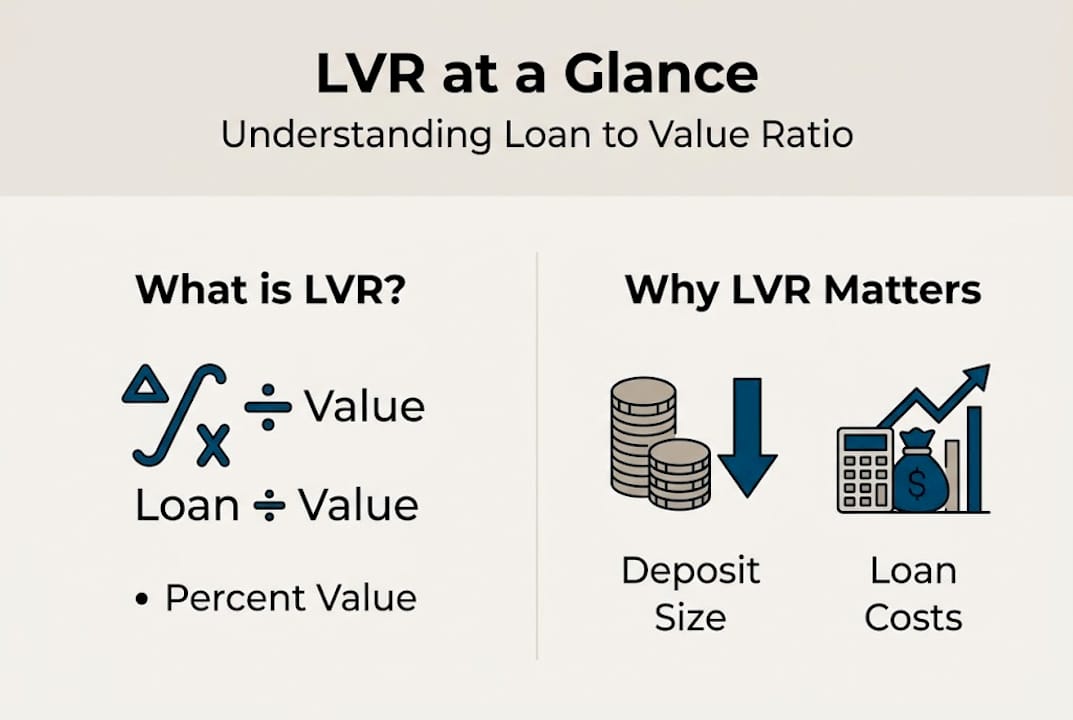
For example: $400,000 ÷ $500,000 × 100% = 80% LVR.
This single number carries significant weight. Lenders use it to gauge risk. The higher your LVR, the less of your own money is at stake, and the more the lender stands to lose if you default and the property needs to be sold. That’s why a higher LVR often translates to stricter loan conditions, higher interest rates, or the requirement to pay lenders mortgage insurance (LMI).
Here’s why LVR matters so much for your property journey:
- Borrowing power: Lenders set maximum LVRs depending on property type, location, and borrower profile. Knowing your LVR helps you understand your ceiling.
- Interest rates: Most Australian lenders reserve their most competitive rates for loans at or below 80% LVR. Borrowing above that threshold can mean paying a premium.
- Lenders mortgage insurance: If your deposit is less than 20% of the property’s value, most lenders will require you to pay LMI, which can add thousands to your upfront costs.
- Loan features: Access to offset accounts, redraw facilities, and flexible repayment terms is often tied to your LVR tier.
- Approval likelihood: A lower LVR signals lower risk to the lender, improving your chances of a successful application.
“A lower LVR is not just about avoiding fees. It’s a signal of financial strength that lenders reward with better products and rates.”
Pro Tip: If your deposit is less than 20%, you’ll likely need to pay LMI. While this allows you to enter the market sooner, it adds a cost that can range from a few thousand dollars to well over $20,000 depending on the loan size. Understanding home loan basics before you apply puts you in a far stronger negotiating position.
With the basics in mind, it’s time to see how LVR is calculated and applied in real-world scenarios.
How lenders calculate loan to value ratio: A closer look
Now that you understand how LVR is defined, it’s crucial to know exactly how the calculation is performed and what affects your numbers. The process isn’t simply about what you pay for a property. Lenders apply their own rigorous assessment before they accept any figure.
Here is how lenders typically work through the LVR calculation:
- Determine the loan amount. This is the amount you’re asking to borrow, which equals the purchase price minus your deposit. Additional costs like stamp duty and legal fees are not included in the property’s purchase price for LVR purposes but must still be funded.
- Conduct a property valuation. Lenders commission an independent valuation, not simply relying on the purchase price. If the valuation comes in lower than what you agreed to pay, the lender uses the lower figure. This can catch buyers off guard and raise your effective LVR.
- Apply the formula. LVR is calculated by dividing the loan amount by the appraised value of the property and multiplying by 100. The result is your LVR percentage.
- Assess against policy limits. The lender then compares your LVR to their internal policy limits, which vary by loan type, property type, and risk appetite.
Worked example: You purchase a property for $600,000 and contribute a $120,000 deposit. Your loan amount is $480,000. The lender’s valuation confirms $600,000. LVR = $480,000 ÷ $600,000 × 100% = 80% LVR. At exactly 80%, you avoid LMI and access the best standard rates.

The following table illustrates how different deposit sizes affect LVR across a range of property values:
| Property value | Deposit | Loan amount | LVR |
|---|---|---|---|
| $500,000 | $50,000 (10%) | $450,000 | 90% |
| $500,000 | $100,000 (20%) | $400,000 | 80% |
| $750,000 | $112,500 (15%) | $637,500 | 85% |
| $750,000 | $150,000 (20%) | $600,000 | 80% |
| $1,000,000 | $200,000 (20%) | $800,000 | 80% |
| $1,000,000 | $300,000 (30%) | $700,000 | 70% |
As you can see, a 20% deposit consistently achieves the 80% LVR benchmark across different price points. But the size of the loan and the absolute dollar value of LMI both scale significantly with the property price.
Pro Tip: Accurate property valuations and a larger deposit can dramatically improve your LVR and your negotiating position with banks. If your valuation comes in lower than expected, you may be able to dispute it or source a second opinion through a different lender. Understanding mortgage approval steps in detail before you apply can help you avoid costly surprises during the settlement process. Working through the numbers with a broker before committing to a purchase price is one of the smartest moves you can make, especially when borrowing near the top of your budget.
Factors that influence your LVR
Having covered how to work out your LVR, it’s important to recognise what can actually shift the outcome in your favour. LVR is not a fixed result of a simple formula. Multiple variables can push it up or bring it down, and understanding each one gives you more control over your borrowing position.
Lender criteria and borrower circumstances can impact LVR limits and eligibility in ways that aren’t always obvious from the outset. Here are the key factors you need to be aware of:
- Property type: Lenders treat different property types with varying levels of caution. Standard residential homes in capital cities generally attract the highest LVR limits, sometimes up to 95%. Regional properties, off-the-plan apartments, rural land, or high-density units in oversupplied suburbs often attract lower maximum LVRs, commonly capped at 70% to 80%. Investing in a property type that limits your LVR can significantly change how much you need to contribute upfront.
- Deposit source and composition: Lenders distinguish between genuine savings, gifted funds, and government grants. While all of these can contribute to your deposit, some lenders require a portion to be genuine savings held over a minimum period, typically three to six months. Using the First Home Owner Grant or other government incentives can bolster your deposit and reduce your LVR, but this varies by lender policy.
- Property market conditions: In a rising market, lenders may tighten LVR limits in certain postcodes or property categories to manage portfolio risk. Conversely, in a stable market, you may find more flexibility. Lender policies can shift without notice, which is why staying informed and working with a specialist matters.
- Your credit profile: A strong credit score, stable employment history, and low existing debt can influence how a lender views your application. Some lenders offer higher LVR loans only to borrowers who meet elevated credit benchmarks.
- Overall debt position: Your total debt-to-income ratio, existing mortgages, and other financial commitments all factor into how lenders assess your overall risk profile alongside LVR.
Pro Tip: Not all lenders assess LVR risks the same way. Shopping around can help you find a lender with more flexible criteria, especially if you’re investing in a non-standard property type or working with a smaller deposit. A skilled broker who understands how lending criteria affect LVR can match you with the right lender for your specific circumstances.
Considering loan structuring strategies early in your planning process can also help you allocate your capital most effectively, particularly when building a multi-property portfolio.
Why LVR matters for first home buyers and investors
Understanding what influences your LVR gives you the chance to use it as a financial lever, whether you’re buying your first home or growing a portfolio. The impact of LVR is not the same for every buyer, and recognising the difference between your situation and an investor’s situation is critical to making the right decisions.
“The right LVR can save you tens of thousands over the life of your loan.”
Consider these two borrowers and how their LVR positions affect their overall costs and options:
| Borrower A | Borrower B | |
|---|---|---|
| Property value | $650,000 | $650,000 |
| Deposit | $65,000 (10%) | $130,000 (20%) |
| LVR | 90% | 80% |
| LMI required | Yes (~$12,000 to $18,000) | No |
| Interest rate (example) | 6.45% | 6.10% |
| Estimated monthly repayment | Higher by approx. $110 to $150 | Lower |
| Access to full loan features | Limited | Full access |
Borrower A enters the market sooner but carries a meaningfully higher cost burden over time. Borrower B takes longer to save but immediately benefits from lower rates, no LMI, and greater product flexibility. Neither approach is universally right. The choice depends entirely on market timing, personal cash flow, and long-term strategy.
Lower LVRs usually result in access to better interest rates and greater borrowing flexibility, which is why most first home buyers are advised to aim for that 80% threshold wherever possible.
For first home buyers, the priority is often minimising long-term costs and preserving financial stability. A lower LVR means:
- Reduced risk of negative equity if property values soften
- No LMI expenditure
- Better loan products from day one
- Lower monthly repayments, freeing up cash flow for life expenses
For property investors, the calculus is different. A higher LVR can be a deliberate strategy to preserve capital and deploy it across multiple assets. For example, instead of putting 30% into one property, an experienced investor might use 20% deposits across two properties, effectively doubling their exposure and potential growth. However, this approach amplifies risk and requires careful cash flow modelling.
Tips for investors considering higher LVR strategies:
- Stress-test your cash flow against rate rises of 2% to 3% above current levels
- Ensure rental income can absorb periods of vacancy
- Understand how buy-to-let investor tips apply to your holding structure
- Plan your equity release strategy before purchasing, especially if you’re financing multiple properties
LVR is not simply a number on a form. It is the foundation of your financial exposure in the property market.
A fresh look: What most guides miss about LVR
Most guides frame LVR as a target to hit. Get to 80%, avoid LMI, and you’re done. That’s useful advice as far as it goes, but it misses the bigger picture, and we believe that gap matters.
LVR is a point-in-time calculation, not a permanent state. Property values rise and fall. Interest rates change. Your income can shift. What feels like a safe 80% LVR today could become a precarious 90% LVR if the market corrects by 10%. That’s not a reason to avoid property, but it is a reason to think beyond the number itself.
The question isn’t just “What is my LVR?” It’s “What happens to my position if conditions change?” At Elite Wealth Creators, we consistently see buyers and investors focus intensely on hitting an LVR threshold to unlock a rate tier, without modelling the scenarios that could shift that position after settlement. A small buffer above the minimum required deposit provides far more financial resilience than most people appreciate.
For investors specifically, chasing the highest permissible LVR to maximise leverage can look compelling in a rising market. When growth stalls or reverses, the same leverage that amplified gains now amplifies losses. Knowing how to structure property loans for returns in a way that balances growth potential with genuine risk management is the real skill. Review your LVR position at least annually, and certainly after any significant property market movement.
Get expert help with your property finance strategy
Once you know what truly matters with LVR, you may want a helping hand to put those insights into action. At Elite Wealth Creators, we work alongside first home buyers and seasoned investors to build finance strategies that are grounded in real numbers, not guesswork. Whether you’re assessing your current position or planning your next acquisition, our team brings the expertise and tools to get you there with precision.
Explore our property investing insights to sharpen your strategy, or dive deeper into equity investment strategies to understand how to leverage your existing assets. If you’re focused on reducing your debt burden faster, our mortgage reduction resources can help you find the most effective path forward. Your vision is clear. Let our expertise make it a reality.

Frequently asked questions
Is a higher or lower LVR better for home buyers?
A lower LVR is generally better for home buyers, as lower LVRs result in better rates and greater borrowing flexibility, reducing your overall cost of ownership from day one.
How much deposit do I need to avoid lenders mortgage insurance?
You typically need a 20% deposit to avoid lenders mortgage insurance, since most Australian lenders set their best rates and standard conditions at or below 80% LVR.
Does LVR affect property investors differently than home buyers?
Yes, investors may strategically use a higher LVR to leverage growth across multiple assets, but lender criteria and borrower circumstances create unique conditions and risks that differ significantly from owner-occupier arrangements.
Can using government grants like the First Home Owner Grant change my LVR?
Yes, grants effectively increase your total deposit amount, thereby lowering your LVR and potentially reducing your loan costs, though the impact depends on the grant amount and the lender’s assessment of lending criteria and borrower circumstances.
What happens if property values fall after I buy?
If values fall, your LVR rises automatically because the denominator in the formula decreases, meaning LVR is recalculated against the appraised value and you may find yourself with reduced equity and fewer refinancing options.
Recommended
- Unlock Equity for Investment Gains | Elite Wealth Creators
- How to finance multiple properties for long-term wealth | Elite Wealth Creators
- Top Australian Mortgage Options in 2023 for Smart Borrowing | Elite Wealth Creators
- Get Max Returns: Master Tax-Smart Property Loan Structuring. | Elite Wealth Creators