
Buying property in Australia can feel overwhelming when you’re navigating it for the first time. Many buyers face unexpected delays, hidden costs, and financing hurdles that derail their plans. This guide provides a clear, step by step roadmap tailored for Australian buyers in 2026, helping you avoid common pitfalls and secure your property with confidence while building the foundation for long-term financial freedom.
Table of Contents
- Prerequisites: Financial Preparation For Property Buying
- Step 1: Understanding Your Property Goals And Budget
- Step 2: Financial Pre-Approval And Loan Preparation
- Step 3: Property Search, Negotiation And Selection
- Step 4: Due Diligence, Building And Pest Inspections
- Step 5: Contract Exchange And Settlement Process
- Step 6: Using Instant Liquidity To Fuel Growth
- Step 7: Optimising Cash Flow With Deferred Interest Payments
- Common Mistakes And Pitfalls To Avoid In Property Buying
- Expected Outcomes And Success Metrics For First-Time Buyers And Investors
- How Elite Wealth Creators Can Help You Succeed In Property Buying
- Frequently Asked Questions
Key takeaways
| Point | Details |
|---|---|
| Financial preparation is essential | Secure loan pre-approval, budget for stamp duty and fees, and maintain a strong credit score before searching. |
| Due diligence protects your investment | Building and pest inspections uncover defects that can save thousands in repairs or renegotiation. |
| Avoid common mistakes | Skipping pre-approval or underestimating upfront costs by 5-7% leads to delays and missed opportunities. |
| Strategic liquidity accelerates growth | Unlocking equity from existing properties provides cash to fuel your next investment move. |
| Clear goals streamline decisions | Define home versus investment objectives early to align property search with your wealth strategy. |
Prerequisites: financial preparation for property buying
Before you start browsing listings or attending open homes, you need a solid financial foundation. Your deposit size directly impacts whether you’ll pay Lenders Mortgage Insurance (LMI). A 20% deposit typically avoids LMI, while smaller deposits between 5-10% trigger this additional cost, adding thousands to your loan.
Stamp duty varies significantly across Australian states, ranging from 3-7% of the property price. New South Wales and Victoria tend to have higher rates, while first-time buyer concessions can reduce your burden. Factor in legal fees, typically $1,500 to $3,000, plus property inspection costs around $400 to $600.
Your credit score and stable income history are crucial for loan approval. Lenders scrutinise your financial behaviour, so clean up debts and avoid major purchases in the months before applying. Obtaining loan pre-approval before you search gives you a clear borrowing capacity and strengthens your negotiating position with sellers.
Beyond the deposit, budget for additional upfront costs including building insurance, connection fees for utilities, and potential strata levies for apartments. These extras often add 5-7% to your initial outlay. Explore property finance options that suit your circumstances, whether you’re buying your first home or building an investment portfolio.
Pro Tip: Create a detailed spreadsheet tracking every anticipated cost, including hidden fees like council rate adjustments and mortgage registration charges, to avoid cash flow shocks at settlement.
Step 1: understanding your property goals and budget
Defining your property goals upfront saves time and prevents costly mistakes. Are you buying a home to live in, or building an investment portfolio for long-term wealth? Each path requires different financial structures and tax considerations. Investment properties generate rental income and capital growth, while owner-occupied homes offer stability and potential first-home buyer grants.
Calculate your realistic borrowing capacity by considering your income, existing debts, and living expenses. Lenders typically allow borrowing up to 6 times your annual income, but your cash flow must comfortably service repayments. Online calculators provide estimates, but pre-approval gives you certainty.
For investors, using SMSFs can be an alternative financing method for appropriate investors. Self-managed superannuation funds let you purchase property using retirement savings, offering tax advantages and wealth accumulation benefits. However, strict compliance rules apply, so professional guidance is essential.
Location choice significantly impacts your long-term returns. Research suburbs with strong employment growth, infrastructure development, and rental demand. Coastal areas may offer lifestyle appeal, while outer metro zones often provide better cash flow through higher rental yields.
Set realistic timelines for each decision phase:
- Financial preparation and pre-approval: 2-4 weeks
- Property search and inspection: 4-8 weeks
- Negotiation and contract exchange: 1-2 weeks
- Settlement period: 4-6 weeks
Rushing decisions under pressure leads to overpaying or choosing unsuitable properties. Give yourself breathing room to evaluate options thoroughly and compare at least 10-15 properties before committing.
Pro Tip: Create a scoring matrix rating each property against your must-have criteria (location, size, condition, growth potential) to make objective comparisons and avoid emotional decisions.
Step 2: financial pre-approval and loan preparation
Securing loan pre-approval transforms you from a casual browser into a serious buyer. Lenders assess your financial position and provide a conditional approval indicating how much they’ll lend you. This process typically takes 3-7 business days and remains valid for 90 days, though some lenders extend to 120 days.
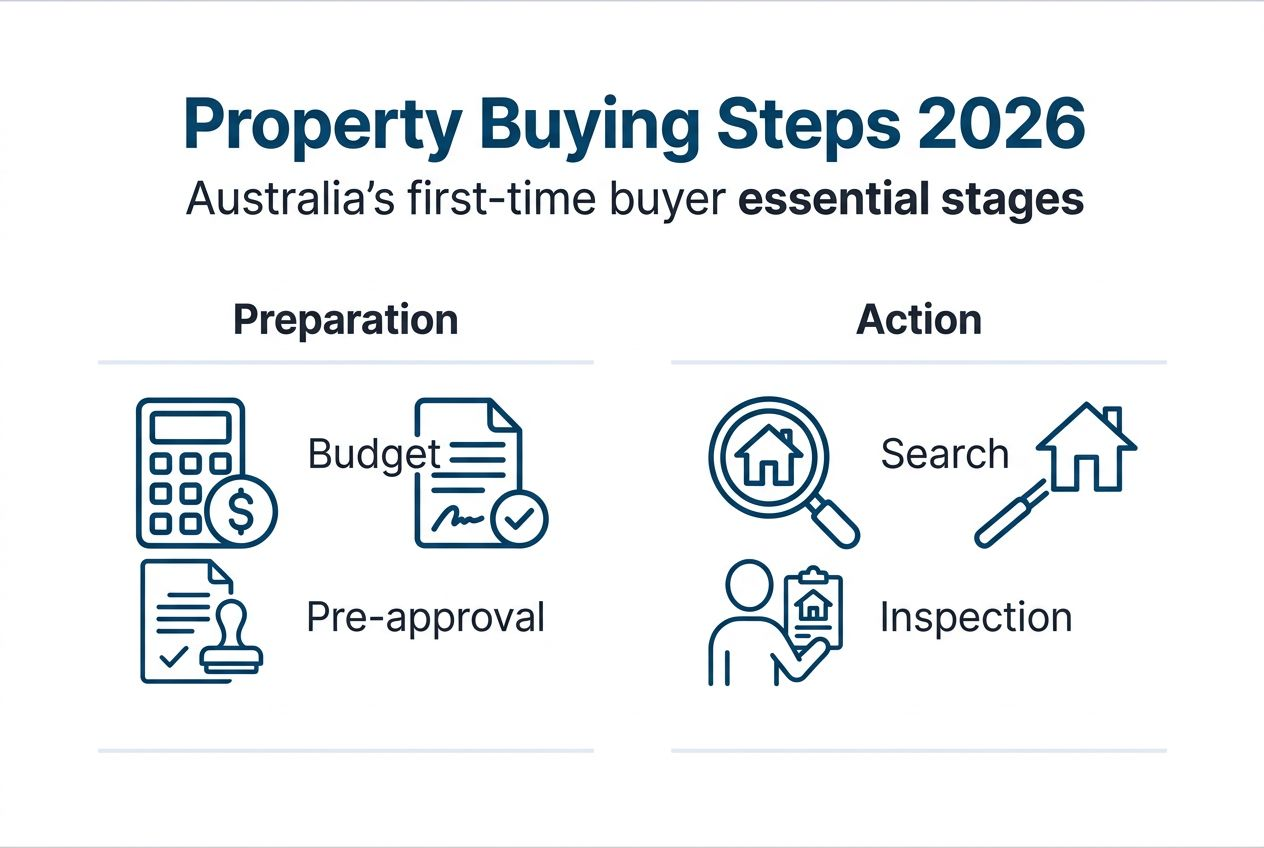
Pre-approval delivers concrete benefits beyond knowing your budget. Sellers and agents take you seriously when you can demonstrate finance readiness, giving you leverage in negotiations. Properties move quickly in competitive markets, and pre-approval lets you make offers immediately without financing contingencies.
Gather your documentation before approaching lenders. You’ll need proof of income (payslips or tax returns for the past two years), bank statements showing savings history, identification documents, and details of existing debts or liabilities. Self-employed buyers face additional scrutiny and should prepare comprehensive financial statements.
Skipping pre-approval creates serious risks. Imagine finding your ideal property, making an offer that’s accepted, then discovering your loan application is rejected. You lose your deposit and face potential legal action from the vendor. Pre-approval eliminates this nightmare scenario.
Research shows buyers with pre-approval complete purchases 40% faster than those applying after making offers. This speed advantage matters when multiple bidders compete for the same property. Consider exploring SMSF loans and superannuation options if you’re building wealth through retirement savings.
Pro Tip: Get pre-approval from multiple lenders to compare interest rates and loan features, potentially saving thousands over your loan term through better terms and flexibility.
Step 3: property search, negotiation and selection
Your property search strategy determines how quickly you find the right opportunity. Start with online listings on major platforms like realestate.com.au and Domain, filtering by your budget, preferred locations, and property type. Set up alerts to receive new listings immediately, as desirable properties often sell within days.
Auctions create time pressure and competitive bidding, potentially driving prices above market value. Private treaty sales allow more negotiation flexibility and time for due diligence. Off-market opportunities bypass public listings entirely, connecting buyers directly with sellers through agents or property networks.
Research indicates off-market deals can secure 5-10% price discounts compared to traditional listings. These properties avoid the marketing costs and competitive frenzy of public campaigns, creating potential savings. However, you need strong networks and proactive searching to access these hidden opportunities.
Average search timelines vary by market conditions. In hot markets, buyers might inspect 20-30 properties over 8-12 weeks before finding the right fit. Cooler markets offer more choice and longer inspection periods. Don’t rush this phase; patience prevents costly compromises.
Conduct thorough property inspections focusing on:
- Structural integrity including cracks, dampness, and foundation issues
- Roof condition and age of major systems (plumbing, electrical, heating)
- Natural light, ventilation, and room flow
- Neighbourhood amenities, transport links, and noise levels
- Future development plans that might impact value or views
Negotiation tactics require realism and research. Analyse recent comparable sales in the area to establish fair market value. Making lowball offers wastes time and offends vendors. Aim for 2-5% below asking price with solid justification based on property condition or market data. Some sellers price properties high expecting negotiation, while others set firm prices reflecting true value.
| Property Type | Negotiation Potential | Typical Discount |
|---|---|---|
| Off-market | High | 5-10% |
| Private treaty | Moderate | 2-5% |
| Auction | Low | 0-2% |
| Distressed sale | Very high | 10-15% |
Align every property choice with your long-term property investment success strategies, ensuring each purchase moves you closer to financial freedom rather than creating cash flow strain.
Step 4: due diligence, building and pest inspections
Professional inspections protect you from expensive surprises after purchase. Building inspectors examine structural integrity, identifying defects like foundation cracks, roof damage, asbestos, or water ingress. Pest inspectors search for termites, borers, and other infestations that can cause tens of thousands in damage.

Engaging accredited inspectors costs $400-600 but potentially saves you from $20,000+ in hidden repairs. The Australian Institute of Building Consultants maintains directories of qualified professionals. Never rely on your own visual assessment or agent reassurances; structural issues hide behind walls and under floors.
Common defects discovered during inspections include:
- Termite damage in timber frames requiring extensive repairs
- Roof leaks causing ceiling damage and mould growth
- Electrical wiring not meeting current safety standards
- Plumbing issues including corroded pipes and drainage problems
- Structural cracks indicating foundation movement
Timing matters for inspections. Include building and pest inspection clauses in your contract, giving you 7-14 days to complete checks before the agreement becomes unconditional. If inspections reveal significant defects, you have three options: withdraw from the purchase without penalty, renegotiate the price downward to account for repair costs, or request the vendor complete repairs before settlement.
Major defects justify price reductions of 5-15% depending on repair scope and urgency. Get written quotes from licensed tradespeople for repair work, then present these to the vendor with your revised offer. Most sellers prefer price adjustments over managing repairs themselves.
Don’t underestimate the value of SMSF property inspection insights when purchasing through superannuation, as compliance requirements add another layer of due diligence beyond standard property checks.
Step 5: contract exchange and settlement process
Conveyancers and solicitors handle the legal complexities of property transfer, protecting your interests throughout the transaction. These professionals review contracts, conduct title searches, calculate adjustments, and ensure all legal requirements are met. Expect to pay $1,200-2,500 for conveyancing services depending on property value and complexity.
The contract exchange timeline unfolds in clear phases:
- Vendor prepares Contract of Sale including title details and property disclosure
- Your conveyancer reviews contract and raises queries about title, easements, or restrictions
- You sign contract and pay deposit (typically 10% of purchase price)
- Cooling-off period begins (2-5 business days in most states, except at auction)
- Contract becomes unconditional after cooling-off expires and conditions are satisfied
Settlement occurs 4-6 weeks after contract exchange, though this varies by agreement. During this period, your lender finalises loan documentation and arranges property valuation. Your conveyancer coordinates with the vendor’s representative to confirm settlement date and prepare financial statements.
Stamp duty payment is due at settlement, calculated as a percentage of property value varying by state. First-home buyers often receive concessions or exemptions up to certain price thresholds. Council rates, water rates, and strata fees are adjusted proportionally based on the settlement date, ensuring you only pay for your ownership period.
Common legal pitfalls include:
- Not reading contract terms carefully, missing unfavourable clauses
- Failing to obtain building insurance before settlement
- Missing settlement deadlines, incurring penalty interest charges
- Not understanding special conditions or easements affecting property use
- Inadequate title searches revealing unresolved legal issues
On settlement day, final funds transfer from your lender to the vendor, and title registration occurs. You receive keys and become the legal owner. Your conveyancer provides a settlement statement detailing all transactions and confirms registration completion.
Understanding the property settlement process thoroughly prevents last-minute surprises and ensures smooth ownership transfer aligned with your investment timeline.
Step 6: using instant liquidity to fuel growth
Instant liquidity unlocks trapped equity in existing properties, providing cash to fund your next investment without selling assets. This strategy works by refinancing or establishing lines of credit against property value, typically releasing 60-80% of equity. For a property worth $500,000 with a $300,000 loan, you could access $80,000-100,000 in available equity.
This released capital accelerates portfolio growth by funding deposits on additional properties. Instead of waiting years to save another deposit, you leverage existing assets to multiply your holdings faster. Each new property generates rental income and capital growth, compounding your wealth creation.
Optimal timing for equity release occurs when:
- Property values have increased significantly since purchase
- Your loan-to-value ratio has improved through principal repayments
- Interest rates are favourable for refinancing
- You’ve identified a strong investment opportunity requiring quick funding
- Your income can service additional borrowing comfortably
Cash flow benefits extend beyond deposit funding. Instant liquidity provides buffer funds for renovations that increase property value, covers unexpected maintenance costs, or bridges gaps between property purchases. This financial flexibility prevents selling assets prematurely or missing time-sensitive opportunities.
Diversification strengthens your portfolio by spreading risk across multiple properties and locations. Rather than concentrating wealth in one asset, instant liquidity enables geographic and property-type diversification. Investment-grade properties in different markets protect you from localised downturns.
Elite Wealth Creators integrates instant liquidity solutions with comprehensive smart property finance options, providing tailored strategies that match your risk tolerance and growth objectives.
Step 7: optimising cash flow with deferred interest payments
Deferred interest payment options preserve cash flow during critical investment phases, particularly during property construction or initial holding periods. The Homepay Advantage and similar products allow you to defer interest charges for up to 12 months, keeping capital available for other investments or living expenses.
This strategy works by capitalising interest charges, adding them to your loan balance rather than requiring monthly payments. During the deferral period, your money remains available for other uses. Once the deferral expires, you resume standard principal and interest repayments based on the adjusted loan balance.
Cash flow advantages during construction are substantial. Building a property requires progress payments over 6-12 months before rental income begins. Deferred interest eliminates the double burden of paying rent or existing mortgage while servicing construction loan interest. This breathing room prevents financial strain and maintains lifestyle quality.
For investment properties, deferral periods bridge the gap between purchase and tenant occupancy. Marketing, minor improvements, and tenant placement take 4-8 weeks. Deferred interest covers this transition without draining reserves.
Eligibility criteria typically require:
- Strong credit history and stable income
- Sufficient equity or deposit (usually 20-30%)
- Clear investment strategy demonstrating viability
- Properties meeting lender investment criteria
Risk considerations include higher total interest costs due to capitalisation and potential payment shock when deferrals end. Structure your finances to handle full payments comfortably before the deferral expires. Calculate total interest costs across the full loan term to ensure the strategy remains profitable.
Real case example: An investor building a $600,000 property defers $24,000 in interest over 12 months. This capital funds marketing campaigns for their existing business, generating $45,000 additional revenue. The deferral costs $1,800 in additional interest through capitalisation, delivering net benefit of $19,200.
Explore how deferred interest payment benefits integrate with your overall wealth strategy, particularly when combined with SMSF structures and equity release strategies.
Common mistakes and pitfalls to avoid in property buying
Skipping loan pre-approval ranks as the costliest mistake first-time buyers make. Without pre-approval, you waste time inspecting properties beyond your budget or miss opportunities when you can’t move quickly. Worse, making offers contingent on finance approval gives sellers reason to reject your bid in favour of pre-approved buyers.
Underestimating additional upfront costs catches buyers off guard repeatedly. Beyond your deposit, stamp duty, legal fees, inspections, insurance, and adjustments typically add 5-7% to the purchase price. A $500,000 property requires $525,000-535,000 total upfront, not just the $50,000 deposit you saved.
Neglecting building and pest inspections creates expensive regrets. Structural defects, termite damage, or major system failures discovered after purchase become your financial burden. The $500 inspection fee seems insignificant compared to $30,000 in foundation repairs you could have negotiated or avoided entirely.
Overestimating negotiation chances leads to disappointment and lost properties. First-time buyers often expect 10-15% discounts based on unrealistic advice or anecdotal stories. In competitive markets, properties sell at or above asking price. Realistic expectations of 2-5% savings prevent missing out while chasing impossible deals.
Failing to engage legal review before signing contracts exposes you to unfavourable terms and hidden obligations. Contracts include clauses about easements, building restrictions, or vendor terms that significantly impact property use and value. Your conveyancer identifies these issues before you commit, not after.
Additional pitfalls include:
- Buying based on emotion rather than investment fundamentals
- Ignoring location research and future development plans
- Overcommitting financially without buffer for rate rises or vacancies
- Neglecting insurance until after settlement
- Missing settlement deadlines and incurring penalty charges
Learn from common property buying mistakes others have made, applying these lessons to strengthen your own purchasing process and avoid painful financial consequences.
Expected outcomes and success metrics for first-time buyers and investors
Measurable success metrics help you evaluate whether your property purchase achieves intended objectives. Typical settlement timelines of 6-12 weeks from contract exchange demonstrate efficient processing and minimal delays. Longer timeframes often indicate financing problems or legal complications.
Your deposit plus upfront costs should stay within planned budgets without causing cash flow strain or emergency borrowing. Successfully managing this initial phase within 5-7% of purchase price shows strong financial preparation and realistic planning.
Securing pre-approval before making any offers proves financial readiness and market seriousness. This metric should show 100% compliance, as bidding without pre-approval creates unnecessary risk.
Negotiation savings of 2-5% below initial asking price demonstrate effective bargaining balanced with market realism. Higher percentages may indicate distressed sales or overpriced listings, while zero savings suggest very competitive markets or premium properties.
| Success Metric | Target Range | Measurement Period |
|---|---|---|
| Settlement timeline | 6-12 weeks | Contract to keys |
| Upfront cost accuracy | Within 5-7% of budget | Pre-purchase to settlement |
| Pre-approval completion | Before first offer | Pre-search phase |
| Negotiation saving | 2-5% | Asking price to contract |
| Cash flow positivity | Within 6 months | Post-settlement |
| Property value growth | 4-6% annually | First 3-5 years |
Post-purchase cash flow positivity within 6 months indicates sustainable investment structure. Rental income should cover mortgage repayments, rates, insurance, and maintenance, ideally generating small positive return. Owner-occupiers should comfortably service mortgages without financial stress.
Long-term capital growth of 4-6% annually over the first 3-5 years validates location and property selection. Regional variations affect this metric, but consistent growth demonstrates sound investment fundamentals.
Track these property success benchmarks regularly, adjusting strategies when metrics fall outside target ranges to maintain progress toward financial freedom goals.
How Elite Wealth Creators can help you succeed in property buying
Navigating property purchase alone means missing opportunities and making preventable mistakes. Elite Wealth Creators delivers tailored investment strategies that transform your property goals into actionable wealth-building plans. Our expertise covers every stage, from initial financial preparation through settlement and portfolio growth.
We specialise in SMSF financing structures and instant liquidity solutions that accelerate your investment timeline. Unlocking up to $100,000 from existing properties provides the capital you need for your next strategic move. Our Homepay Advantage keeps your cash flow optimised through deferred interest payments during crucial growth phases.
Our precision sourcing connects you with off-market opportunities unavailable through standard channels, potentially saving 5-10% on property prices. These exclusive listings give you competitive advantage in tight markets where quality properties sell before public advertising.
Expert guidance prevents the costly pitfalls first-time buyers and investors commonly face. We help you structure purchases that align with long-term financial freedom rather than creating short-term cash flow strain. Explore comprehensive property investing insights and discover how SMSF investment property benefits can amplify your wealth accumulation.
Partner with us to engineer your path toward unlocking financial freedom through strategic property investment backed by proven systems and personalised support.
Frequently asked questions
What is the minimum deposit required for buying property in Australia?
Minimum deposits typically range between 5-20%, influenced by loan type and lender requirements. A 20% deposit helps you avoid Lenders Mortgage Insurance (LMI), which can add thousands to your loan costs. First-home buyer schemes sometimes accept deposits as low as 5%, though smaller deposits mean higher LMI premiums and potentially less favourable loan terms.
Why is loan pre-approval important before searching for properties?
Pre-approval confirms your borrowing capacity, strengthens negotiations, and speeds purchase timelines significantly. Skipping this step risks loan denial after your offer is accepted, causing you to lose the property and potentially forfeit your deposit. Sellers and agents take pre-approved buyers more seriously, giving you competitive advantage in hot markets where properties receive multiple offers.
What additional costs should I budget for when buying a property in Australia?
Stamp duty varies by state and represents a significant cost, typically ranging from 3-7% of the property price. Legal fees, building and pest inspections, insurance, loan establishment fees, and settlement adjustments typically add another 5-7% to your total upfront investment. For a $500,000 property, budget an additional $25,000-35,000 beyond your deposit to cover all purchasing costs comfortably.
How can Elite Wealth Creators support first-time property buyers and investors?
We offer tailored property finance and investment strategies including specialised SMSF solutions that leverage your superannuation for wealth building. Our instant liquidity service unlocks up to $100,000 from existing properties, while the Homepay Advantage optimises cash flow through deferred interest payments. Access our property investing insights and expert guidance that helps you avoid costly mistakes while accelerating your journey toward financial freedom.