

Navigating mortgage approval in Australia can feel like a maze. First home buyers and investors often face delays, rejections, or missed opportunities due to incomplete preparation or misunderstanding lender requirements. This guide breaks down the exact steps to secure mortgage approval efficiently in 2026, helping you boost your borrowing power and fast track your property goals with confidence.
Table of Contents
- Preparation Prerequisites: What You Need Before Applying
- Step-by-Step Mortgage Approval Process
- Common Mistakes and How to Avoid Them
- Timeline and Expected Outcomes
- Special Considerations for Investors and Foreign Buyers
- Explore Expert Property Investment Solutions
- Frequently Asked Questions
Key Takeaways
| Point | Details |
|---|---|
| Preparation is critical | Check credit score, reduce debts, and gather all required documentation before applying. |
| Follow sequential steps | Work through broker consultation, pre-approval, property search, formal application, and settlement systematically. |
| Avoid common mistakes | Budget for extra costs, complete inspections, and seek professional advice to prevent delays. |
| Timelines vary | Preparation to settlement typically takes 12-24 months but can be shortened with digital tools and brokers. |
| Investors face stricter rules | Higher deposit requirements and additional documentation apply to property investors and foreign buyers. |
Preparation Prerequisites: What You Need Before Applying
Before you submit a single form, you need to get your financial house in order. Lenders assess your capacity to repay, so preparation directly impacts your approval odds and borrowing limit.
Start by verifying your Australian ID and residency status. Lenders require proof of identity and legal right to borrow. Next, focus on your deposit. You’ll need at least 5% for some first home buyer schemes, but reaching 20% avoids Lenders Mortgage Insurance, which can add thousands to your upfront costs. A larger deposit also signals financial discipline and reduces lender risk.
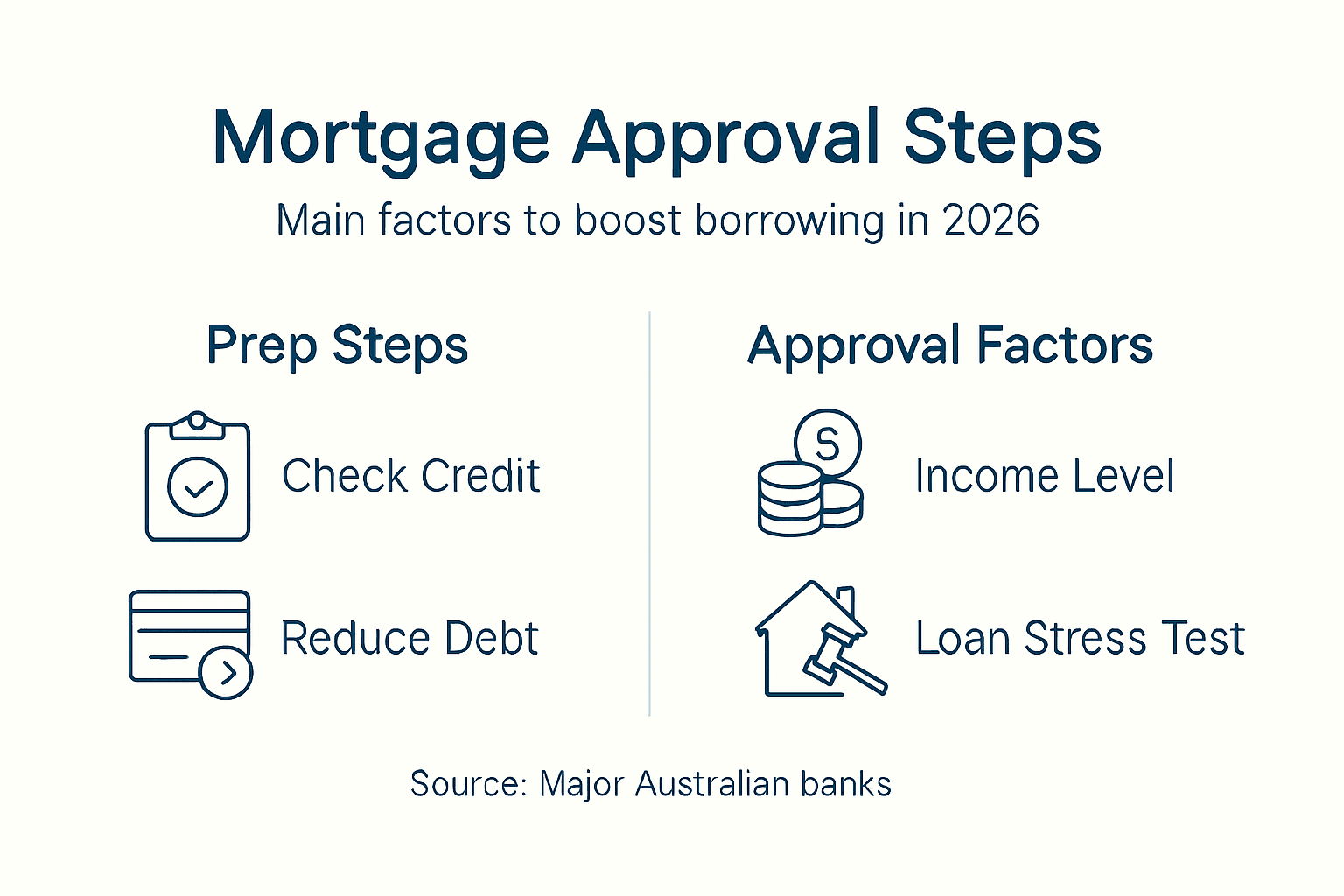
Your credit score plays a huge role. Check it through free services and address any errors or defaults immediately. Lenders use your score to gauge reliability. If it’s below 600, consider delaying your application until you improve it. Pay bills on time, avoid multiple credit applications, and keep credit card balances low.
Debt reduction is equally vital. Clearing $10,000 in personal debts can increase borrowing capacity by approximately $100,000 because lenders view you as less risky. Focus on high interest debts first, like credit cards and personal loans. Even small reductions improve your debt to income ratio, which directly affects how much you can borrow.

Documentation requirements are strict. Lenders require payslips from the last 4-6 weeks, last 2 years’ tax returns, bank statements, and asset/debt records to assess your application reliably. Gather these early to avoid delays. Self employed borrowers need extra documents like ABN registration, profit and loss statements, and accountant letters.
Consult a mortgage broker or financial planner before applying. They assess your situation, identify suitable loan products, and flag issues early. Brokers often access lender panels with better rates and policies than you’d find alone. Early consultation saves time and increases your approval chances.
Pro Tip: Create a digital folder with all your financial documents organized by category. This speeds up applications and shows lenders you’re organized and serious.
Key preparation steps include:
- Verify Australian ID and residency status
- Save at least 20% deposit to avoid LMI
- Check and improve your credit score above 600
- Reduce high interest personal debts aggressively
- Gather payslips, tax returns, bank statements, and asset/debt records
- Consult a mortgage broker early for tailored advice
Step-by-Step Mortgage Approval Process
Once your preparation is solid, follow these sequential steps to navigate mortgage approval efficiently. Each stage builds on the previous one, so skipping ahead creates delays.
-
Meet a mortgage broker or lender. Schedule a consultation to assess your borrowing power and identify suitable loan options. Brokers compare dozens of lenders and products, finding deals you wouldn’t access alone. They also strategize to strengthen weak spots in your application. This first meeting sets your budget and timeline.
-
Collect and submit financial documents. Provide all required paperwork to your broker or lender. Incomplete submissions delay assessment and frustrate underwriters. Double check that payslips, tax returns, bank statements, and debt records are current and accurate. Digital verification tools in 2026 speed this process, but you still need originals ready.
-
Obtain conditional pre-approval. Pre-approval provides conditional approval validating your borrowing limit so you can search properties confidently. It typically lasts 3 to 6 months and strengthens your negotiating position with sellers. Pre-approval isn’t a guarantee, but it signals serious intent and financial readiness. Most brokers can secure pre-approval within 1 month if your documents are complete.
-
Search for properties within your approved budget. Use your pre-approval limit to narrow your search. Conduct building and pest inspections on any property you’re serious about. Attend auctions or submit offers knowing exactly what you can afford. Pre-approval gives you an edge in competitive markets because sellers know you’re finance ready.
-
Submit formal loan application. Once you’ve accepted an offer, submit a full application. The lender conducts underwriting, verifying all your documents and assessing the property’s value. They may request additional information or clarification. Respond quickly to avoid delays. This stage typically takes 2 to 4 weeks.
-
Receive unconditional approval and settle. After underwriting and valuation checks, you receive unconditional approval. Complete final paperwork, transfer the deposit, and attend settlement. Your conveyancer or solicitor handles most legal tasks. Settlement usually occurs 30 to 90 days after approval, depending on contract terms.
Pro Tip: Stay responsive during underwriting. Lenders often request extra documents or explanations. Delayed responses push back your settlement date and risk losing the property.
Common Mistakes and How to Avoid Them
Even well prepared buyers make mistakes that delay or derail mortgage approval. Recognizing these pitfalls helps you avoid costly setbacks.
Not budgeting for additional costs. Stamp duty, legal fees, and inspection costs add 3% to 5% to your purchase price. First home buyers often underestimate these, leaving them short at settlement. Budget conservatively and keep a cash buffer for unexpected expenses. Use online calculators to estimate stamp duty in your state.
Neglecting building and pest inspections. Skipping inspections creates risks of costly repairs and settlement delays. A $500 inspection can uncover $20,000 in hidden problems. Always inspect before committing to a property, even if it looks perfect. Inspections also provide negotiating leverage if issues arise.
Making emotional decisions without financial due diligence. Falling in love with a property before checking affordability leads to over borrowing or financial stress. Stick to your pre-approved budget. Run the numbers on repayments, rates, and holding costs before committing. Emotion clouds judgment, so involve your broker or advisor in the decision.
Failing to reduce high interest debts before applying. Credit card balances and personal loans lower your borrowing capacity significantly. Lenders assess your ability to service all debts, not just the mortgage. Pay down high interest debts aggressively before applying to maximize your borrowing limit.
Avoiding professional advice from brokers or conveyancers. Going solo limits your access to the best deals and guidance. Brokers save time, negotiate better rates, and handle paperwork. Conveyancers manage legal complexities and protect your interests. The small upfront cost pays for itself in better outcomes and fewer mistakes.
Pro Tip: Before making an offer, calculate the true cost of ownership including rates, insurance, maintenance, and interest. This prevents post purchase regret and financial strain.
Key mistakes to avoid:
- Underestimating additional costs like stamp duty and legal fees
- Skipping building and pest inspections
- Making emotional property decisions without financial checks
- Carrying high interest debts that reduce borrowing capacity
- Not using professional brokers or conveyancers
Timeline and Expected Outcomes
Understanding realistic timelines and outcomes helps you plan effectively and avoid frustration. Mortgage approval isn’t instant, but preparation speeds the process.
Preparation to settlement generally spans 12 to 24 months, depending on your starting point and market conditions. First time buyers with no deposit or poor credit take longer. Those with savings, good credit, and broker support can compress this to under 12 months. Digital income verification and Open Banking reduce processing time by up to 30% in 2026, making approvals faster than ever.
Borrowing capacity typically ranges from 5 to 6 times your annual income, adjusted for expenses and debts. Lenders stress test your application with a 3% interest rate buffer to ensure you can handle rate rises. This means if you earn $80,000 annually, you might borrow $400,000 to $480,000, depending on your financial commitments.
Pre-approval usually takes under 1 month if your documents are complete. Full approval after property acceptance takes 2 to 3 months, including underwriting, valuation, and final checks. Settlement follows 30 to 90 days later, depending on contract terms.
Success rates improve dramatically with preparation and professional help. Borrowers using brokers experience fewer rejections and faster approvals because brokers match applicants to suitable lenders. DIY applicants face higher rejection rates due to mismatched lender policies or incomplete applications.
| Stage | Typical Timeframe | Key Actions |
|---|---|---|
| Preparation | 3 to 6 months | Save deposit, improve credit, gather documents |
| Pre-approval | Under 1 month | Submit documents, receive conditional approval |
| Property search | 2 to 6 months | Inspect properties, make offers |
| Full approval | 2 to 3 months | Underwriting, valuation, final checks |
| Settlement | 30 to 90 days | Legal paperwork, deposit transfer |
Key timeline factors:
- Digital tools and Open Banking speed approvals by up to 30%
- Broker support reduces delays and rejection rates
- Borrowing capacity is typically 5 to 6 times annual income
- Pre-approval lasts 3 to 6 months
- Full process from preparation to settlement averages 12 to 24 months
Special Considerations for Investors and Foreign Buyers
Property investors and foreign buyers face unique mortgage challenges in Australia. Understanding these differences helps you prepare effectively and avoid surprises.
Investors face stricter lender criteria than first home buyers. Lenders assess investment loans more conservatively because they carry higher risk. You’ll need larger deposits, typically 20% to avoid LMI, and demonstrate stronger financial capacity. Rental income projections are discounted by 20% to 30% when calculating serviceability, reducing your borrowing power compared to owner occupier loans.
Foreign buyers generally need 30% to 40% deposit versus 20% for locals to avoid LMI and meet stricter lending criteria. Non-residents also face additional restrictions like FIRB approval and limited lender options. Some lenders won’t finance foreign buyers at all, so you need a broker familiar with international lending.
Recent lending regulations and Open Banking impact investor loan conditions. Lenders now scrutinize rental income assumptions more carefully and apply tighter debt to income ratios. However, Open Banking allows faster income verification, which can speed approvals if you’re well prepared.
Specialized deposit schemes and loan products exist for investors, though fewer than for first home buyers. Some lenders offer interest only loans or line of credit facilities to improve cash flow. Investors should explore pre-approval options tailored to their strategy, whether building a portfolio or optimizing tax outcomes.
| Requirement | Local Buyer | Foreign Investor |
|---|---|---|
| Minimum deposit | 5% to 20% | 30% to 40% |
| LMI avoidance threshold | 20% deposit | 40% deposit |
| Income verification | Standard payslips/tax returns | Additional overseas income proof |
| FIRB approval | Not required | Required for new/existing property |
| Lender options | Wide range | Limited panel |
Key investor and foreign buyer considerations:
- Investors face higher deposit requirements and stricter serviceability tests
- Rental income is discounted by 20% to 30% in borrowing calculations
- Foreign buyers need 30% to 40% deposit and FIRB approval
- Specialized investor loan products improve cash flow and tax outcomes
- Broker support is essential to navigate limited lender options
Explore Expert Property Investment Solutions
Securing mortgage approval is just the beginning of your wealth creation journey. Elite Wealth Creators specialize in helping SMSF investors and property buyers maximize returns through strategic planning and exclusive opportunities. Our team provides tailored guidance to optimize your borrowing strategy, avoid common pitfalls, and unlock financial freedom through property investing in Australia. Whether you’re building your first portfolio or scaling an existing one, we engineer solutions that deliver impossible wins. Discover how smart property investing can accelerate your wealth goals with expert support and off-market access.
Frequently Asked Questions
What documents are essential for mortgage pre-approval?
You need payslips from the last 4 to 6 weeks, last 2 years’ tax returns, recent bank statements, and details of all assets and debts. Self-employed buyers also require ABN registration, profit and loss statements, and accountant verification letters.
How does the First Home Loan Deposit Scheme help reduce deposit requirements?
The scheme allows eligible first home buyers to purchase with as little as 5% deposit without paying LMI. The government guarantees the remaining 15%, reducing upfront costs and making homeownership more accessible.
What is Lenders Mortgage Insurance and when is it required?
LMI protects lenders if you default on a loan with less than 20% deposit. It’s a one-time premium added to your loan, costing thousands depending on loan size. You avoid it entirely by saving a 20% deposit.
How long does mortgage pre-approval last?
Pre-approval typically lasts 3 to 6 months, though exact duration varies by lender. It remains valid as long as your financial situation doesn’t change significantly. You’ll need to reapply if it expires before you find a property.
Are there special mortgage considerations for SMSF investors?
Yes, SMSF borrowing capacity is limited to 80% of property value, and loans must be structured as limited recourse. Lenders assess the fund’s ability to service debt from contributions and rental income, with stricter criteria than standard loans.