

Many homebuyers and investors believe they can navigate Australia’s property market alone, relying on online listings and open inspections to find their ideal property. The reality is far more complex. Securing the right property at the best price requires expert market knowledge, negotiation skills, and access to opportunities most buyers never see. A buyer’s agent acts as your dedicated advocate, representing your interests exclusively and leveraging their expertise to deliver results that self-directed searches simply cannot match. Understanding what a buyer’s agent does and how they operate transforms your approach to property acquisition.
Table of Contents
- Understanding The Role Of A Buyer’s Agent In Australia
- Benefits Of Using A Buyer’s Agent For Homebuyers And Investors
- Common Fee Structures And What To Expect When Hiring A Buyer’s Agent
- How To Choose The Right Buyer’s Agent For Your Property Goals
- Explore Expert Property Investment Support At Elite Wealth Creators
- Frequently Asked Questions
Key takeaways
| Point | Details |
|---|---|
| Exclusive buyer representation | Buyer’s agents work solely for you, not sellers, ensuring your interests come first in every transaction. |
| Access to hidden opportunities | They unlock off-market and pre-market properties unavailable through standard channels, giving you a competitive edge. |
| Expert negotiation delivers savings | Professional negotiation skills often secure lower purchase prices that offset agent fees entirely. |
| Time and risk reduction | Comprehensive due diligence and property screening eliminate costly mistakes and streamline your search. |
| Legal duty to protect you | Buyer’s agents have fiduciary obligations to act transparently and loyally in your best interest. |
Understanding the role of a buyer’s agent in Australia
A buyer’s agent is a licensed property professional who represents buyers exclusively throughout the property acquisition process. Unlike traditional real estate agents who typically work for sellers to achieve the highest sale price, buyer’s agents advocate solely for purchasers. This fundamental difference shapes every interaction, ensuring the advice you receive prioritises your financial interests and property goals rather than maximising vendor returns.
The role of real estate agents varies significantly depending on who they represent. Buyer’s agents operate under strict fiduciary duties, meaning they must act with complete transparency, loyalty, and in your best interest at all times. This legal obligation creates a relationship built on trust, where conflicts of interest are eliminated and your objectives drive every decision.
Buyer’s agents handle multiple critical tasks throughout your property journey:
- Conducting comprehensive property searches tailored to your specific criteria and budget
- Analysing market data to identify suburbs and properties with strong growth potential
- Arranging and attending property inspections on your behalf
- Performing thorough due diligence including building reports, contract reviews, and title searches
- Negotiating purchase terms and price to secure the best possible outcome
- Coordinating with solicitors, conveyancers, and other professionals throughout settlement
Their expertise extends beyond simple property finding. Buyer’s agents provide strategic market insights that help you understand true property values, identify emerging growth areas, and avoid overpaying in competitive situations. They maintain extensive networks with developers, other agents, and industry contacts, giving them early access to properties before they reach public listings.
Pro Tip: When engaging a buyer’s agent, clearly articulate your long-term property goals whether building a portfolio, securing a family home, or maximising rental yields. This clarity allows them to tailor their search and advice to outcomes that genuinely matter to you.
The value proposition becomes particularly evident in Australia’s fast-moving property markets, where desirable properties can sell within days or even hours of listing. Having a buyer’s agent monitoring opportunities constantly and acting swiftly when suitable properties emerge prevents you from missing out on ideal acquisitions while you juggle work and personal commitments.
Benefits of using a buyer’s agent for homebuyers and investors
The strategic advantages buyer’s agents deliver extend far beyond convenience. One of the most significant benefits is access to off-market and pre-market properties that never appear on public listing portals. These hidden opportunities often represent the best value, as sellers prefer discreet sales and buyers face less competition. Buyer’s agents tap into their professional networks to uncover these exclusive listings, giving you first access to properties that align with your criteria.
Professional negotiation expertise frequently delivers substantial financial benefits. Experienced buyer’s agents understand market psychology, vendor motivations, and negotiation tactics that secure favourable purchase terms. They know when to push for a lower price, when to hold firm, and how to structure offers that appeal to sellers while protecting your interests. This skill often results in purchase price reductions that exceed the agent’s fees, making their service cost-neutral or even profitable.
Risk mitigation represents another crucial advantage. Buyer’s agents conduct comprehensive due diligence that uncovers potential issues before you commit to purchase:
- Identifying structural defects, pest problems, or maintenance issues through detailed building inspections
- Reviewing contracts to flag unfavourable terms or hidden costs
- Researching planning overlays, zoning restrictions, and future development impacts
- Analysing comparable sales data to ensure you pay fair market value
- Investigating neighbourhood dynamics, infrastructure projects, and growth indicators
This thorough screening process prevents costly mistakes that could undermine your investment returns or create unexpected expenses after settlement. First-time buyers particularly benefit from this protection, as they often lack the experience to spot warning signs that seasoned investors recognise immediately.
“The difference between buying with and without a buyer’s agent often comes down to information asymmetry. Agents level the playing field by bringing professional knowledge and market intelligence that individual buyers simply cannot replicate.”
Time savings prove invaluable for busy professionals and investors managing multiple commitments. Rather than spending weekends attending inspections, researching suburbs, and chasing agents for information, you delegate these tasks to someone who does this full-time. Your buyer’s agent shortlists properties matching your criteria, attends inspections, and presents only the most suitable options for your consideration. This efficiency accelerates your property acquisition timeline while ensuring you don’t compromise on quality.
Pro Tip: Leverage your buyer’s agent’s market knowledge to explore suburbs you might not have considered initially. Their data-driven insights often reveal hidden gems offering better value or growth potential than your original target areas.
In competitive markets like Sydney, Melbourne, and Brisbane, where auction clearance rates regularly exceed 70%, having an experienced advocate becomes essential. Buyer’s agents understand auction dynamics, bidding strategies, and how to position you for success in high-pressure situations where emotions can override rational decision-making.

Common fee structures and what to expect when hiring a buyer’s agent
Understanding buyer’s agent fees helps you budget appropriately and evaluate the value proposition they offer. Most Australian buyer’s agents use one of three primary fee structures, each with distinct advantages depending on your circumstances and the service scope required.
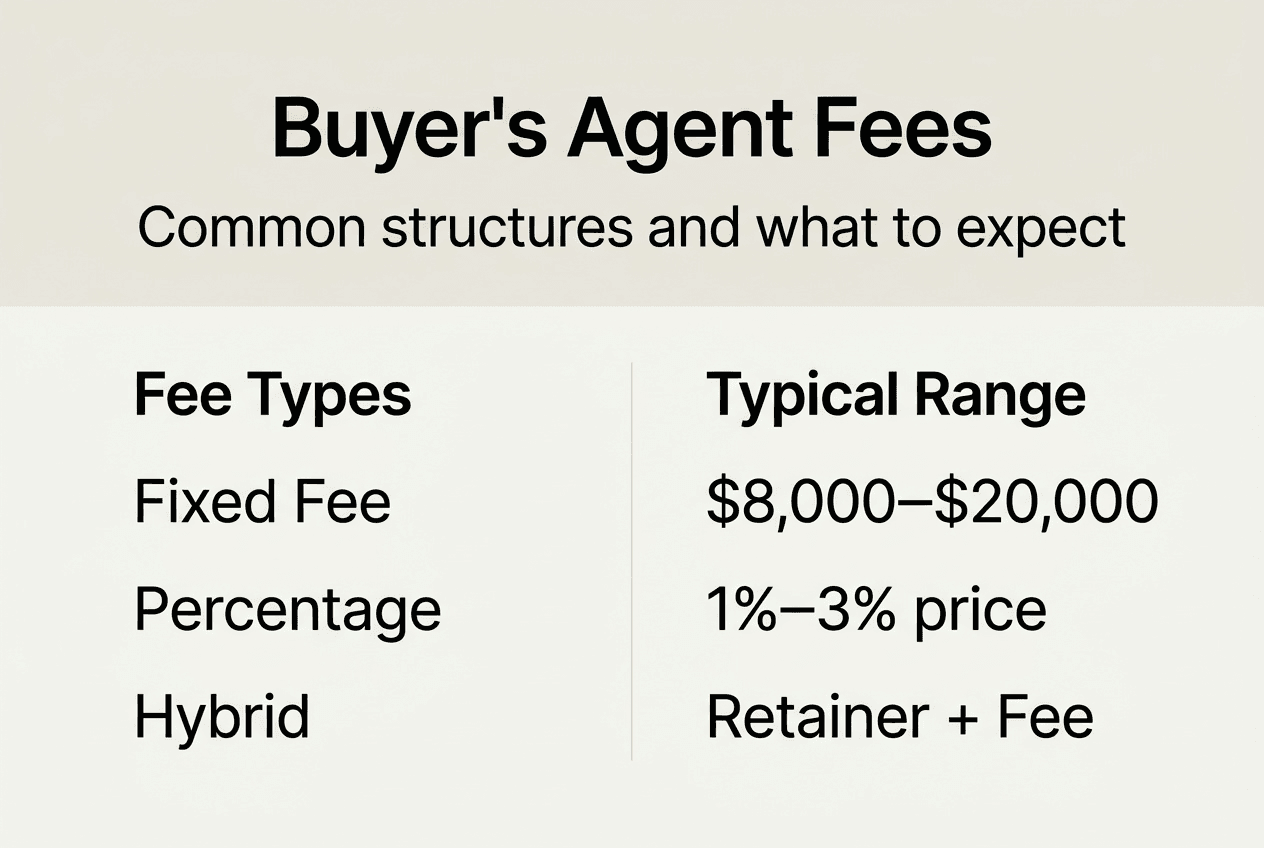
Fixed fee arrangements involve paying a predetermined amount regardless of the final purchase price. This structure provides cost certainty and works well for buyers with clear budgets. Fixed fees typically range from $8,000 to $20,000 for standard residential purchases, varying based on property price range, search complexity, and the agent’s experience level. This model aligns agent incentives with finding the right property rather than pushing you toward more expensive options.
Percentage-based commission structures charge a fee calculated as a percentage of the purchase price, usually between 1% and 3%. For a $800,000 property, this translates to $8,000 to $24,000 in fees. While this approach scales with property value, it can create concerns about agents encouraging higher-priced purchases. Reputable agents mitigate this by focusing on value and suitability rather than simply maximising price.
Hybrid models combine elements of both approaches, such as a smaller fixed retainer plus a success fee upon settlement. This structure balances cost predictability with performance incentives, ensuring agents remain motivated to secure the best outcome while you maintain reasonable budget control.
| Fee Structure | Typical Range | Best For | Key Consideration |
|---|---|---|---|
| Fixed Fee | $8,000 – $20,000 | Budget-conscious buyers, lower-priced properties | Provides cost certainty regardless of final price |
| Percentage Commission | 1% – 3% of purchase price | Higher-value properties, complex searches | Fee scales with property value |
| Hybrid Model | Retainer + success fee | Buyers wanting balanced incentives | Combines predictability with performance motivation |
Most buyer’s agent fees cover core services including property search, market analysis, inspection attendance, negotiation, and coordination through settlement. However, some additional costs may apply:
- Building and pest inspection reports, typically $400 to $800 per property
- Strata reports for apartments, usually $150 to $300
- Travel expenses for regional or interstate property searches
- Administrative fees for contract reviews or additional research
When evaluating whether buyer’s agent fees represent good value, consider the potential savings and strategic advantages they deliver. A skilled negotiator who secures a 3% to 5% reduction on an $800,000 property saves you $24,000 to $40,000, far exceeding typical agent fees. Beyond immediate savings, their expertise in selecting properties with strong growth potential can add tens of thousands in equity over subsequent years.
Pro Tip: Request a detailed breakdown of services included in the quoted fee and clarify any potential additional costs upfront. Transparency around fees indicates professionalism and helps avoid unexpected expenses during your property search.
Some buyer’s agents offer tiered service packages, allowing you to choose between full-service representation or more limited advisory roles depending on your needs and budget. Understanding these options ensures you select the service level that delivers maximum value for your specific situation.
How to choose the right buyer’s agent for your property goals
Selecting the right buyer’s agent requires careful evaluation of their qualifications, experience, and alignment with your objectives. Start by confirming their licensing and credentials. In Australia, buyer’s agents must hold a valid real estate licence in the state where they operate. Verify their licence status through the relevant state regulatory body and check for any disciplinary actions or complaints that might raise concerns about their professionalism.
Local market expertise proves essential for successful property acquisition. An agent with deep knowledge of your target suburbs understands nuanced factors that influence property values, such as school zones, transport accessibility, neighbourhood dynamics, and upcoming infrastructure projects. Ask potential agents about their transaction history in your preferred areas and request examples of recent purchases they’ve facilitated. Their familiarity with local agents, developers, and market conditions directly impacts their ability to uncover opportunities and negotiate effectively.
Assess their communication style and responsiveness during initial consultations. Property markets move quickly, and you need an agent who keeps you informed, responds promptly to queries, and explains complex concepts clearly. Pay attention to how well they listen to your requirements and whether they ask insightful questions about your goals, timeline, and preferences. An agent who truly understands your objectives will tailor their search strategy accordingly rather than presenting generic options.
Follow these steps when evaluating potential buyer’s agents:
- Request and contact at least three client references from recent transactions similar to yours
- Review online testimonials and case studies showcasing their negotiation successes and client outcomes
- Discuss their property search methodology and how they identify suitable opportunities
- Clarify their fee structure, payment terms, and what services are included versus additional costs
- Review their service agreement carefully, paying attention to contract duration, termination clauses, and any exclusivity requirements
- Ask about their current client load to ensure they have capacity to dedicate adequate attention to your search
Transparency around fees and contract terms indicates professionalism and builds trust. Reputable agents provide clear, written agreements outlining their obligations, your responsibilities, and the basis for their fees. Be wary of agents who are vague about costs or reluctant to put terms in writing. Understanding exactly what you’re paying for and the conditions under which you can terminate the agreement protects you from unfavourable arrangements.
Discuss their strategic approach to finding properties that match your investment or lifestyle goals. A quality buyer’s agent will ask detailed questions about your risk tolerance, growth expectations, preferred property types, and long-term plans. They should demonstrate analytical thinking about market trends and explain how they’ll identify properties offering the best value and potential. Their understanding of investor needs and ability to articulate a clear search strategy distinguishes exceptional agents from those simply going through the motions.
Pro Tip: During initial meetings, present a hypothetical property scenario and ask how they would approach the negotiation. Their response reveals their strategic thinking, market knowledge, and whether their style aligns with your expectations.
Chemistry and trust matter significantly in this relationship. You’ll be sharing financial information, discussing personal goals, and relying on their judgment for one of the largest purchases you’ll make. Choose an agent whose professionalism, expertise, and communication style make you feel confident and comfortable throughout the process.
Explore expert property investment support at Elite Wealth Creators
Navigating Australia’s property market requires more than just finding the right property. It demands strategic thinking, market intelligence, and access to opportunities that create genuine wealth. At Elite Wealth Creators, we specialise in engineering financial freedom through precision property acquisition tailored to your unique vision. Our property investing insights combine buyer advocacy with innovative wealth solutions you won’t find elsewhere.
Whether you’re building a high-yield portfolio, optimising your SMSF investment property strategy, or stepping into your first home, we provide the strategic edge that transforms property purchases into wealth-building milestones. Our exclusive advantages include instant liquidity options to unlock up to $100,000 from existing investments and deferred interest payment solutions that preserve your cash flow exactly where you need it.
Ready to experience property acquisition done differently? Discover how our precision sourcing and strategic guidance accelerate your journey toward unlocking financial freedom in 2026 and beyond.
Frequently asked questions
What is the difference between a buyer’s agent and a real estate agent?
Buyer’s agents represent buyers exclusively throughout the property acquisition process, working to secure the best possible terms and price for purchasers. Real estate agents typically represent sellers, focusing on achieving the highest sale price for vendors. This fundamental difference in representation creates opposite incentives and obligations. Buyer’s agents have a fiduciary duty to act in your best interest, while selling agents prioritise vendor outcomes.
How much does it typically cost to hire a buyer’s agent in Australia?
Buyer’s agent fees generally range from $8,000 to $20,000 as a fixed fee, or 1% to 3% of the purchase price as a commission. The exact cost depends on the property price range, search complexity, location, and the agent’s experience level. These fees often prove cost-neutral or profitable when agents negotiate purchase price reductions that exceed their charges. Many buyers find the time savings, risk mitigation, and access to off-market properties justify the investment regardless of direct savings.
Can a buyer’s agent help find off-market properties?
Yes, accessing off-market and pre-market properties represents one of the most valuable services buyer’s agents provide. Through their professional networks with developers, other agents, and industry contacts, they learn about properties before they reach public listings. This early access reduces competition and often reveals better value opportunities. Off-market properties appeal to sellers seeking discretion and buyers wanting to avoid bidding wars, creating win-win scenarios that buyer’s agents facilitate effectively.
What questions should I ask before hiring a buyer’s agent?
Ask about their experience in your target suburbs, including recent transactions and success stories demonstrating their local market knowledge. Clarify their fee structure, what services are included, payment terms, and any potential additional costs for inspections or reports. Discuss how they’ll tailor their search strategy to your specific property goals, timeline, and budget. Request client references and review their service agreement carefully, paying attention to contract duration and termination clauses. Understanding their current workload and approach to serving investor needs ensures they have capacity to dedicate proper attention to your search.