

Buying your first home in Australia can feel like a big leap, especially when the property market seems out of reach. For many young buyers, understanding how to secure the right home loan is the foundation for lasting financial stability. With government support programs offering low deposit options and tailored assistance, you can confidently map your path from financial readiness to loan approval. This guide shows you key steps to help make your home ownership goals achievable.
Table of Contents
Quick Summary
| Key Point | Explanation |
| 1. Assess Financial Readiness | Evaluate your income, expenses, savings, and credit history to establish your borrowing capacity. |
| 2. Compare Loan Options | Investigate various lenders and loans, focusing on interest rates, fees, and repayment flexibility. |
| 3. Gather Necessary Documentation | Compile clear, current documents to support your home loan application and streamline the process. |
| 4. Submit Your Application | Complete the application with your chosen lender, ensuring all information is accurate and transparent. |
| 5. Understand Approval Stages | Familiarise yourself with conditional and unconditional approvals to confidently navigate the next steps. |
Step 1: Assess your financial readiness
Securing your first home loan starts with a thorough understanding of your financial landscape. This critical step involves a comprehensive evaluation of your current financial health, ensuring you’re positioned to successfully navigate the home buying journey.
Begin by examining your income, expenses, and savings capacity. The Australian Government offers first home buyer support programs designed to help you enter the property market more effectively. Key areas to assess include:
-
Your annual income and stability of employment
-
Total savings and potential deposit amount
-
Monthly expenses and existing financial commitments
-
Credit score and credit history
-
Debt-to-income ratio
Developing a clear picture of your financial readiness requires honest self-assessment and potentially seeking professional financial advice. Calculate your borrowing capacity by considering your regular income, existing debts, and potential home loan repayments. Many lenders use a standard formula to determine how much you can borrow based on your financial profile.
Understanding your financial readiness is not just about numbers, but about creating a sustainable pathway to homeownership.
Documenting your financial history and preparing comprehensive records will significantly streamline your home loan application process. Gather essential documents like payslips, tax returns, bank statements, and proof of existing assets.
Pro tip: Start building a strong savings history at least 6-12 months before applying for your home loan to demonstrate financial discipline and increase your approval chances.
Step 2: Compare lenders and loan options
Navigating the complex world of home loans requires careful comparison of available lenders and their specific offerings. Your goal is to find a loan that aligns perfectly with your financial situation and long-term property ownership objectives.
Start by exploring the range of home loan products available through participating lenders and government initiatives. Key factors to evaluate when comparing loan options include:
-
Interest rates (fixed and variable)
-
Loan term lengths
-
Deposit requirements
-
Application fees and ongoing charges
-
Flexibility of repayment structures
-
Additional features like offset accounts or redraw facilities
Understand different loan types that might suit your specific needs. Some options include principal and interest loans, interest-only loans, and loans with different fixed or variable rate periods. Consider your financial stability, income potential, and long-term property investment strategy when making your selection.

Compare popular loan features to help choose the right product for your needs:
| Feature | Fixed Rate Loan | Variable Rate Loan |
| Interest Rate | Predictable, no surprises | May fluctuate with market |
| Early Repayment Flexibility | Often limited | Usually flexible |
| Rate Lock Option | Commonly available | Rarely offered |
| Predictable Payments | Yes | No |
| Suited To | Budget-conscious buyers | Those who want flexibility |
Not all home loans are created equal – the right loan can save you thousands over its lifetime.
Utilise online comparison tools and seek advice from mortgage brokers who can provide independent guidance tailored to your unique financial circumstances. Research multiple lenders thoroughly, comparing their total loan costs, not just headline interest rates.
Pro tip: Request loan pre-approval before serious house hunting to understand exactly how much you can borrow and demonstrate your credibility to sellers.
Step 3: Gather required documentation
Preparing your home loan application requires meticulous documentation to demonstrate your financial credibility and capability. Your goal is to compile a comprehensive set of paperwork that provides lenders with a clear, transparent view of your financial profile.
Start by collecting essential home loan application documents. The key documentation you’ll need to assemble includes:
-
Primary identification (passport, driver’s licence)
-
Proof of income (recent payslips, tax returns)
-
Bank statements covering the past 3-6 months
-
Details of current assets and liabilities
-
Proof of savings and deposit funds
-
Employment verification documents
-
Details of existing financial commitments
Organise your documents systematically to streamline the application process. Create digital and physical copies of each document, ensuring they are clear, current, and easily accessible. Lenders appreciate thorough, well-presented documentation that allows them to quickly assess your financial standing.
A well-prepared documentation package can significantly reduce processing time and improve your loan approval chances.
Each document should be recent, typically no older than 3-6 months, and demonstrate consistent financial behaviour. Verify document authenticity by ensuring all copies are legible and include current contact information.
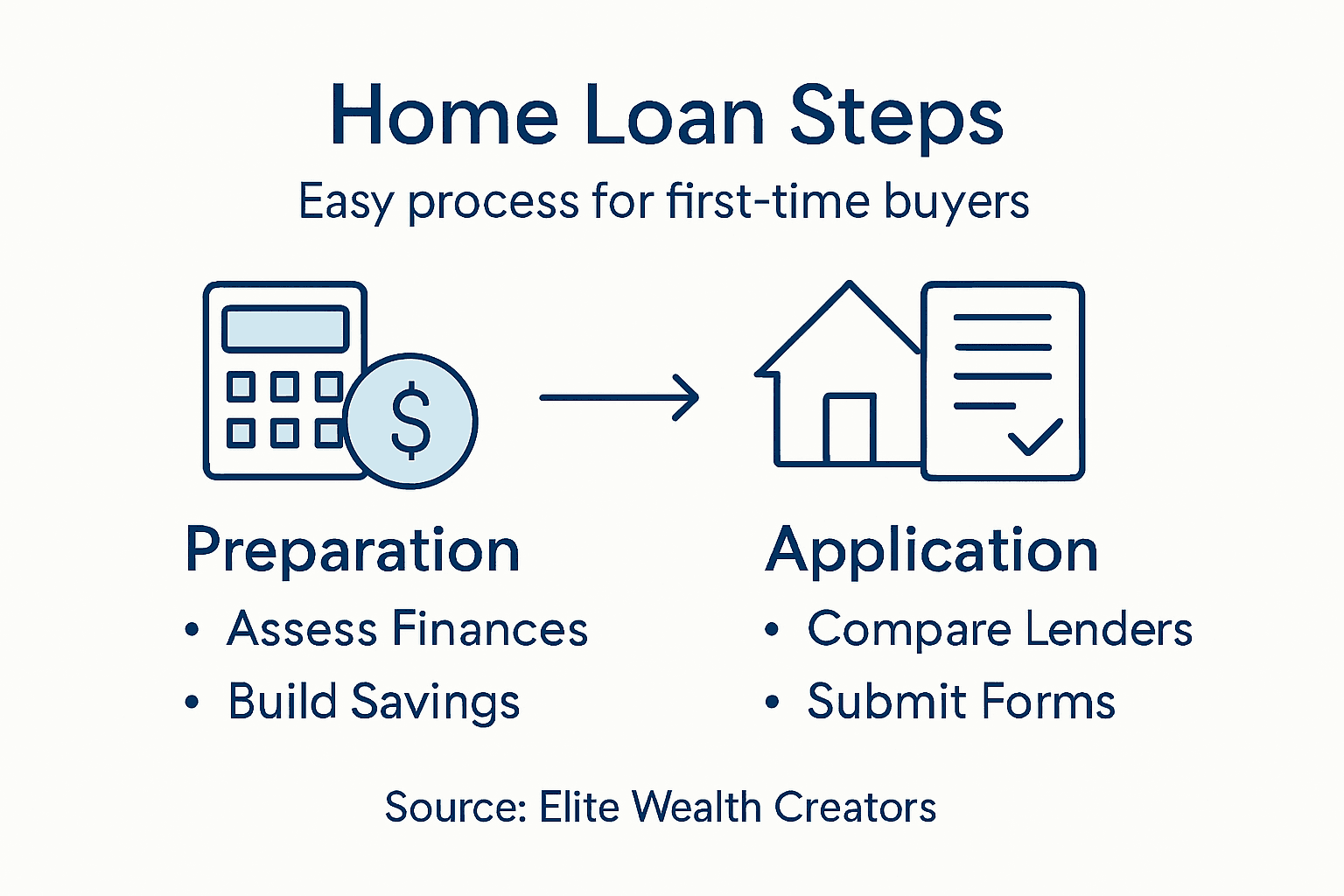
Pro tip: Create a dedicated folder or digital file specifically for your home loan application documents to keep everything organised and easily retrievable.
Step 4: Lodge your home loan application
Submitting your home loan application marks a pivotal moment in your property ownership journey. This stage transforms your preparation and planning into a concrete step towards securing your first home.
Navigate the application process using government-supported first home buyer schemes, which offer streamlined pathways for new property investors. Your application should comprehensively demonstrate your financial readiness through these key steps:
-
Select your preferred lender and loan product
-
Complete the official application form
-
Submit all required documentation
-
Provide comprehensive financial information
-
Authorise credit and background checks
-
Respond promptly to any additional lender requests
Prepare for a thorough assessment of your financial profile. Lenders will meticulously review your income, expenses, assets, and liabilities to determine your borrowing capacity. Be transparent and provide clear, accurate information to expedite the process.
Your home loan application is more than paperwork – it’s your financial passport to homeownership.
Most lenders now offer online application platforms that allow you to complete the process efficiently. Track your application status regularly and maintain open communication with your chosen financial institution.
Pro tip: Keep digital and physical copies of all submitted documents and correspondence to maintain a comprehensive record throughout your loan application journey.
Step 5: Verify your approval and next steps
Congratulations on reaching the critical stage of home loan verification, where your property ownership dreams transition from possibility to reality. This phase involves understanding and responding to your lender’s final assessment of your financial readiness.
Navigate the home loan approval process by carefully reviewing the different approval stages. Typically, you’ll encounter two key approval milestones:
-
Conditional approval (initial pre-approval)
-
Unconditional approval (final loan confirmation)
Understand your approval status thoroughly. Conditional approval means the lender has provisionally assessed your financial situation and is willing to lend, subject to additional checks. This stage allows you to start property hunting with confidence.
Here’s a quick overview of the two main home loan approval stages in Australia:
| Approval Stage | What It Means for You | Typical Next Steps |
| Conditional Approval | Lender provisionally agrees to lend funds | Begin house hunting, keep records up to date |
| Unconditional Approval | Final confirmation, all checks completed | Finalise contract, prepare for settlement |
Your loan approval is not just a document, but a gateway to your new home.
Once you receive conditional approval, prepare for final verification by keeping all financial documentation current and accessible. Lenders will conduct final checks on your income, employment, and the specific property you intend to purchase.
Pro tip: Maintain open communication with your lender and respond quickly to any additional information requests to prevent delays in your final approval.
Take the Stress Out of Securing Your First Home Loan with Expert Support
Navigating the complex process of assessing financial readiness and comparing loan options can feel overwhelming for first-time buyers. You want to avoid costly mistakes and gain confidence in every step—from understanding conditional approvals to lodging your application with all the correct documents. At Elite Wealth Creators, we understand these challenges and offer tailored strategies designed to simplify your journey to homeownership.
Discover specialised insights and tools crafted specifically for First Home Buyers | Elite Wealth Creators. Our experienced team, with over 30 years in property and finance, is here to guide you through building a strong financial profile, evaluating lender options, and navigating approvals with ease. Don’t let uncertainty hold you back. Visit Elite Wealth Creators today and take your first confident step to securing a home loan that fits your goals. Learn more about making property investing easy and empowering your wealth future.
Start your journey now by exploring our expert advice for Investors & Owner Occupied | Elite Wealth Creators and prepare to unlock your dream home with clarity and confidence.
Frequently Asked Questions
How can I assess my financial readiness for a home loan?
Start by evaluating your income, expenses, and savings. Document your current financial health by calculating your borrowing capacity, checking your credit score, and gathering essential financial statements to understand your readiness better.
What documents do I need to gather for my home loan application?
You will need to collect primary identification, proof of income, bank statements, details of assets and liabilities, and proof of savings. Organise these documents systematically to ensure a smooth application process and to demonstrate your financial credibility.
How do I compare different home loan options effectively?
Evaluate interest rates, loan terms, deposit requirements, and any fees associated with the loan products you’re considering. Use online comparison tools to list the features of each loan, which will help you select a product that aligns perfectly with your financial situation.
What steps should I take after submitting my home loan application?
Once you submit your application, stay proactive by tracking its progress and maintaining open communication with your lender. Ensure that you are ready to provide any additional information requested, as this can expedite the approval process.
What does conditional approval mean in the home loan process?
Conditional approval indicates that the lender is willing to lend you funds based on an initial assessment of your financial situation, but specific checks are still required. Use this stage to begin property hunting while keeping all your financial documents up to date for the next steps.
How can I increase my chances of getting home loan approval?
Build a strong savings history and maintain a good credit score well before you apply. Ensure you have documented evidence of your financial discipline, and aim to keep your debt-to-income ratio low to improve your overall financial profile.