

Starting your property journey often feels daunting, especially when every dollar counts and long-term security matters. Australian Government initiatives like the First Home Super Saver Scheme let you save for a deposit inside super with tax benefits, while the 5% Deposit Scheme helps you enter the market sooner with a small deposit and no Lenders Mortgage Insurance. This guide walks you through building a strong financial foundation, weighing loan options, and assessing properties to help you make confident, wealth-building choices.
Table of Contents
- Step 1: Assess Your Financial Position
- Step 2: Secure Strategic Finance Solutions
- Step 3: Identify and Evaluate Ideal Properties
- Step 4: Execute Purchase and Verify Settlement
Quick Summary
| Key Insight | Explanation |
|---|---|
| 1. Assess Your Finances Thoroughly | Understand your savings, income, and expenses to determine your borrowing capacity before starting your home search. |
| 2. Explore Government Schemes | Take advantage of Australian government options like the 5% Deposit Scheme to reduce upfront costs of home buying. |
| 3. Compare Financing Options Smartly | Investigate various loan structures and lenders to find the most beneficial terms and avoid hidden costs. |
| 4. Evaluate Properties Analytically | Assess properties based on market trends and investment potential, not just personal preference, to make informed decisions. |
| 5. Prepare for Settlement Diligently | Ensure all legal requirements and inspections are met before settlement to protect your investment and confirm ownership. |
Step 1: Assess your financial position
Before you start house hunting, you need a clear picture of where you stand financially. This isn’t about feeling discouraged—it’s about building confidence. When you understand your actual position, you can make strategic decisions instead of chasing properties that stretch you too far.
Start by calculating your current savings and any funds you can realistically access for a deposit. Most Australian lenders want to see 5% to 20% of the property price saved, though government schemes like the 5% Deposit Scheme can help bridge that gap if you have less. Write down exactly what you have available right now, including any help from family members.
Next, check your credit score and fix any issues before applying for a mortgage. Lenders scrutinise your credit history carefully, and even small problems can affect your interest rate or approval. You can request a free credit report from Australian credit bureaus to see what lenders will see.
Calculate your genuine monthly expenses honestly. Many first-time buyers underestimate how much they actually spend on groceries, subscriptions, insurance, and transport. Track your spending for a month if you’re unsure. This number matters because lenders use it to determine how much you can borrow.
Understand your current income and whether it’s stable. If you’re self-employed or on contract work, lenders typically want to see 2 years of consistent income. If you’re about to change jobs, wait until you’re settled—timing matters.
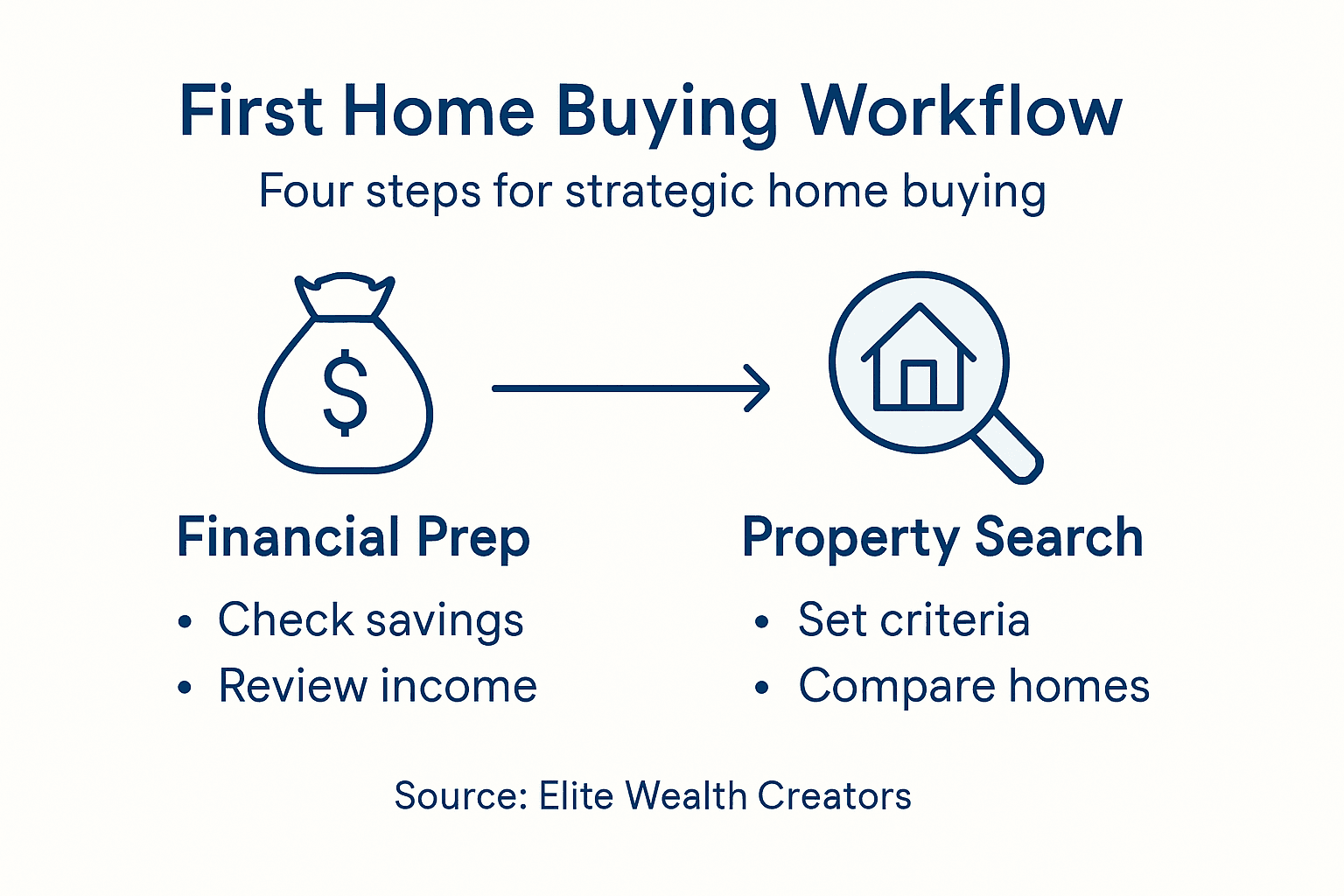
Consider tax-advantaged savings options available to you. The First Home Super Saver Scheme lets you contribute up to $50,000 from your super to your deposit, with tax benefits that accelerate your savings.
Review any existing debts: car loans, credit cards, student loans, personal loans. Lenders factor all of this into your debt-to-income ratio. The lower your ratio, the more you can borrow for a home.
Your financial assessment is your competitive advantage. Buyers who know their numbers walk into negotiations with clarity and confidence.
Make a simple spreadsheet with these numbers:
- Current savings balance
- Monthly income (after tax)
- Monthly expenses
- Current debts and repayments
- Credit score status
- Available deposit options (super, family help, schemes)
Once you’ve gathered this information, you’re ready to explore borrowing capacity and understand what price range suits your situation.
Pro tip: Review your superannuation statement now—if eligible, you could unlock significant deposit funds through the First Home Super Saver Scheme, which grows your savings at concessional tax rates rather than your marginal rate.
Here is a quick comparison of common first homebuyer government schemes in Australia:
| Scheme Name | Minimum Deposit Required | Key Benefit | 2024 Max Contribution/Value* |
|---|---|---|---|
| 5% Deposit Scheme | 5% of property price | Avoids Lenders Mortgage Insurance | Property price cap (regional limits) |
| Help to Buy Shared Equity | Varies (often 2-5%) | Govt. contribution to purchase price | Govt. covers up to 30% of value |
| First Home Super Saver Scheme | 5%+ savings in super | Tax-advantaged savings/withdrawal | $50,000 total super withdrawal |
| First Home Owner Grant | Not specified (by state) | Lump-sum grant for eligible buyers | Around $10,000 to $20,000 (by state) |
*Check official sources for current limits, as these may change.
Step 2: Secure strategic finance solutions
Now that you understand your financial position, it’s time to explore the actual financing options available to you. The right finance structure can mean the difference between struggling with repayments and building genuine wealth through your property.
Start by understanding what the Australian Government offers first-time buyers. The 5% Deposit Scheme lets you buy with just a 5% deposit and government guarantee, eliminating lenders mortgage insurance costs. This can save you tens of thousands of dollars upfront. The Help to Buy shared equity scheme provides direct government contributions toward your purchase price, reducing the amount you need to borrow.
If you have superannuation, investigate the First Home Super Saver Scheme carefully. You can contribute up to $50,000 from your salary into super and withdraw it tax-free for your deposit. This accelerates savings with significant tax advantages that ordinary savings accounts can’t match.
Compare loan structures strategically. Split loans allow you to divide your mortgage between fixed and variable rates, balancing certainty with flexibility. Interest-only periods can help if you’re building a property portfolio. Offset accounts linked to your mortgage effectively reduce the interest you pay by allowing your savings to work against your loan balance.
Contact multiple lenders, not just your bank. Mortgage brokers can access wholesale rates and products not available to the public. They often find better terms and can negotiate on your behalf without costing you extra.
Understand the true cost of borrowing beyond interest rates. Lenders vary on fees, early repayment penalties, and annual charges. A lower rate with high fees might cost more overall than a slightly higher rate with transparent, minimal costs.
Strategic finance isn’t about borrowing the maximum—it’s about borrowing smart and structuring your loan to accelerate your wealth-building timeline.
Review these loan elements carefully:
- Interest rate (fixed, variable, or split)
- Monthly repayment amount
- Offset account availability and limits
- Early repayment flexibility
- Government scheme eligibility
- Total fees and charges
- Loan term options
Once you’ve compared lenders and secured pre-approval, you’ll know exactly what you can borrow and what your genuine repayment commitment looks like. This clarity positions you perfectly for the next phase: identifying and evaluating actual properties.
The table below summarises strategic loan features and their typical advantages:
| Loan Feature | What It Does | Buyer Advantage |
|---|---|---|
| Split loan | Mixes fixed/variable rate options | Balances stable payments with rate flexibility |
| Offset account | Links savings to reduce interest | Lowers interest paid, pays off loan faster |
| Interest-only | Pays just interest for set period | Improves cash flow, useful for investors |
| Redraw Facility | Lets you access extra repayments | Quick access to prepaid funds for emergencies |
| Early repayment | Allows lump sum repayments | Minimises interest and shortens loan term |
Pro tip: Before committing to any loan, calculate your repayment scenario if interest rates rise by 3%, and ensure you could comfortably manage that scenario—this reveals whether your chosen loan truly suits your long-term financial security.
Step 3: Identify and evaluate ideal properties
With your finances secured and pre-approval in hand, you’re ready to search for properties that match your strategy. This isn’t just about finding a house you like—it’s about identifying an asset that builds wealth while meeting your lifestyle needs.

Start by defining your core criteria clearly. Are you buying a primary residence, an investment property, or both? Do you want a house, townhouse, or apartment? What’s your preferred location and why? Understanding whether you prioritise proximity to work, school catchment areas, or growth potential helps you stay focused instead of being distracted by every listing.
Research regional market trends before you start inspecting properties. Housing price patterns across Australian regions reveal which areas have stronger growth trajectories and rental yields. Looking at historical data shows you whether a location is appreciating consistently or stagnating. This insight prevents you from overpaying in declining areas.
Understand the government price caps if you’re using the 5% Deposit Scheme or Help to Buy. These caps vary by region and property type, ensuring affordability while protecting scheme participants. Know your regional cap before you fall in love with a property that exceeds it.
Inspect properties thoroughly and take detailed notes. Look beyond aesthetics to structural condition, building reports, pest inspections, and council records. A cheap price with hidden maintenance issues becomes expensive quickly. Ask about upcoming rates increases, special levies, or planned infrastructure that could affect value.
Property evaluation isn’t emotional—it’s analytical. The best investment is often the one that makes financial sense, not necessarily the one you love at first glance.
When evaluating each property, assess these factors:
- Purchase price relative to regional average
- Rental yield potential (if investment focused)
- Growth trajectory of the suburb
- Quality of building condition and systems
- Distance to transport and amenities
- Comparable sales in the area
- Future development plans nearby
Use property comparison tools to analyse multiple options side by side. This prevents analysis paralysis and helps you see which properties genuinely offer the best value against your criteria.
Once you’ve identified properties worth pursuing, you’re ready to make strategic offers and navigate negotiations with confidence.
Pro tip: Visit potential properties at different times of day and on different days of the week to assess traffic, noise, and neighbourhood activity patterns—what feels quiet on Sunday may be chaotic on weekday mornings.
Step 4: Execute purchase and verify settlement
You’ve found the right property and made a competitive offer. Now comes the critical phase where everything becomes official. Execution and settlement require attention to detail and understanding of the process to protect your investment and secure your new home.
Once your offer is accepted, you’ll sign the contract of sale. This is a binding legal document, so review it carefully with your solicitor or conveyancer. Ensure all conditions are clear, including inspection periods, finance contingencies, and settlement date. Don’t rush this stage—clarifying terms now prevents costly disputes later.
Apply for any government grants you’re eligible for immediately. First Home Owner Grant eligibility and application requirements vary by state and property type. Some grants close on specific dates, and missing deadlines can cost you thousands. Your conveyancer can help, but stay involved in the process.
Arrange a building and pest inspection before contracts exchange. This inspection reveals structural issues, termite damage, or major repairs needed. If problems emerge, you can negotiate price reductions or walk away before you’re legally committed. This is your last chance to back out without penalty.
Coordinate with your lender to confirm final loan approval. Provide any documents they request promptly. Delays at this stage can jeopardise your settlement date and create stress. Keep communication lines open with your broker, solicitor, and lender throughout.
Understand the settlement process clearly. The 5% Deposit Scheme settlement procedures outline specific steps and timelines. Settlement typically occurs 30 to 60 days after contract exchange. On settlement day, funds transfer from your lender to the seller’s solicitor, documents are exchanged, and you receive the keys to your new home.
Settlement day is when ownership officially transfers. Ensure your conveyancer has confirmed all conditions are met and funds are cleared before proceeding.
Prepare for settlement by:
- Arranging final loan funds with your lender
- Confirming settlement date with all parties
- Obtaining final inspection clearance from your lender
- Arranging home and contents insurance before settlement
- Planning your moving logistics
- Reviewing all settlement statements for accuracy
Your conveyancer will conduct final searches to verify there are no title issues, outstanding rates, or other encumbrances. Once all checks pass and funds are cleared, settlement proceeds and you become the official owner.
Congratulations. You’ve successfully navigated the first home buying journey and executed a strategic purchase. What comes next is optimising your investment and building on this foundation.
Pro tip: Schedule your final property inspection 24 hours before settlement to confirm agreed repairs are completed and no damage has occurred since contract exchange—this is your last verification opportunity.
Turn Your First Home Buying Strategy into Real Wealth with Elite Wealth Creators
The journey through assessing your finances, securing smart loans and choosing the right property can feel overwhelming. This article highlights how critical it is to have clarity on your financial position, understand government schemes like the 5% Deposit Scheme and the First Home Super Saver Scheme, and lock in strategic financing options that protect your future. If you are feeling the pressure of navigating these complex steps on your own Elite Wealth Creators can provide the expertise to transform these challenges into your greatest advantages.
Our tailored services offer solutions aligned to the precise concepts you need such as instant liquidity to unlock cash from existing assets and the Homepay Advantage to optimise your cash flow during repayments. With our precision sourcing access off-market opportunities that perfectly fit your individual wealth-building strategy and lifestyle goals. Don’t delay your first home success get professional support today at Elite Wealth Creators and explore how we make financial freedom possible for first home buyers like you. Find out how to engineer your dream home purchase and accelerate your path by visiting Instant Liquidity Solutions and the Homepay Advantage pages now.
Frequently Asked Questions
How do I assess my financial position before buying my first home?
To assess your financial position, calculate your current savings, monthly expenses, and debts. Create a spreadsheet with these figures to gain clarity on what you can realistically afford.
What financing options should I consider as a first-time home buyer?
As a first-time home buyer, explore government schemes like the 5% Deposit Scheme and the First Home Super Saver Scheme. Evaluate various loan structures to find one that fits your financial goals and risk tolerance.
How can I evaluate potential properties effectively?
To evaluate properties, define your criteria clearly and research regional market trends. Inspect each property thoroughly to assess its condition and compare it against your defined criteria.
What steps do I need to take after my offer on a property is accepted?
Once your offer is accepted, review the contract carefully with a solicitor, arrange for building and pest inspections, and confirm final loan approval with your lender. Stay proactive in coordinating with all parties involved to avoid delays.
What should I prepare for the settlement process?
For the settlement process, ensure all conditions are met, final loan funds are arranged, and home insurance is secured. Conduct a final inspection 24 hours prior to settlement to confirm all agreed repairs are complete.
How can I use government grants to reduce my home buying costs?
Utilise government grants like the First Home Owner Grant immediately after your offer is accepted. Research eligibility criteria and deadlines to ensure you can access these funds and potentially save thousands on your purchase.