

TL;DR:
- Property valuation accurately estimates a property’s current market worth based on comparable sales, not asking or assessed values. Using the appropriate method—sales comparison, cost, or income—depends on the property type and purpose, influencing strategic decisions. A professional valuation guides confident bidding, financing, and investment choices, preventing costly mistakes caused by outdated or inaccurate estimates.
Most buyers treat a property valuation as a formality. That’s a costly mistake. Understanding what is property valuation, and using it correctly, is the difference between a confident bid and a regret you carry for years. A professional valuation tells you what a property is genuinely worth in the current market, not what a seller hopes to get, and not what a council calculated for tax purposes. This guide breaks down exactly how valuations work, what drives them, and how you can use them to make decisions that hold up financially.
Table of Contents
- Key takeaways
- What is property valuation?
- The three main valuation methods
- What affects property value?
- The property valuation process, step by step
- Using valuations to make better decisions
- My take on why valuation mastery changes everything
- Ready to act with the right insight?
- FAQ
Key takeaways
| Point | Details |
|---|---|
| Valuation is not asking price | A professional valuation reflects real buyer behaviour, not seller strategy or outdated tax data. |
| Three core methods exist | Sales comparison, cost approach, and income approach each suit different property types and purposes. |
| Location and condition drive value | Local market trends, property condition, and infrastructure plans directly shape every valuation outcome. |
| The process has six structured phases | From assignment definition through to the final report, the property appraisal process follows clear professional standards. |
| Inaction has a financial cost | Waiting for perfect information while relying on inaccurate estimates means missed opportunities and lost equity. |
What is property valuation?
Property valuation is the professional process of estimating the market value of a property based on current conditions, comparable sales, and property-specific attributes. It answers one question precisely: what would a willing buyer pay a willing seller, in an open market, with neither party under duress?
That definition matters because it separates three numbers that buyers frequently confuse.
- Market value is what a valuer determines through evidence and analysis. It reflects actual buyer behaviour rather than seller strategy or administrative lag.
- Asking price is a seller’s opening negotiation position. It may be grounded in market data or completely disconnected from it.
- Assessed value is a council or government figure used for tax calculations. It is often updated annually or less, making it a poor proxy for real-time market value.
Relying on asking price or assessed value to inform your purchase decisions is like navigating with last year’s map. The market shifts constantly. In some areas, prices move 9.6% year over year, which means a valuation from twelve months ago could already be misleading you. A current, professional valuation is your financial reality check before you commit.
The three main valuation methods
Not all properties are valued the same way. Valuation methods are not interchangeable. Selection depends on the property’s characteristics, its intended use, and what data is actually available. Understanding real estate valuation means knowing which method applies to your situation.
| Method | Best suited for | Core logic |
|---|---|---|
| Sales comparison approach | Residential homes with recent comparable sales | Adjusts recent sale prices of similar properties to estimate current market value |
| Cost approach | New builds, unique properties, or limited sales data | Estimates land value plus the cost to reconstruct, minus depreciation |
| Income approach | Investment and commercial properties | Capitalises net rental income or uses discounted cash flow to determine value |
The sales comparison approach is the most common method in residential real estate. A valuer finds properties sold recently that are similar in size, location, condition, and features, then adjusts for differences. If comparable homes sold for $850,000 but yours has an additional bathroom, the valuer will add an upward adjustment to reflect that.
The cost approach is less common in established residential markets but becomes relevant when there are few comparable sales or when the property is a new build. The valuer estimates what it would cost to reconstruct the improvements from scratch, deducts accumulated depreciation, and adds the land value. This method works well for specialised properties such as churches or industrial facilities.
The income approach is the method investors need to understand deeply. It works by capitalising a property’s net rental income at a market-derived yield, or by projecting future cash flows and discounting them back to present value. Income capitalisation and discounted cash flow methods integrate future cash flow projections and market risk, giving investors a more complete picture of what a property is truly worth as a financial asset.
Pro Tip: When valuing an investment property, ask your valuer which income method they applied. Capitalisation rate methods suit stable income streams; discounted cash flow suits properties with variable or growing rents. Knowing the difference helps you interrogate the report intelligently.
Importantly, no single valuation model fits all circumstances. Professional valuers weigh the available evidence and select the method that produces the most defensible outcome for that specific property type and purpose.
What affects property value?
You cannot control the market, but you can understand what shapes it. Several factors combine to produce a property’s final valuation figure, and some of them are within your reach as an owner or buyer.
- Location and comparable sales. The most recent sales within a one to two kilometre radius carry the most weight. A suburb that has seen strong auction clearance rates signals upward pressure on valuations.
- Physical condition and improvements. A well-maintained kitchen or bathroom renovation adds demonstrable value. Deferred maintenance does the opposite. If a valuation comes back lower than expected, engaging your valuer to identify specific improvements can unlock a better outcome at the next assessment.
- Infrastructure and development plans. A new train station, school, or employment precinct within the catchment area can shift values materially. These factors are reflected in sales data before most buyers realise what is driving the numbers.
- Market timing and volatility. Property values are not static. Market changes can render a valuation outdated quickly, particularly in fast-moving corridors.
Automated valuation models (AVMs), the kind you find on real estate portals, are particularly unreliable here. They rely on broad assumptions and fail to consider micro-market factors such as recent renovations, exceptional views, or noise issues. They give you a starting point for curiosity, not a figure you should rely on for financial decisions.
The role of the appraiser in Australian home buying is precisely to account for these nuanced, property-specific factors that algorithms miss.

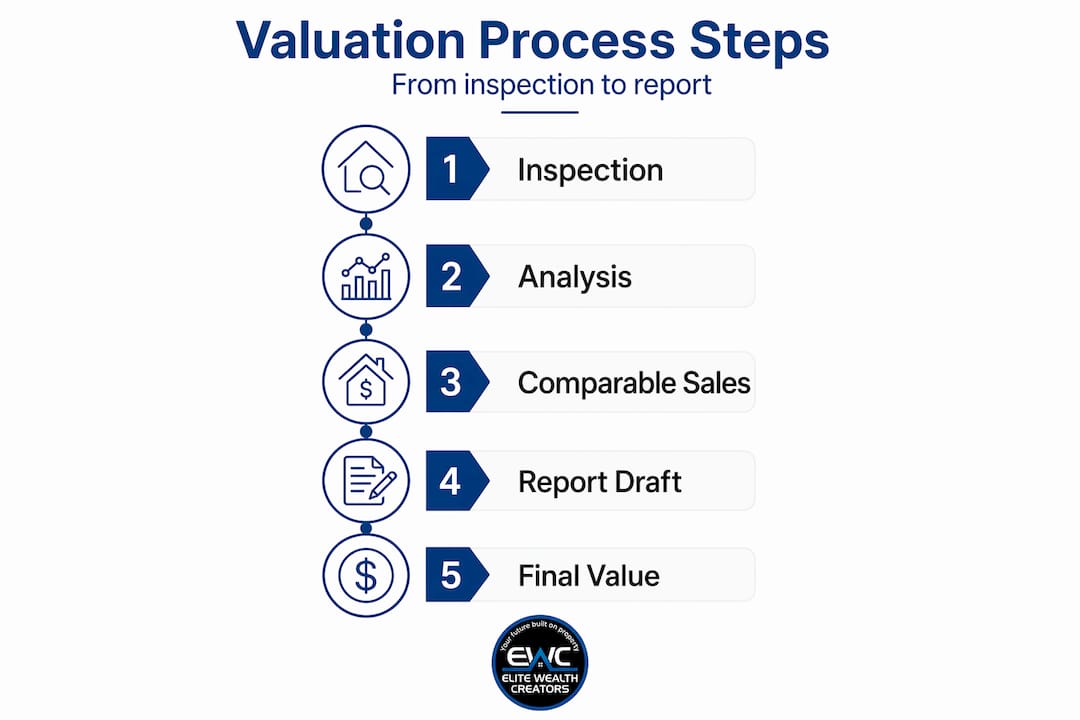
The property valuation process, step by step
The property appraisal process follows a structured sequence. Knowing what happens at each stage prepares you to engage confidently and interpret your report without confusion.
- Assignment definition. The valuer establishes the purpose of the valuation, whether it is for purchase, refinancing, SMSF acquisition, or legal proceedings. Purpose shapes methodology.
- Data collection. The valuer inspects the property physically, records its attributes, and collects market data including recent comparable sales and rental evidence.
- Comparable analysis. Sales data is filtered, adjusted, and ranked by relevance. Proximity, recency, and similarity to the subject property all determine how much weight each comparable receives.
- Methodology application. The appropriate valuation method is applied, or multiple methods are used where warranted. Appraisers weigh all three approaches according to property type and available data before settling on a final figure.
- Reconciliation. Where multiple methods produce different figures, the valuer reconciles them into a single defensible value. This is the most analytical phase of the process.
- Report preparation. The final report documents the findings, methodology, comparable evidence, and the certified market value opinion. The professional valuation process conforms to legal and ethical standards throughout.
Timelines vary, but a standard residential valuation typically takes two to five business days from inspection to report delivery. Complex or unusual properties can take longer.
Pro Tip: Before the valuer arrives, compile a list of any improvements made since purchase, including dates and approximate costs. Valuers work from observable evidence. Giving them complete information means a more accurate result.
Using valuations to make better decisions
A property valuation is not just a compliance document. Used well, it is one of the sharpest financial tools available to buyers and investors. Here is where it matters most.
- Bidding with confidence. When you know the independent market value before an auction, you know exactly where to set your ceiling. You stop second-guessing and start competing strategically.
- Finance and refinancing. Lenders commission their own valuations to determine how much they will lend. Understanding the property appraisal process means you can anticipate their result, choose properties that will stack up, and access equity when you need it. Sound property research before any purchase reduces the risk of a valuation shortfall that delays settlement.
- SMSF compliance. The Australian Taxation Office requires annual market valuations for property held inside a self-managed super fund. An inaccurate or outdated valuation inside an SMSF is a compliance risk, not just a financial one. The importance of property valuation in this context cannot be overstated.
- Avoiding analysis paralysis. Every month you spend gathering more data without acting is a month the market moves. Buyers who wait for certainty are outpaced by those who act on professional insight. A reliable valuation gives you the certainty you have been waiting for.
For investors building a portfolio, tailored investment strategies that incorporate current valuations allow you to compare assets honestly and allocate capital where the numbers genuinely support it.
My take on why valuation mastery changes everything
I have watched buyers lose properties they genuinely wanted, not because they couldn’t afford them, but because they didn’t trust the numbers in front of them. They were waiting for one more data point, one more online estimate, one more conversation. The property sold while they were still thinking.
Here is what experience has taught me: the clients who move decisively are the ones who understood valuation before they needed it. They went into negotiations knowing the independent market value. They weren’t rattled by a vendor’s inflated asking price, and they didn’t second-guess their lender’s figure.
The other lesson I’d share is this. Professional valuers are allies, not obstacles. When a valuation comes back below expectations, the instinct is frustration. The productive response is to ask the valuer exactly which factors dragged the figure down, then address them. That conversation has saved clients tens of thousands of dollars more than once.
Automated estimates and gut feel are not substitutes for a signed, certified valuation report. The cost of getting it right is trivial compared to the cost of getting it wrong.
— Nick
Ready to act with the right insight?
Understanding property valuation is the foundation. Acting on it with expert support is where wealth is actually built. At Elitewealthcreators, we work with buyers and investors across Australia who are done hesitating and ready to move with precision.
Whether you are assessing your first purchase, comparing investment opportunities, or navigating the compliance demands of an SMSF, you need more than a number. You need context, strategy, and someone who already knows which properties will stack up before they hit the open market.
Explore our property investing insights to see how we translate valuation knowledge into real acquisition advantage. If you are managing a self-managed super fund, our SMSF property investment guide walks you through compliance, methodology, and returns in plain language.
We limit new clients monthly, not for exclusivity, but because quality guidance requires genuine attention. Spots are limited. If you are ready to stop watching and start acting, now is the time.
FAQ
What is the difference between market value and asking price?
Market value is an independent estimate of what a buyer would realistically pay for a property in current conditions. Asking price is the seller’s opening figure and may not reflect actual market evidence.
How long does the property valuation process take?
A standard residential valuation typically takes two to five business days from inspection to report. Complex or unusual properties can take longer depending on data availability.
Which property valuation method is used for investment properties?
The income approach is most commonly applied to investment and commercial properties. It uses either capitalisation of net rental income or a discounted cash flow model to determine value.
Can I challenge a property valuation I disagree with?
Yes. If a valuation appears to be based on inaccurate data, you can engage the valuer directly to discuss the findings. Providing evidence of improvements or more relevant comparable sales can support a revised outcome.
How often should I get a property valuation?
In stable markets, every one to two years is reasonable. In volatile markets or for SMSF-held properties, annual valuations are often required and always advisable to avoid acting on outdated figures.