

TL;DR:
- Fixed rate loans provide certainty and stable repayments, aiding in financial planning and reducing stress.
- They are ideal for long-term investors seeking predictability and protection from interest rate increases.
- Strategically using fixed loans can enhance wealth-building by aligning loan terms with investment goals.
Many Australians assume variable rate loans are the smarter financial choice because they can drop when the market shifts. But that assumption ignores a critical truth: certainty has enormous value in property investment. When you know exactly what your repayments will be each month, you can plan with confidence, protect your cash flow, and build wealth without the anxiety of rate surprises. Fixed rate loans offer precisely that kind of stability. In this article, we cover what fixed rate loans are, how they work, their core benefits, how they compare to variable options, and how you can use them strategically to grow your property portfolio.
Table of Contents
- What are fixed rate loans and how do they work?
- Benefits of fixed rate loans for Australian home buyers and investors
- Comparing fixed vs variable rate loans: which is right for you?
- How to optimise fixed rate loans in your property strategy
- What most Australians miss about fixed rate loans
- Next steps to maximise your property wealth with fixed rate loans
- Frequently asked questions
Key Takeaways
| Point | Details |
|---|---|
| Stable repayments | Fixed rate loans offer predictable repayments so you can plan your property finances with confidence. |
| Reduced risk | Avoid unexpected interest hikes and keep your budget secure for the loan period. |
| Strategic wealth building | Use fixed loans to optimise your long-term property and investment strategy. |
| Flexible structuring | Combine fixed and variable loans for portfolio balance and refinancing opportunities. |
What are fixed rate loans and how do they work?
Fixed rate loans allow borrowers to lock in an interest rate for a set period, meaning your repayments stay the same regardless of what the Reserve Bank of Australia does with the official cash rate. This predictability is the foundation of their appeal, especially for buyers and investors who need to model cash flow with precision.
In Australia, fixed rate loan terms typically range from one to five years, with some lenders offering up to ten years. Once your fixed period ends, the loan usually rolls onto the lender’s standard variable rate unless you choose to re-fix or refinance. It is important to plan for this transition, as the variable rate that follows can be considerably higher than your fixed rate was.
Here is a quick overview of how fixed rate loan terms are structured in Australia:
| Fixed term | Common use case | What happens at end of term |
|---|---|---|
| 1 to 2 years | Short-term certainty, testing the market | Rolls to variable or re-fixed |
| 3 years | Balanced stability for home buyers | Rolls to variable or refinanced |
| 5 years | Long-term planning for investors | Reviewed and renegotiated |
| 10 years | Maximum certainty, rare in Australia | Renegotiated or refinanced |
When applying for a fixed rate loan, you will generally go through the following steps:
- Pre-approval: Your lender assesses your income, expenses, and credit history.
- Rate selection: You choose a fixed period that aligns with your financial goals.
- Loan settlement: Funds are drawn down and your fixed rate begins.
- Fixed period: Your principal (the amount you borrowed) and interest repayments remain stable.
- End of term: You decide to re-fix, switch to variable, or refinance.
Understanding these key terms is essential. The principal is the original loan amount. Interest is the cost of borrowing, expressed as a percentage. The fixed period is the window during which your rate cannot change. Exploring your home loan options early gives you the clearest picture of what structure suits your situation best.
Benefits of fixed rate loans for Australian home buyers and investors
The practical advantages of fixed rate loans extend well beyond simple peace of mind. For both first home buyers and seasoned investors, the ability to forecast repayments with precision changes how you approach financial planning entirely.
Predictable repayments are a major factor in reducing financial stress for homeowners. When you remove the variable of fluctuating interest, your household budget becomes a reliable blueprint rather than a moving target. This matters enormously when you are managing living expenses, saving for your next deposit, or planning renovations.
Here are the key benefits worth knowing:
- Stable monthly repayments make it far easier to manage household cash flow and long-term savings goals.
- Protection from rate rises means a Reserve Bank increase does not immediately affect your repayment amount during the fixed period.
- Confidence in multi-property strategies allows investors to model portfolio-wide cash flow without guessing at future rate movements.
- First home buyer support through budget planning tips that help you understand upfront costs, including stamp duty for buyers and other acquisition expenses.
- Strategic timing lets you lock in a low rate during a favourable market cycle, protecting your position for years.
Statistic to note: Research consistently shows that financial stress linked to mortgage repayments is one of the leading causes of poor property decision-making among Australian homeowners. Removing that variable changes behaviour, not just budgets.
For investors managing two or more properties, fixed rate loans provide a framework for property buying essentials that keeps acquisition costs predictable. When you know your holding costs are stable, you can assess new opportunities with far greater clarity.
Pro Tip: If interest rates are at or near a cyclical low, consider locking in a fixed rate immediately. Even a modest rate rise of 0.5% over a 30-year loan adds tens of thousands of dollars to your total repayment. Timing your fix strategically is one of the highest-value decisions you can make.
Comparing fixed vs variable rate loans: which is right for you?
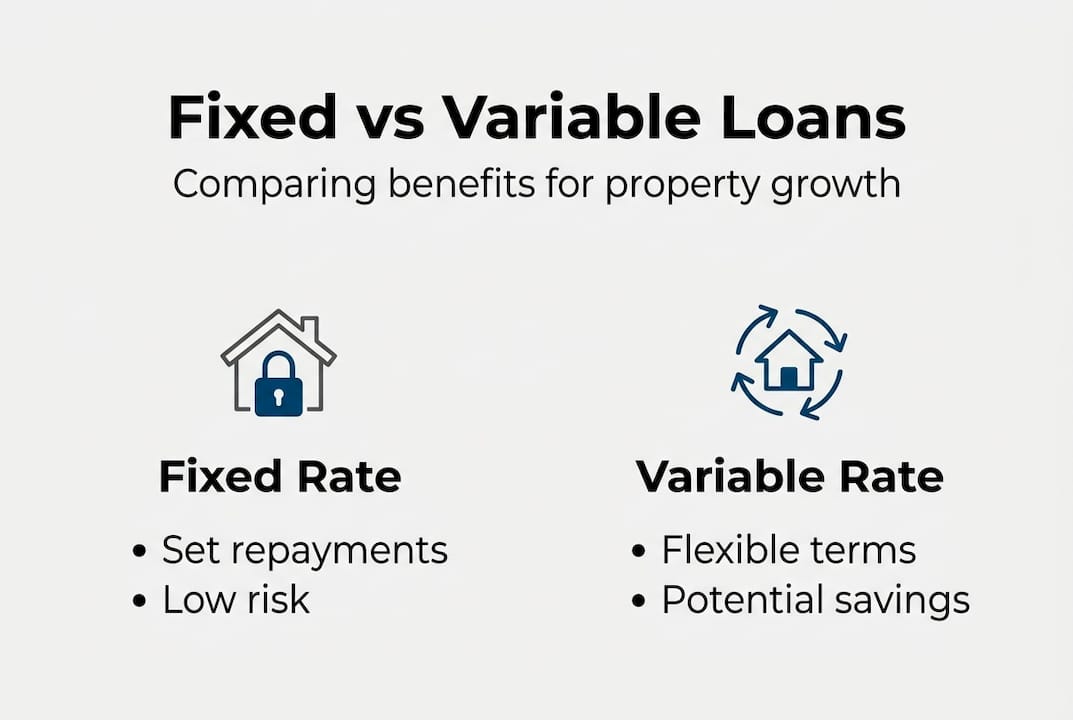
Variable rate loans fluctuate with the market, whereas fixed rate loans offer security but may limit flexibility. Understanding this trade-off is central to choosing the right structure for your goals.

Here is a side-by-side comparison to help clarify the differences:
| Feature | Fixed rate loan | Variable rate loan |
|---|---|---|
| Repayment certainty | High | Low |
| Flexibility to make extra repayments | Limited | High |
| Break fees if exiting early | Yes, often significant | Rarely |
| Offset account availability | Rare | Common |
| Suits falling rate environments | No | Yes |
| Suits rising rate environments | Yes | No |
To choose the right option, work through these considerations in order:
- Assess your risk tolerance. If rate uncertainty causes you anxiety or disrupts your planning, fixed is likely the better fit.
- Review your investment timeline. Short-term holders may prefer variable flexibility; long-term investors benefit from fixed certainty.
- Consider your cash flow needs. If you want to make large lump-sum repayments, variable may suit you better.
- Evaluate the current rate environment. Fixing when rates are high locks in a disadvantage; fixing when rates are low locks in an advantage.
“Choosing a fixed rate loan may help investors unlock equity and reduce risk by providing a stable cost base from which to assess future acquisitions.”
For many investors, the answer is not one or the other. A split loan, where part of your borrowing is fixed and part is variable, gives you stability on one portion while retaining flexibility on another. Exploring your choosing mortgage types options with an experienced adviser helps you find the right balance for your specific portfolio.
How to optimise fixed rate loans in your property strategy
Strategically structuring fixed rate mortgages helps investors maximise long-term returns by aligning loan terms with investment goals rather than simply reacting to market conditions. This is where fixed rate loans shift from a defensive tool to an active wealth-building vehicle.
Here is how to use fixed rate loans effectively within your property strategy:
- Time your fix to the rate cycle. Locking in when rates are at or near a low point gives you the greatest long-term advantage. Watch Reserve Bank commentary and economic indicators closely.
- Align your fixed term with your investment horizon. If you plan to hold a property for five years before selling, a five-year fix protects your cash flow for the entire hold period.
- Use fixed loans for income properties. Rental income is relatively stable, so pairing it with a fixed loan creates a predictable net income position that simplifies tax planning and portfolio modelling.
- Combine fixed and variable loans across your portfolio. Fixing your primary residence loan while keeping investment loans variable, or vice versa, can give you the best of both structures.
- Plan for the revert rate. Always know what rate your loan reverts to at the end of the fixed period. Build this into your long-term loan structuring tips so you are never caught off guard.
Refinancing is another powerful lever. If rates fall significantly during your fixed period, you may want to break and refix, though this requires careful calculation of break fees versus savings. Your mortgage approval strategies should account for this scenario from the outset.
Pro Tip: Review your fixed rate options at least once a year, even mid-term. Understanding lending criteria for investors and current market rates keeps you informed and ready to act when a refinancing opportunity arises.
What most Australians miss about fixed rate loans
Most buyers and investors evaluate fixed rate loans purely on rate. They compare the fixed rate to the variable rate and ask, “Which is cheaper right now?” That question misses the point entirely.
The real value of a fixed rate loan is not the rate itself. It is the certainty that rate provides. When your repayments are predictable, your decision-making improves. You assess new properties with clearer numbers. You sleep better. You hold assets longer because you are not reacting to every Reserve Bank announcement with panic.
We have seen investors abandon genuinely strong properties because rising variable repayments created short-term cash flow pressure. That pressure forced a sale at the wrong time, erasing years of capital growth. A fixed rate loan, even at a slightly higher rate, would have been the better financial outcome.
Think of the premium you pay for a fixed rate as a peace-of-mind investment that protects your long-term strategy from short-term noise. Certainty is not a cost. It is a competitive advantage.
Next steps to maximise your property wealth with fixed rate loans
Understanding fixed rate loans is the first step. Applying that knowledge strategically is where real wealth is built. At Elite Wealth Creators, we work with home buyers and investors across Australia to structure loan arrangements that align with long-term wealth goals, not just today’s rate environment. Whether you are looking to grow your portfolio, access property equity strategies, or simply get your first property purchase right, our team provides the strategic guidance you need. Explore our property investing insights to see how a well-structured fixed rate loan fits into a broader, high-performing property strategy.
Frequently asked questions
Do fixed rate loans have disadvantages for investors?
Fixed rate loans may have break costs and less flexibility compared to variable loans, so investors should carefully weigh those trade-offs against the certainty and planning benefits they provide.
When should you consider fixing your loan rate?
Locking in a low rate can secure financial stability against future rises, making it ideal to fix when rates are near a cyclical low and you want budgeting certainty for the years ahead.
Can you refinance a fixed rate loan in Australia?
Fixed loan contracts allow refinancing, often with penalties for early exit, so it is essential to review your lender’s break fee structure before making any decision to refinance mid-term.
How does a fixed rate loan protect my property portfolio?
Predictable repayments are crucial for property investors managing complex portfolios, as they eliminate cash flow uncertainty and allow you to assess and acquire new assets with confidence.
Recommended
- Fixed rate loans: stability for Australian homeowners 2026 | Elite Wealth Creators
- Top Australian Mortgage Options in 2023 for Smart Borrowing | Elite Wealth Creators
- NDIS Property Investment Guide | Elite Wealth Creators
- 5 innovative ways to finance property in Australia 2026 | Elite Wealth Creators
- How RBA Rate Changes Impact Your Investment Property Returns | AlphaIQ