

TL;DR:
- Residential property offers lower entry costs, easier financing, and government incentives, making it accessible for most investors.
- While commercial property can have higher gross yields, it involves greater risks, longer vacancies, and slower liquidity.
- Residential markets tend to recover faster and provide more stable demand, especially in Australia’s growing urban areas.
There is a widely held belief among new investors that commercial property is the smarter, more profitable path. After all, longer lease terms and higher gross yields sound compelling on paper. Yet a growing number of Australians are discovering that residential property offers a compelling combination of accessibility, government support, and long-term stability that commercial assets simply cannot match for most investors. This guide breaks down the real differences between the two, cuts through the noise, and gives you the clarity you need to make a well-informed decision that aligns with your personal wealth-building goals.
Table of Contents
- Understanding residential and commercial property investment
- Key advantages of residential property investment
- Comparing returns, risks, and liquidity
- Market trends and future growth outlook
- What most investors miss when choosing residential over commercial
- Next steps: how Elite Wealth Creators can help your investment journey
- Frequently asked questions
Key Takeaways
| Point | Details |
|---|---|
| Easier entry and finance | Residential property typically requires less initial capital and is easier to finance than commercial property. |
| Stronger market resilience | Australian residential property has historically weathered market downturns better than commercial. |
| Ongoing demand | Stable need for housing means consistent tenant demand and lower vacancy rates in most locations. |
| Attractive incentives | Government schemes often favour residential investors, providing grants and concessions to boost returns. |
| Balanced risk and return | Residential property provides a balanced entry point for investors seeking growth with manageable risk. |
Understanding residential and commercial property investment
To weigh up the advantages, it’s critical to understand what counts as residential and commercial property in the Australian context. These are not just two categories on a listing website. They represent entirely different legal frameworks, financing structures, and risk profiles.
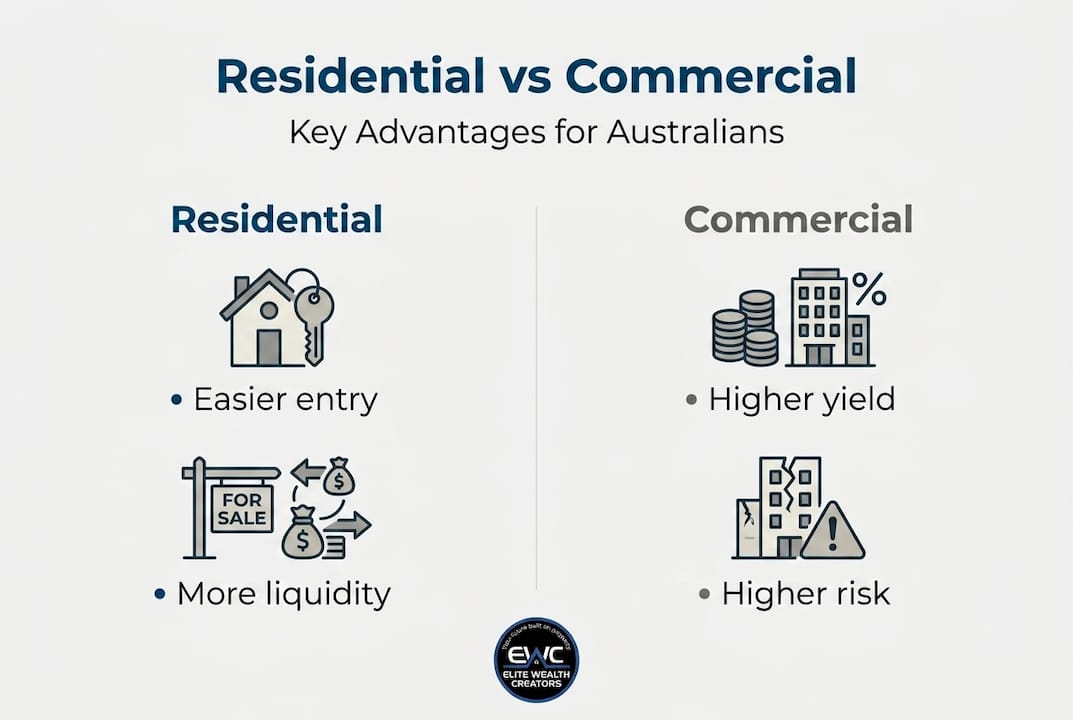
Residential property refers to any property used primarily for people to live in. This includes houses, townhouses, units, apartments, duplexes, and student accommodation. In Australia, residential properties are governed by residential tenancy legislation at the state level, which offers strong protections for both landlords and tenants.
Commercial property covers buildings and land used for business purposes. Common examples include:
- Office buildings and co-working spaces
- Retail shops and shopping centres
- Industrial warehouses and logistics facilities
- Medical centres and childcare facilities
- Hospitality venues such as hotels and restaurants
As our property investment guide outlines, the distinction between these two property types in Australia matters enormously when you factor in financing eligibility, tax treatment, tenant rights, and your risk exposure. For example, commercial leases are far more flexible and negotiable, which can benefit experienced investors but expose newcomers to unpredictable vacancy periods and complex legal obligations.
Understanding this foundational difference is your starting point. Once you know what you’re comparing, you can evaluate each category on its genuine merits rather than relying on assumptions.
Key advantages of residential property investment
With definitions covered, let’s explore why so many Australians choose the residential path first, and why that instinct is backed by solid financial logic.
Residential property has a lower barrier to entry than almost any other asset class of comparable wealth-building potential. You do not need hundreds of thousands of dollars in upfront capital to get started. Lenders are far more willing to finance residential purchases, often at loan-to-value ratios of 80% or more. That means your capital goes further, and you can build a multi-property portfolio over time without needing a significant commercial-sized deposit from day one.
Here are four key reasons why residential property is the preferred starting point for most Australian investors:
-
Lower entry costs. Many investors start with residential due to lower entry costs and accessible finance, compared to the 30% to 40% deposits often required for commercial property. This accessibility levels the playing field.
-
Government incentives and concessions. First-time buyers and investors can access stamp duty concessions and grants that are simply not available for commercial purchases. These incentives can save you tens of thousands of dollars and meaningfully reduce your initial cash outlay.
-
Steady rental demand. Australia’s population continues to grow, particularly in Sydney, Melbourne, Brisbane, and Perth. Housing undersupply is a persistent feature of our market, meaning residential properties in urban and suburban areas rarely sit vacant for extended periods. You benefit from a consistent pool of tenants.
-
Simpler financing. Banks and lenders have well-established frameworks for residential mortgages. Interest rates are generally lower, loan products are more flexible, and approval criteria are more straightforward than commercial lending, which often involves full business case submissions and stricter serviceability assessments.
Pro Tip: Before you commit to any property type, map out your borrowing capacity across both residential and commercial lending scenarios. You may find you can access significantly more capital for residential purchases, which changes the entire calculus of your investment strategy.
For anyone beginning this journey, reading a thorough guide for first-time property investors will save you from common early mistakes and help you structure your first acquisition strategically. You can also benefit from reviewing property tips for new investors to understand how to position yourself in a buyers’ or sellers’ market.
Comparing returns, risks, and liquidity
It’s vital to look at how the numbers and the risks line up side by side. Raw yield figures are often quoted without context, which can lead investors to draw misleading conclusions about which property type is actually more profitable over time.
| Factor | Residential property | Commercial property |
|---|---|---|
| Gross rental yield | 3% to 6% typically | 5% to 10% typically |
| Vacancy risk | Low in most markets | Higher, especially post-COVID |
| Average lease length | 6 to 12 months | 3 to 10 years |
| Deposit requirement | 10% to 20% | 30% to 40% |
| Lender accessibility | High | Moderate to low |
| Liquidity (speed of sale) | Fast, broad buyer pool | Slower, niche buyer pool |
| Capital growth potential | Strong and consistent | Variable by sector |
While commercial properties do offer higher gross yields on paper, these figures do not account for longer vacancy periods, higher maintenance obligations under certain lease structures, or the significantly larger deposits required. As explored in our strategies for higher returns, the differences in returns between property types depend heavily on market timing, location, and asset quality.
One area where residential clearly wins is liquidity. Selling a residential property, particularly in a metropolitan area, typically involves a broad buyer pool of owner-occupiers and investors. This means you can exit your position relatively quickly if your circumstances change. Commercial property sales are much slower, with a narrower pool of qualified buyers and longer due diligence periods.

Pro Tip: When assessing yield, always compare net yield after expenses, not gross. Commercial tenants sometimes cover outgoings, but vacancy and specialist maintenance can erode those gains quickly.
Finance and risk profile are also critical. Finance and capital requirements for commercial property are usually stricter, which can tie up significant capital that could otherwise be deployed across multiple residential assets. A well-structured residential portfolio across two or three properties may produce comparable total returns to a single commercial asset, with far less concentration risk.
If you want to explore high-yield property types that sit between the two categories, such as NDIS housing and dual-occupancy properties, these can also offer residential-level accessibility with elevated income potential.
Market trends and future growth outlook
Once risk and return are considered, it’s smart to understand how broader market forces and trends influence value. Australian property markets do not move in a single direction, and being aware of current trends helps you position your portfolio for resilience.
Australian residential property has shown strong resilience during recent downturns, with a steady growth outlook supported by persistent housing undersupply and population growth. In contrast, commercial property, particularly retail and office, experienced significant disruption through the pandemic years and continues to face structural challenges from remote work adoption and shifting consumer behaviour.
Key demand drivers differ significantly between the two classes:
- Residential demand drivers: Population growth, immigration, household formation rates, low rental vacancy rates, and ongoing housing undersupply in capital cities.
- Commercial demand drivers: Economic activity, business confidence, e-commerce growth (positive for industrial), and corporate real estate decisions (often volatile for office and retail).
The following table highlights projected growth areas and yield expectations for 2026 across both property types:
| Property type | Key growth regions 2026 | Expected yield range | Capital growth outlook |
|---|---|---|---|
| Residential (houses) | Brisbane, Perth, Adelaide | 3.5% to 5.5% | Strong |
| Residential (units) | Sydney, Melbourne CBD fringe | 4% to 6% | Moderate to strong |
| Commercial (industrial) | Western Sydney, outer Melbourne | 5% to 8% | Moderate |
| Commercial (office) | CBD markets broadly | 5% to 7% | Weak to moderate |
| Commercial (retail) | Neighbourhood centres | 5.5% to 7.5% | Variable |
For investors tracking 2026 property market trends, the consensus is that residential property in growth corridors and infrastructure-rich suburbs will continue outperforming broader commercial benchmarks in terms of reliable capital growth.
One emerging segment worth noting is NDIS housing, which bridges residential and social infrastructure investment. NDIS housing returns have attracted significant attention from both individual investors and SMSF trustees seeking yield above typical residential benchmarks without the complexity of traditional commercial assets. This is a space we know extremely well and one worth including in any forward-looking portfolio review.
What most investors miss when choosing residential over commercial
Bringing it all together, let’s reflect on the subtler side of why residential may be the smarter fit and what you should weigh up before you decide.
Here is something most market commentary will not tell you directly: many investors choose commercial property for the wrong reasons. They are attracted to the optics of a longer lease or a higher headline yield without fully accounting for the concentration risk, the specialist knowledge required to manage tenancy negotiations, or the potentially devastating impact of a single prolonged vacancy on their cash flow.
We have worked with investors who committed to a single commercial asset because the numbers looked impressive, only to find themselves managing a vacant property for 12 to 18 months while still servicing a large loan. That scenario can undo years of wealth-building progress.
Equally, some investors dismiss residential property as “too boring” or assume they cannot generate meaningful returns without moving into commercial territory. That thinking overlooks the compounding effect of capital growth in well-located residential assets, the refinancing capacity that comes with growing equity, and the diversification achievable by building a residential portfolio across multiple markets.
There is also the matter of exit strategy, which is chronically under-discussed. When you need to sell, residential property gives you options. Owner-occupiers and investors alike will compete to buy your asset. Commercial properties sell to a far smaller audience, and during periods of economic uncertainty, that buyer pool contracts sharply.
Our experience in exploring high-yield investments confirms that common pitfalls in residential property are real but avoidable. Strategic investors who approach residential property with the same rigour they would apply to commercial acquisitions consistently achieve superior long-term outcomes. The key is pairing emotional confidence in your asset class with a disciplined, data-driven acquisition strategy.
Start with a clear outcome in mind. Define your income goals, your growth targets, and your time horizon before you choose your property type. That framework will tell you far more than any headline yield figure.
Next steps: how Elite Wealth Creators can help your investment journey
Armed with insight, you will want the right support and resources to put your strategy into action. At Elite Wealth Creators, we specialise in helping Australian investors navigate exactly these decisions, whether you are choosing your first residential property or building a diversified portfolio that includes specialist assets.
Our team has deep expertise in residential investment, including high-growth strategies and government-backed housing programmes. Our NDIS housing investment guide is an excellent resource if you want to explore residential assets with above-average income potential. We also provide detailed NDIS property growth insights to help you evaluate these opportunities with confidence. When you are ready to take that next step, our financial freedom client process walks you through exactly how we work with investors to build lasting, strategic wealth. Your vision, our expertise.
Frequently asked questions
What’s the main difference between residential and commercial property?
Residential properties are used for living purposes, like houses and units, while commercial properties are used for business activities such as offices and warehouses. The two types are governed by separate legal frameworks and attract very different financing conditions.
Is residential property a safer investment than commercial in Australia?
Residential property typically offers more stable demand and less vacancy risk, making it safer for most first-time investors, particularly in capital cities where housing undersupply is a persistent feature of the market.
How do market cycles impact residential compared to commercial property?
Residential markets generally recover faster from downturns and maintain consistent growth due to ongoing housing demand, whereas commercial property, particularly office and retail, can face prolonged weakness during economic contractions.
Are there more government incentives for residential property investment?
Yes, Australian governments offer more incentives for residential buyers, including stamp duty concessions and grants for first-time owners, advantages that are not available to commercial property purchasers and that can meaningfully reduce your upfront costs.
Can I invest in both residential and commercial for portfolio diversity?
Yes, many successful investors combine both property types to balance returns and mitigate risks, and high-yield property types such as NDIS housing can serve as an effective bridge between the two categories for investors seeking income and growth simultaneously.