You find a property listing. It says "dual key". Your builder quotes you on a "dual occ". Your accountant mentions a "duplex". Everyone seems to be describing the same thing, yet the contracts, titles, and finance structures can be completely different depending on which one you are actually buying.
Getting the terminology right matters, because the structure affects how you finance the property, how you sell it, and what council approvals you need.
The three structures, defined plainly
Duplex
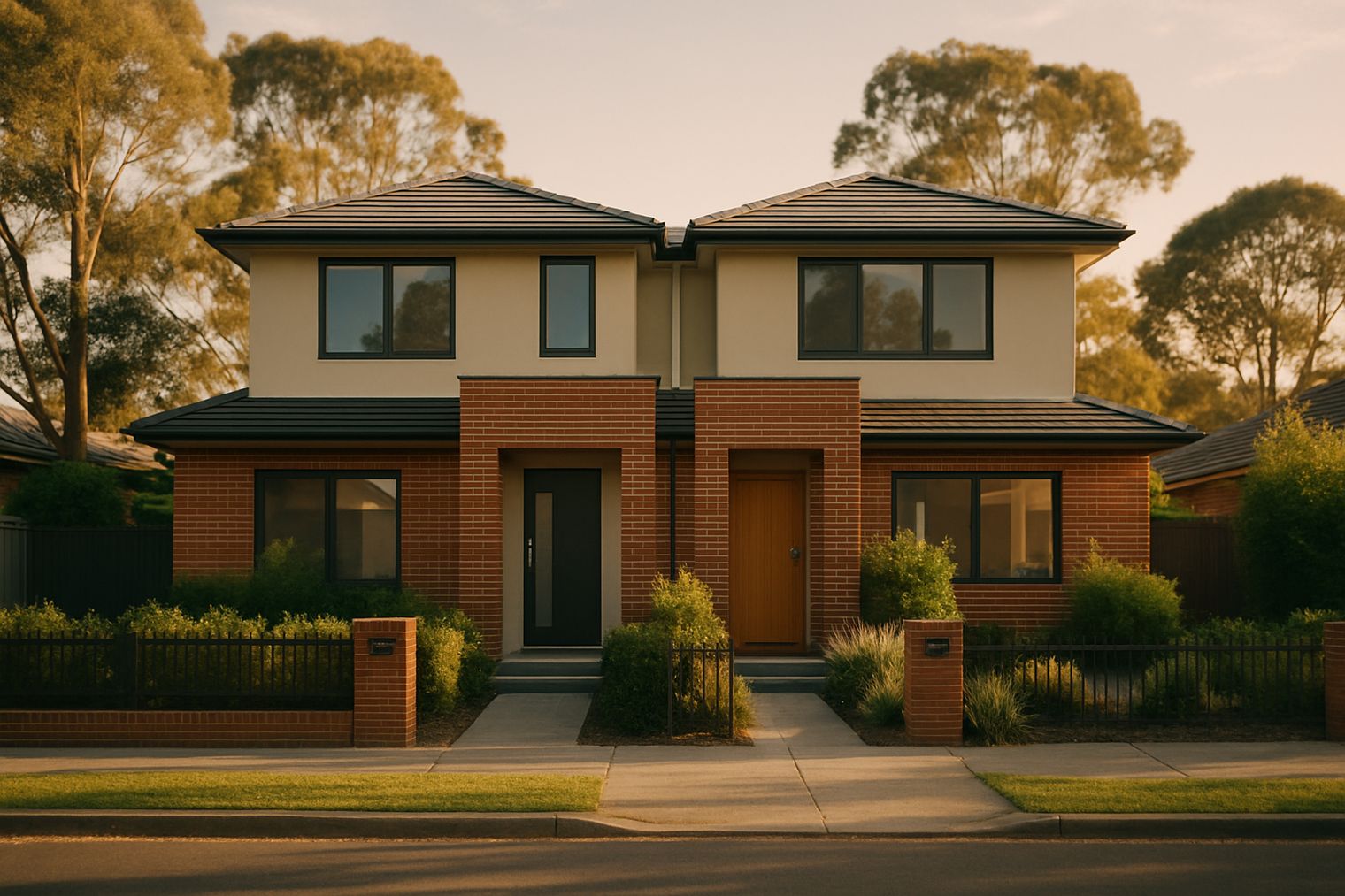
The traditional duplex is a single residential building split into two separate units divided by a common wall. Duplexes are normally torrens or strata titled, which means each unit holds its own individual title and can be sold separately, the same as a unit or townhouse. The main practical differences are that a duplex gives you greater land title flexibility, more land is usually required, and there are greater costs associated with a duplex.
One important caveat: the word "duplex" has no formal planning definition in Australian legislation. There is no specific planning term for a duplex in Australia. Many people refer to duplexes in conversation, but the correct planning term is "dual occupancy". In practice, in Victoria, "duplex" is a colloquial term: these homes are formally assessed as an attached dual occupancy under the planning scheme.
Dual occupancy (dual occ)
A dual occupancy is defined as two dwellings on a single lot of land and can be either attached or detached. An attached dual occupancy consists of two dwellings on one lot that are attached to each other, characterised by the fact that the two dwellings share a common wall in a semi-detached configuration. A detached dual occupancy places two standalone structures on the same block.
The key distinction from a duplex is the title arrangement. Both dwellings remain on the same land title unless the property is subdivided later, allowing two households to live independently on the same property. A dual occupancy is also different from a secondary dwelling, also known as a granny flat.
Dual key
A dual key home is a single dwelling with two self-contained living areas sharing one entry, often a main home with an internal studio or apartment. Dual key homes remain one dwelling under planning rules and are more common in multi-unit developments.
Unlike duplexes and separate granny flats, a dual-key home is one space shared by two individual tenants. The big difference between dual key and duplex is that you cannot sell the two parts separately. They sit on one title, so it is one property, two tenants, and one set of outgoings.
How they differ on title, finance, and planning
The table below summarises the structural differences:
| Feature | Duplex | Dual occ | Dual key |
|---|---|---|---|
| Separate titles | Yes (torrens/strata) | No (unless subdivided) | No |
| Can sell each side independently | Yes | Only after subdivision approval | No |
| Shared wall | Usually | Attached or detached | Internal only |
| Planning term | Dual occupancy (colloquial: duplex) | Dual occupancy | Single dwelling |
| Council rates | Two sets | One set | One set |
Planning rules add another layer of complexity. Planning rules vary significantly between states, which can be confusing if you are researching projects online. What is referred to as a duplex in property listings may be assessed differently depending on whether you are in Victoria or New South Wales.
In NSW, the rules have shifted recently. The State Environmental Planning Policy (Housing) Amendment (Dual Occupancies and Semi-detached Dwellings) 2024 was enacted on 1 July 2024. Under the new rules, councils remain the primary assessors of development applications, but they are now required to consider duplex applications. Duplexes and semi-detached homes are now allowed in 124 council areas across NSW.
In Brisbane, dual occupancy is defined in City Plan as the residential use of premises containing two dwellings on one lot, whether or not attached, and is the term used in Brisbane City Plan 2014 to refer to duplex developments.
For dual key specifically, lenders often treat these properties differently from standard residential stock. Home lenders in Australia typically impose stricter lending requirements on dual-key properties than on standard residential properties and apartments. Lenders generally require higher deposits and more significant serviceability requirements due to the limited demand for dual-key homes. This is worth factoring into any finance conversation before you settle on a structure.
A worked scenario
Consider two investors, each purchasing a new build in a Brisbane suburb.
Investor A buys a duplex. Each side has its own strata title. She owns both at settlement, collects rent from two separate tenancies, and several years later sells one side to release equity while holding the other. Each title can be valued, financed, and sold independently.
Investor B buys a dual occupancy on one title. He collects rent from both dwellings, pays one set of council rates, and holds both under a single mortgage. If he later wants to split and sell one dwelling, he needs to go through a subdivision approval process with council first. That process takes time and involves cost, but it is possible in many zones.
Investor C buys a dual key apartment in a mid-rise complex. She has two separate tenancy agreements generating income from one property on one title. She cannot sell one tenancy separately. Her lender required a larger deposit than they would for a standard apartment, and the resale pool of buyers who understand dual key is narrower.
None of these is objectively better. The right structure depends on the block, the zone, the state, the finance strategy, and the investor's exit plan. Vacancy periods and rental yield will always vary by location and dwelling type, so independent rental appraisals are important before assuming any income level.
What to do before you choose a structure
Check the planning zone first. Your local council's website (or the relevant state planning portal) will tell you what is permissible on a given block and what approval pathway applies: complying development, a development application, or something else. The rules around dual occupancy are governed by local council, and information can usually be found on their websites. The first step is to check the property's planning zone to see which planning codes apply to the address.
Talk to a broker who understands multi-dwelling finance. Lending policy differs across duplex, dual occ, and dual key. Loan-to-value ratios, deposit requirements, and how lenders count rental income in serviceability assessments can all vary. A licensed mortgage broker is the right person to map this out for your situation.
Get independent advice on structure before you sign anything. A property solicitor can review titles and contract terms. A quantity surveyor can advise on depreciation schedules for new builds, which differ across structure types. A licensed financial adviser can factor the structure into your broader position.
If you want to talk through which structure suits the kind of investment property you are considering, the team at Elite Wealth Creators coordinates property sourcing and finance referrals across all three formats. Start at /services or book a call to walk through the options.
General information only, not personal financial advice. Speak with a licensed adviser before acting.