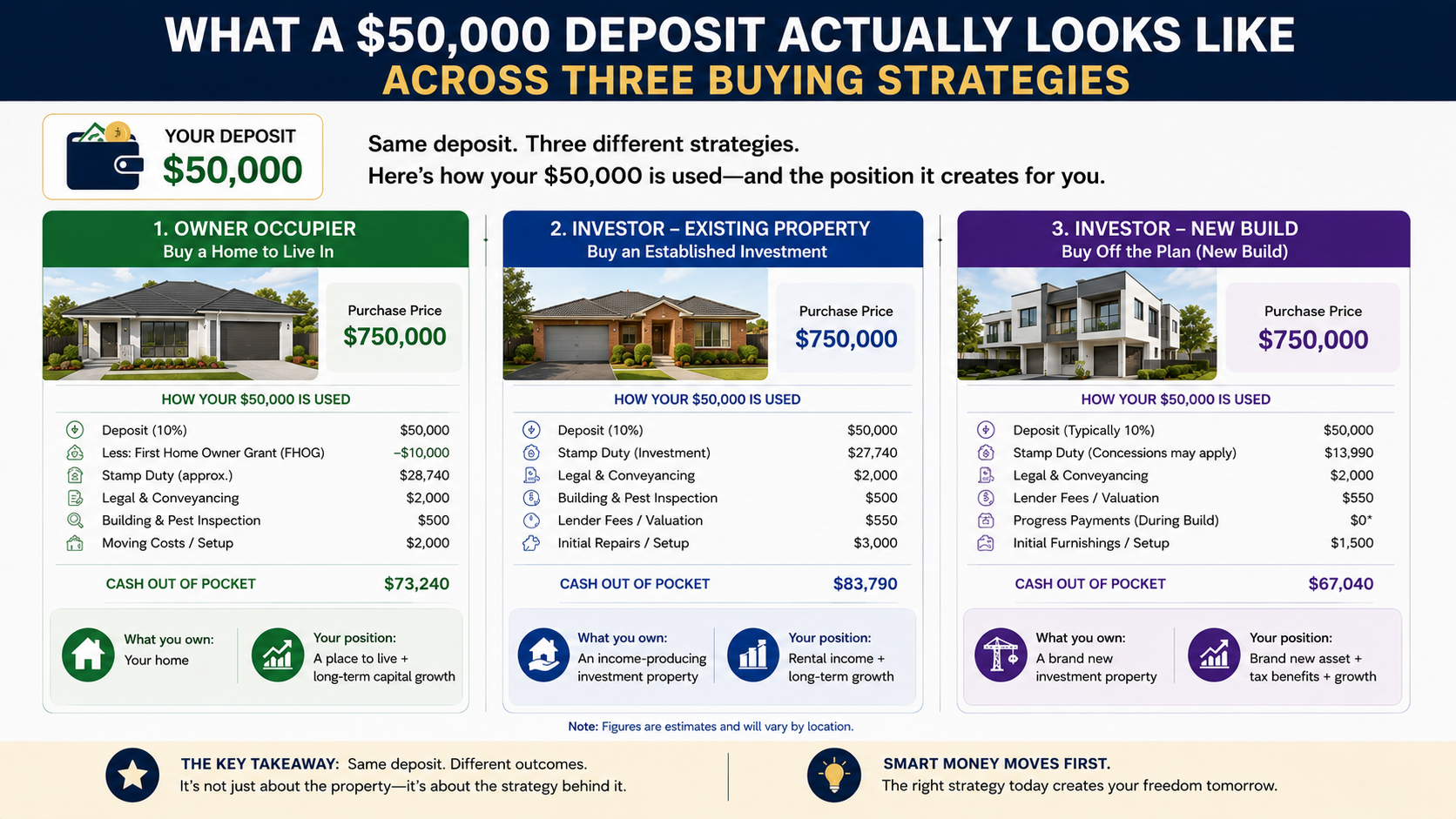
You have $50,000 saved and you're thinking about property. The question is not just whether that's enough, it's enough for what, exactly. The answer shifts considerably depending on which structure you're buying through.
Below is a plain breakdown of how that same $50,000 stacks up across three common paths: a standard investment property loan, a first home purchase under the Australian Government 5% Deposit Scheme, and an SMSF purchase via a limited recourse borrowing arrangement (LRBA).
Strategy 1: Standard investment property (in your own name)
When buying an investment property in Australia, most lenders prefer a 20% deposit, an amount considered the standard because it keeps the Loan-to-Value Ratio (LVR) at a safe level for both borrower and lender.
The same LVR threshold applies to investment properties as to owner-occupied properties: if you don't have a deposit of at least 20% of the purchase price, you will likely need to pay LMI. LMI protects the lender, not you, and the cost cannot be avoided simply by being a good borrower, it is triggered by the LVR, not by your credit history.
So what does $50,000 actually buy?
- On a $250,000 property, $50,000 is a clean 20% deposit. You'd still need stamp duty, legal fees, and inspection costs on top, typically another $10,000, $20,000 depending on state.
- On a $500,000 property, $50,000 is 10%. With a 10% deposit on a $500,000 property, you'd also be looking at LMI adding roughly $13,000, $16,500 to your costs.
- Stamp duty is the single largest non-negotiable cash cost in your upfront budget and varies enormously across Australian states and territories. For investors, those numbers are almost always higher than for owner-occupiers, because most states offer first home buyer exemptions or principal place of residence concessions that simply don't apply to investment purchases.
The short version: $50,000 is a reasonable deposit on a lower-priced property in your own name, but in most capital city markets it falls short of the 20% threshold on its own. You'd either be topping it up from other funds, accepting LMI, or targeting a lower price point.
Strategy 2: First home purchase under the Australian Government 5% Deposit Scheme
If you haven't owned property in Australia in the past ten years, the picture changes.
On 1 October 2025, the government expanded the scheme to give all first home buyers the ability to buy with a 5% deposit. The number of places is now uncapped, income caps have been removed, and property price caps have been increased under all streams.
Under the First Home Guarantee, you can purchase with a 5% deposit, and the government provides a guarantee, typically up to 15%, so LMI isn't charged. This is a government guarantee to the lender, not a cash grant. You remain fully responsible for your loan and repayments.
With $50,000 as a 5% deposit, you could potentially purchase a property up to $1,000,000, subject to the price cap for your location. In NSW capital cities and regional centres, the property price cap has increased to $1,500,000 (up from $900,000). Price caps vary by state and suburb, so checking the Housing Australia postcode tool before you search is worth doing.
There are important restrictions to understand:
- The property must be owner-occupied, not an investment. You must move in within six months (timing rules vary by property type).
- Applicants must be home buyers who have not owned nor part-owned a property in the past ten years anywhere in Australia.
The short version: $50,000 goes the furthest here, in raw purchasing power terms. A $50,000 deposit unlocks up to $1,000,000 in purchasing capacity on a 5% basis, without LMI, in many locations. The trade-off is that the property must be your home, not a rental, and you are borrowing at a high LVR with a correspondingly large mortgage to service.
What to look at next
If you have $50,000 and are deciding between these paths, three conversations are worth having:
Talk to a licensed mortgage broker about your borrowing capacity across each structure. What you can borrow is not determined by deposit alone; it also depends on income, existing liabilities, and the lender's assessment criteria. A broker who works across both standard residential and SMSF lending can show you how the numbers compare side by side.
If you're considering the first home path, confirm the price cap for your target suburb via the Housing Australia eligibility tool, and check what state-level concessions, stamp duty exemptions or first home owner grants might apply in your state.
For more on how EWC coordinates property sourcing and finance referrals across each of these strategies, take a look at our services page or book a call to talk through your situation.
General information only, not personal financial advice. Speak with a licensed adviser before acting.