

Taking the first step into the Australian property market can feel overwhelming, especially when your next investment depends on making the most of what you already own. As property values rise and mortgage repayments build, many first-time buyers are surprised by how much potential is locked away in their own home. Understanding home equity loans gives you a flexible tool to fund future purchases without selling your existing property, all while supporting stable cash flow as you expand your portfolio.
Table of Contents
- Home Equity Loans Explained For Australians
- Types Of Home Equity Loans And Differences
- How Home Equity Loans Offer Investment Leverage
- Risks, Costs, And Obligations In The Process
- Alternatives For Australian Home Buyers
Key Takeaways
| Point | Details |
|---|---|
| Home Equity Loans Definition | Home equity loans allow Australians to borrow against the value of their home, unlocking capital without needing to sell their property. |
| Investment Strategy | These loans provide a practical tool for first-time property investors to fund new purchases while retaining existing homes. |
| Types of Loans | Various home equity loan types include standard loans, lines of credit, and schemes for pension age Australians, each addressing different borrower needs. |
| Risks and Costs | It is crucial for borrowers to understand the interest costs, legal obligations, and market risks associated with home equity loans before proceeding. |
Home equity loans explained for Australians
A home equity loan is borrowing money against the value of your home. Think of it as unlocking the wealth you’ve already built through mortgage payments and property appreciation. You borrow a lump sum, then repay it over a fixed term with interest.
For first-time buyers stepping into investment property ownership, home equity loans offer a practical way to fund your next move without selling your current property. This is where most Australians unlock capital to expand their portfolios.
How home equity loans work
Your home has value. If you’ve paid down your mortgage, you’ve created equity—the difference between what your property is worth and what you still owe the bank.
Lenders will let you borrow against this equity, typically up to 80-90% of your home’s total value. So if your home is worth $500,000 and you owe $300,000, your equity is $200,000. You might borrow $100,000 to $150,000 against that equity.
The process follows these steps:
- Get your property valued by the lender
- Apply for the loan and provide financial documents
- Lender assesses your ability to repay
- Funds are released as a lump sum or ongoing access
- You repay with monthly or fortnightly payments plus interest
Why first-time property investors use them
You’ve bought your first home. You’ve paid it down. Now you want to invest in the next property, but you don’t have $100,000 sitting in savings.
Instead of selling your home, you tap into the equity. This keeps your primary residence generating personal benefit while freeing capital for investment purposes. It’s the smart move most successful investors make.
Home equity loans also offer better interest rates than personal loans because they’re secured against property. Lenders see lower risk, so they charge less.
Key differences from other borrowing
Home equity loans sit somewhere between personal loans and investment property loans. Here’s what sets them apart:
- Security: Backed by your home, so rates are lower than unsecured personal loans
- Speed: Often faster than investment property loans because lenders already know your property
- Flexibility: Some come with redraw facilities, letting you borrow, repay, then borrow again
- Interest rates: Typically lower than credit cards or personal loans
Home equity loans let you access capital without selling the asset that generated it in the first place—this is why Australian investors favour them for portfolio expansion.
Government support for home buyers
The Australian Government offers programs like the 5% Deposit Scheme and Help to Buy Scheme to help first-time and returning home buyers access financing more easily. These reduce upfront costs and speed up the buying process.
Additionally, older Australians at pension age can access the Home Equity Access Scheme, which allows voluntary non-taxable loans using home equity as security.
Real-world scenario
You bought your first home in Sydney five years ago for $600,000. You’ve paid $120,000 off the mortgage. Your home is now worth $680,000, giving you $200,000 in equity.

You want to invest in a Melbourne property. You take out a $150,000 home equity loan at 6.5% interest. This funds your deposit and costs, keeping your Sydney home and starting your investment portfolio simultaneously.
Meanwhile, understanding investment property loans in Australia helps you structure the second purchase efficiently and maximise your overall borrowing capacity.
Pro tip: Get your property independently valued before applying—knowing your exact equity position strengthens your application and helps you negotiate better loan terms.
Types of home equity loans and differences
Not all home equity loans work the same way. The type you choose depends on your age, financial situation, and what you’re trying to achieve. Understanding the options helps you pick the right tool for your wealth-building strategy.
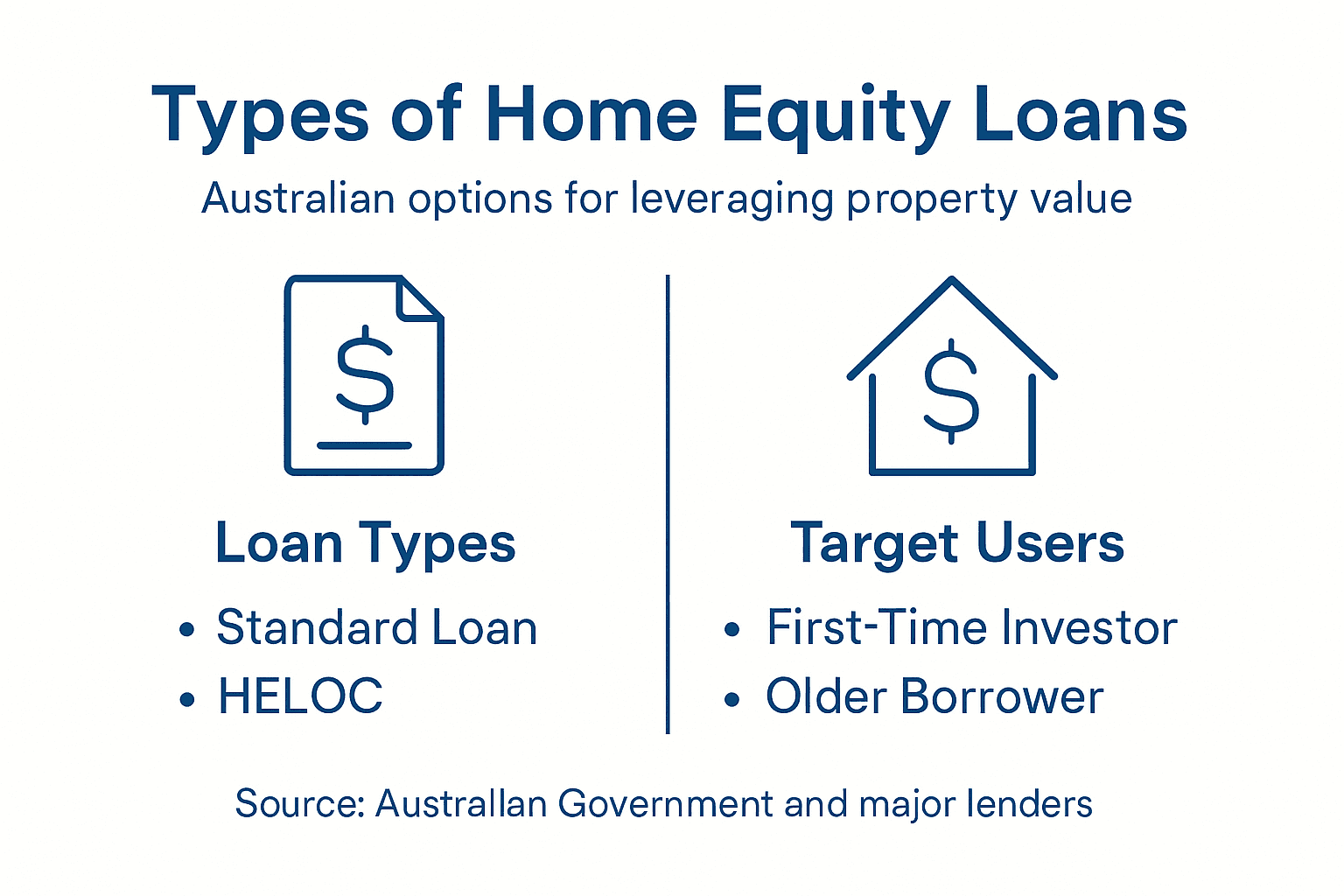
Home equity loans come in several distinct varieties, each designed for different Australian circumstances. The main types include standard home equity loans, lines of credit, and specialist schemes for older Australians.
Standard home equity loans
A standard home equity loan is the most common type. You borrow a fixed amount upfront, then repay it over a set period (usually 5 to 15 years) with regular payments.
This type works best when you know exactly how much capital you need. You get the funds as a lump sum, so there’s no waiting around or drawing money gradually.
The advantages are straightforward:
- Fixed repayment schedule gives you budget certainty
- Interest rates are typically fixed or variable
- Monthly payments remain consistent (if fixed rate)
- Simple to understand and manage
Home equity lines of credit
A home equity line of credit (HELOC) works differently. Instead of a lump sum, you get access to a pool of funds that you can draw from as needed.
Think of it like a credit card backed by your home. You only pay interest on the amount you actually use, not the full available limit.
This suits investors who are gradually building a portfolio. You might draw $50,000 now, repay some of it, then draw another $30,000 in six months.
Home equity lines of credit offer flexibility that standard loans don’t—you access capital only when you need it, keeping your interest costs lower throughout the process.
Home Equity Access Scheme
If you’re aged pension age or older, the Home Equity Access Scheme provides a voluntary, non-taxable loan option using your home as security. This scheme supplements retirement income through regular or lump-sum payments.
Repayment includes both interest and legal costs, with terms based on your individual circumstances and pension eligibility. It’s designed specifically for older Australians who have built substantial equity.
Shared equity schemes
Shared equity schemes allow you to share property purchase costs with government or not-for-profit partners. This reduces your initial deposit and ongoing costs.
These work through two main models:
- Individual equity: You gradually buy more equity over time
- Community equity: A trust retains ownership interests, limiting your capital gains but reducing upfront pressure
They’re valuable for first-time buyers with smaller deposits.
Here’s a concise comparison of the main types of home equity loans available for Australians:
| Loan Type | Access Method | Typical Borrower | Use Case |
|---|---|---|---|
| Standard Equity Loan | Lump sum upfront | All ages | Single property purchase |
| Equity Line of Credit | Flexible withdrawals | Investors/portfolio | Ongoing investment needs |
| Home Equity Access | Regular/lump payments | Pension age Australians | Retirement income supplement |
| Shared Equity Scheme | Partial ownership | First-home buyers | Lower deposit requirement |
Comparing the types
Choosing between them depends on several factors:
- Access timing: Do you need funds now (standard loan) or gradually (line of credit)?
- Age: Are you pension age (Access Scheme eligibility)?
- Deposit size: Do you need help reducing upfront costs (shared equity)?
- Interest certainty: Do fixed payments help your cash flow planning?
When exploring smart property finance options, consider how each loan type integrates with your broader investment strategy.
Pro tip: Compare rates across at least three lenders before deciding, as home equity loan rates vary significantly—even 0.5% difference saves thousands over the loan term.
How home equity loans offer investment leverage
Leverage means using borrowed money to amplify your investment returns. Home equity loans are one of the most powerful leverage tools available to Australian property investors because they unlock capital that’s already sitting in your home.
Instead of waiting years to save a deposit for your next investment property, you borrow against your existing home’s value. This accelerates your portfolio growth significantly.
The leverage equation
Here’s how it works in real numbers. You own a home worth $600,000 with $200,000 equity. You take out a $150,000 home equity loan at 6.5% interest.
You use those funds as a deposit on an investment property worth $500,000. Without leverage, you’d need to save that $150,000 over several years. With leverage, you deploy it immediately.
The investment property appreciates at 3% annually. In five years, it’s worth $580,000—a $80,000 gain. You’ve made that return on borrowed money, keeping your original capital intact.
Leverage magnifies both gains and losses, so understanding your risk tolerance before borrowing is essential for your investment strategy.
Why investors use home equity loans for leverage
Home equity loans are preferred because they offer several advantages over other borrowing methods:
- Lower interest rates: Secured by property, so rates beat personal loans by 2-3%
- Larger amounts: You can borrow more than unsecured lenders allow
- Speed: Already-valued property means faster approval
- Tax efficiency: Interest may be tax-deductible on investment loans
- Maintain ownership: You keep your original home while accessing its value
Amplifying returns through strategic deployment
Your first home has built equity through mortgage payments and appreciation. Rather than letting that wealth sit idle, you leverage it to generate investment income.
You might use home equity to fund:
- Deposit on an investment property generating rental income
- Purchase of shares or managed funds yielding dividends
- Renovation of an existing investment property to increase value
- Multiple property acquisitions across different growth corridors
Each dollar borrowed can generate returns that exceed the interest cost, creating positive leverage.
Government-backed leverage options
Government shared equity schemes help you leverage your investment by contributing a share of the purchase price, reducing your required borrowing. This means you need less of your own capital to enter the market.
Similarly, the Home Equity Access Scheme provides older Australians with structured leverage options to supplement income whilst maintaining ownership.
The risk side of leverage
Leverage works both ways. If your investment property declines 5% in value, you’ve lost more than you invested because you used borrowed funds.
Property markets can move slowly, so leverage requires patience. You must be confident you can service the debt through rental income or personal cash flow if markets soften.
When structuring equity investment strategies, consider your ability to weather market downturns without financial stress.
Calculating your leverage capacity
Most lenders allow you to borrow up to 80-90% of your home’s value. If you owe $300,000 on a $600,000 home, you have $300,000 in equity available.
However, responsible leverage means borrowing less than your maximum. Many successful investors borrow only 60-70% of available equity, preserving a safety buffer.
Pro tip: Calculate your serviceability before borrowing—lenders want to see you can afford repayments if interest rates rise by 2-3%. Use this same calculation to stress-test your investment assumptions.
Risks, costs, and obligations in the process
Home equity loans aren’t free money. Every dollar borrowed carries obligations, costs, and risks that you must understand before signing. Underestimating these can derail your investment strategy or create financial stress.
The good news? These risks are manageable when you approach them strategically. The bad news? Ignoring them is how investors get into trouble.
Interest costs compound quickly
Interest is the price you pay for borrowing. On a $150,000 home equity loan at 6.5% over 10 years, you’ll pay roughly $58,000 in interest alone. That’s almost 40% extra on top of your borrowed amount.
With shared equity schemes, you also share capital gains or losses with the government, which affects your final returns. These ongoing obligations mean you’re not keeping 100% of any property appreciation.
Interest rates aren’t fixed forever either. If rates rise, your repayments increase. Many investors assume rates stay low, then get shocked when serviceability becomes tight.
The obligation to repay
When you borrow, you enter a legal obligation to repay. This isn’t optional. Your home is security, meaning the lender can force its sale if you default on payments.
With home equity loans, interest compounds regularly and the longer your loan remains outstanding, the more interest accumulates. This creates a growing debt obligation that compounds over time.
Understand your repayment schedule before borrowing:
- Monthly payments on a standard loan
- Interest-only options (higher risk, lower cash flow)
- Variable repayments if you have a line of credit
- Balloon payments at end of loan term (rare but possible)
Legal costs and fees
Banks charge legal fees to set up home equity loans, typically $300-$800. You’ll also pay valuation fees ($200-$400) to have your property assessed.
Some lenders charge annual account-keeping fees. Over 10 years, these small costs add up significantly. Always ask for a full fee breakdown before applying.
This table summarises extra costs and risks associated with home equity loans in Australia:
| Cost or Risk | Typical Amount | Impact on Borrower |
|---|---|---|
| Establishment fees | $300-$800 | Adds to upfront expenses |
| Valuation fees | $200-$400 | Required for loan approval |
| Annual account fees | $120-$300 | Ongoing cost over loan term |
| Interest paid | $58,000 (on $150k) | Reduces final investment return |
| Market downturn risk | Variable | May create negative equity |
| Cash flow pressure | Monthly repayments | Stress during vacancies/rate rises |
The total cost of borrowing includes interest, legal fees, valuation costs, and potentially annual charges—add these together to see the true price of your capital.
Market risk affects your investment
You’ve borrowed against your home to invest in property or shares. If that investment declines in value, you still owe the full loan amount. This is negative equity risk.
Property markets move slowly but downturns do happen. Economic recessions, interest rate spikes, or local market corrections can reduce your investment value whilst your debt remains constant.
Many first-time investors panic when markets soften, forcing sales at poor times. You need cash reserves to weather downturns without forced liquidation.
Cash flow pressure from repayments
Borrowing creates a fixed repayment obligation every month. If your investment income drops (rental vacancy, dividend cuts), you still must pay the loan.
This is where analysis paralysis stops many investors:
- Can you afford payments if interest rates rise 2%?
- What happens if your rental property sits vacant for 3 months?
- Do you have emergency savings separate from the loan?
- Can you service the debt from personal income alone?
Stress-test these scenarios before borrowing. If answers worry you, borrow less.
Protect yourself against downside risk
Responsible borrowing means preserving safety buffers:
- Borrow only 60-70% of available equity, not the maximum 80-90%
- Maintain 3-6 months of repayment costs in emergency savings
- Diversify investments rather than putting all borrowed capital into one property
- Use fixed-rate loans to lock in interest costs
- Review your loan annually and adjust if circumstances change
Pro tip: Before borrowing, create a detailed cash flow projection showing loan repayments, investment income, and personal expenses. Run the numbers with interest rates 2% higher than current rates to identify genuine serviceability risk.
Alternatives for Australian home buyers
Home equity loans aren’t your only path to property ownership or investment expansion. Australian homebuyers have several alternatives, each suited to different circumstances and risk profiles. Understanding these options helps you choose the strategy that aligns with your goals.
The right alternative depends on your deposit size, income level, and timeline. Some options work better for first-time buyers, whilst others suit experienced investors.
Government-backed shared equity schemes
The Australian Government Help to Buy Scheme lets you share property purchase costs with the government. This reduces your upfront capital requirement significantly.
Here’s how it works: the government contributes towards your purchase price, reducing the amount you need to borrow. You gradually buy out the government’s share over time.
The benefits are substantial:
- Lower initial deposit required
- Reduced borrowing amount
- Faster entry into home ownership
- No lenders mortgage insurance fees
- Government shares the investment risk
The 5% Deposit Scheme
Traditionally, lenders require 20% deposits to avoid mortgage insurance. The 5% Deposit Scheme removes this barrier for first-time buyers.
You can purchase with just 5% down, and the government-backed guarantee protects the lender. This eliminates expensive lenders mortgage insurance, saving thousands in costs.
It’s ideal if you’ve saved $25,000 for a $500,000 property but lack the full 20% deposit. You get into the market sooner without crippling insurance fees.
Government-backed schemes help first-time buyers overcome the deposit hurdle—they’re designed specifically to reduce the years of saving many Australian buyers face.
Affordable housing programs
Housing Australia offers various programs including affordable housing initiatives and community housing support. These provide alternatives to traditional lending by connecting buyers with below-market properties or subsidised financing.
These aren’t mainstream options, but they exist for eligible buyers. Eligibility depends on income thresholds and other criteria.
Offset accounts and redraw facilities
If you already have a mortgage, offset accounts let you park savings against your loan balance without withdrawing them. You earn no interest on the offset balance, but you save interest on the mortgage.
This is cheaper than a home equity loan if you have decent savings. You’re essentially using your own money rather than borrowing additional capital.
Redraw facilities on your existing mortgage work similarly. You can access equity you’ve paid down, often with lower fees than a new home equity loan.
Personal loans and unsecured borrowing
For smaller amounts ($20,000-$50,000), personal loans might work. Interest rates are higher than home equity loans, but you don’t risk your home as security.
If you’re uncomfortable leveraging your primary residence, a personal loan preserves ownership security. The trade-off? You’ll pay 2-3% more in interest.
Comparison of alternatives
Choosing between options requires clarity on your situation:
- First home, small deposit? Use 5% Deposit Scheme or Help to Buy Scheme
- Existing equity, want lower cost? Use offset account or redraw facility
- Need $20,000-$50,000 only? Personal loan might suit
- Building investment portfolio? Home equity loan offers better rates
- Limited income, eligible for support? Explore Housing Australia programs
When preparing to enter the market, understanding property buying essentials helps you evaluate which alternative aligns with your long-term wealth strategy.
Pro tip: Compare total costs across all alternatives, not just interest rates. Include fees, insurance, legal costs, and timeframes. A scheme with slightly higher interest but lower upfront costs might save you thousands overall.
Unlock Your Home Equity Potential with Elite Wealth Creators
If you are ready to harness the power of your home equity loan but feel overwhelmed by interest costs, repayment obligations and market risks highlighted in this article then you are not alone. Many Australians face the challenge of leveraging their property without jeopardising financial stability or cash flow. The key is strategic access to capital combined with expert guidance tailored to your unique situation.
At Elite Wealth Creators, we specialise in transforming your property equity into unlimited potential. Imagine unlocking up to $100,000 in instant liquidity from your existing investment properties to fund your next move without selling your home. Our Precision Sourcing service helps you find off-market opportunities perfectly aligned with your long-term wealth strategy. Plus, with The Homepay Advantage you can build your dream home or investment property with deferred interest payments to keep your cash flow exactly where you need it.
Take the next step today to unlock wealth and secure your financial future Visit Elite Wealth Creators now to explore how our exclusive solutions can empower your home equity strategy before interest rates rise or markets shift.
Frequently Asked Questions
What is a home equity loan?
A home equity loan allows you to borrow money against the value of your home, unlocking equity that you’ve built through mortgage payments and property appreciation.
How do I determine my home equity?
Home equity is calculated by subtracting the remaining mortgage balance from your home’s current market value. For example, if your home is worth $500,000 and you owe $300,000, your equity is $200,000.
What are the different types of home equity loans available?
There are several types of home equity loans, including standard home equity loans, home equity lines of credit (HELOCs), the Home Equity Access Scheme for older Australians, and shared equity schemes for first-time buyers.
What are the risks associated with home equity loans?
The main risks include the obligation to repay the loan, potential for negative equity if property values decline, and the pressure on cash flow from monthly repayments, especially if your investment income decreases.