
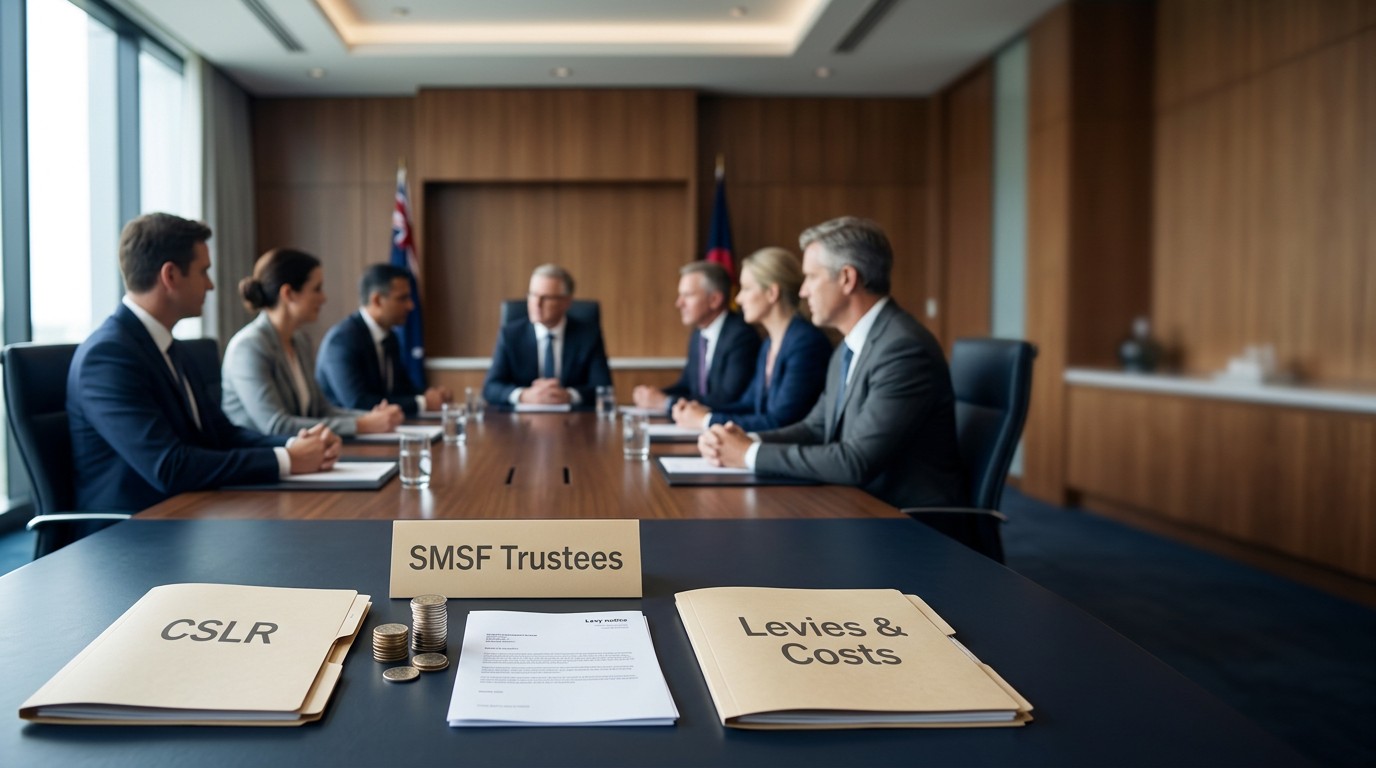
In April 2026, the Minister for Financial Services, Daniel Mulino, released a paper outlining options for including self-managed super funds in CSLR funding — the Compensation Scheme of Last Resort. For SMSF trustees, it’s the most consequential policy debate of the year that almost nobody is talking about.
The CSLR was introduced to compensate consumers of financial services who hold unpaid determinations from the Australian Financial Complaints Authority (AFCA), typically against insolvent advice firms. Until now, the cost of the scheme has been carried by APRA-regulated funds and licensed financial advisers. Mulino’s April 2026 paper opens the door to changing that.
What Is Actually Being Proposed
The paper sets out several options for how SMSFs and the SMSF sector might contribute to CSLR funding in the future. Importantly, the paper is consultative — no final decision has been made. But the direction of travel is clear: the government is exploring how to expand the levy base beyond the two groups currently funding the scheme.
Possible options canvassed in policy commentary include:
- A levy collected as part of the SMSF supervisory levy (the existing per-fund ATO charge)
- A levy on SMSF audit, administration, or accounting fees
- A levy structured around specialist SMSF advisers holding an AFSL relationship with the sector
- A combination of the above
Each option carries different distributional consequences. Some would fall almost entirely on the fund (and therefore directly on trustees); others would fall on service providers and be passed through to trustees indirectly. None would be zero cost.
Why This Matters
The CSLR exists to compensate consumers who have suffered loss from financial services that fall within AFCA’s jurisdiction — most often, advice from insolvent licensed firms. From the perspective of SMSF trustees, this raises an obvious question: why should self-managed super, which sits outside the AFCA jurisdiction in most cases, contribute to compensating consumers of advice firms that did not deal with SMSFs?
The counter-argument — laid out in part in the Mulino paper — is that the SMSF sector now holds well over a trillion dollars in assets and is growing fast. A sector of that scale, the argument runs, should bear some share of the cost of a scheme that exists to protect the broader retail financial services ecosystem.
Whichever view you take, the direction of the policy debate is unmistakable. Some form of CSLR contribution from the SMSF sector is now a live possibility for the first time since the scheme was introduced.
The Cost-of-Running Question
For SMSF trustees, the practical issue is what the average fund running cost could look like under each option:
- A modest per-fund levy added to the existing supervisory levy would translate to a predictable annual cost increase
- A levy on audit or admin fees would likely show up as a line-item increase from service providers
- A levy on specialist SMSF advice would be priced into ongoing advice fees over time
The current cost of running a typical SMSF — supervisory levy, audit, accounting, advice, ASIC fees on corporate trustees — already varies widely depending on fund complexity. A CSLR contribution would sit on top of that base, regardless of where in the chain it is collected.
What Trustees Should Do Now
Three reasonable steps for trustees this quarter:
Engage with consultation. The Mulino paper is open to industry consultation. SMSF Association submissions, individual trustee feedback, and professional adviser responses all influence where the final settings land. Trustees with a view have an opportunity to express it.
Build the cost into multi-year fund planning. Whether the levy lands as a small per-fund charge or a more material amount — and the final figure is genuinely not yet known — fund running costs should be modelled with some allowance for the change. A levy of this kind, once introduced, tends to be a permanent feature.
Review provider arrangements. Trustees paying premium prices for routine SMSF administration may find that any incremental CSLR cost is best absorbed by reviewing the existing fee base. The conversation with your accountant or administrator on this point is more productive now than after a levy lands.
The Bigger Picture
The CSLR consultation is part of a broader policy environment in which the SMSF sector is being asked to behave more like a regulated industry and less like a collection of individual funds operating in isolation. Division 296 commencing on 1 July 2026, the Payday Super start date on the same day, the ATO’s compliance pressure earlier this year, and now the CSLR question — each is part of the same trend.
For trustees who treat SMSFs as a structured, advised, long-term retirement vehicle, the trend is manageable. For those who set up a fund and forget about it, the trend is expensive.
Speak to your SMSF specialist about how the CSLR debate may affect your fund — and stay close to the consultation as it progresses through 2026.
This article is general information only and reflects publicly available commentary on the Mulino paper released in April 2026. It does not constitute personal financial, tax, or legal advice.