

Many Australians assume property trusts are only for the ultra-wealthy or require complex legal expertise to navigate. In reality, property trusts have become an accessible investment vehicle for everyday investors seeking passive income and tax advantages. Yet confusion persists about how they work, their tax implications, and whether the benefits outweigh the costs. This guide cuts through the noise to explain what property trusts are, how they generate wealth, and the critical land tax nuances across Australian states that can make or break your investment returns.
Table of Contents
- Key takeaways
- What is a property trust and how does it work?
- Tax advantages and land tax implications of property trusts in Australia
- How property trusts can generate passive income and wealth for investors and families
- Comparing property trusts to direct ownership: risks, costs and when is a trust right for you
- Unlock expert help for property trust investments
- Frequently asked questions
Key Takeaways
| Point | Details |
|---|---|
| What is a property trust | A property trust is a separate legal entity with a trustee that holds and manages assets for beneficiaries, distributing income according to the trust deed. |
| Tax advantages explained | Trusts enable income splitting among beneficiaries to lower overall tax, with capital gains concessions applying to assets held longer than 12 months and a fifty per cent discount for distributions. |
| State land tax rules | Land tax treatment varies by state and can significantly affect returns, so investors should understand each jurisdiction’s rules before investing. |
| Seek expert advice | Given the complexity and potential land tax traps, informed decisions are best made with expert guidance and reliable resources. |
What is a property trust and how does it work?
A property trust is a legal structure where a trustee holds and manages property trust benefits on behalf of one or more beneficiaries. Unlike direct ownership where you hold title in your personal name, a trust creates a separate legal entity that owns the asset. The trustee, whether an individual or company, makes decisions about the property and distributes income according to the trust deed.
Australia recognises two primary trust types for property investment. Discretionary trusts give the trustee flexibility to decide how much income each beneficiary receives in any given year. Unit trusts operate more like companies, with beneficiaries holding fixed units that entitle them to a proportionate share of income and capital. Most family investors prefer discretionary trusts for their income distribution flexibility, while unit trusts suit partnerships or commercial arrangements.
The trust deed serves as the governing document, outlining the trustee’s powers, beneficiary rights, and distribution rules. This deed determines who can receive income, how decisions are made, and what happens when the trust ends. Australian law requires trusts to comply with state legislation and taxation rules, meaning your trust structure must align with both Commonwealth tax law and state-based property regulations.
Income flows from the property to beneficiaries as distributions, typically rental returns or capital gains from property sales. The trust itself doesn’t pay tax on distributed income. Instead, beneficiaries include their share in their personal tax returns and pay at their marginal rates. This tax transparency creates opportunities for income splitting that direct ownership cannot match.
Investors choose trusts over personal ownership for several strategic reasons:
- Separate legal entity status protects personal assets from property-related liabilities
- Flexible income distribution allows directing earnings to lower-tax family members
- Asset protection shields property from personal creditors in many circumstances
- Tax transparency enables beneficiaries to claim deductions and concessions
- Succession benefits simplify estate planning and intergenerational wealth transfer
The trustee role carries significant responsibility. They must act in beneficiaries’ best interests, maintain proper records, lodge tax returns, and comply with trust deed provisions. Breaching these duties can result in personal liability, making professional trustee services worth considering for substantial property portfolios.
Tax advantages and land tax implications of property trusts in Australia
Property trusts deliver tax efficiency through income splitting amongst beneficiaries. A trustee can distribute rental income to family members in lower tax brackets, reducing the overall tax burden compared to one high-income earner holding the property directly. For example, distributing income to an adult child earning modest wages could save thousands annually compared to a parent in the top tax bracket receiving all the income.

Capital gains tax concessions apply when trusts sell property held longer than 12 months. Beneficiaries receiving capital gains distributions can claim the 50% CGT discount, effectively halving the taxable gain. This benefit mirrors direct ownership but combines with income distribution flexibility for enhanced tax outcomes.
Land tax presents the most significant trap for property trusts. Tax savings range from 10% to 47% on trust distributions, but land tax can add 1% to 4% effective cost depending on your state. Unlike individuals who enjoy substantial tax-free thresholds, trusts face harsher treatment across Australia.
| State | Individual threshold | Trust threshold | Key difference |
|---|---|---|---|
| New South Wales | $969,000 | $0 | Trusts pay land tax from dollar one on all property |
| Victoria | $300,000 general / $25,000 trust | $25,000 | Trust threshold 92% lower than individual rate |
| Queensland | $600,000 | $350,000 | Trust threshold 42% lower, with higher rates |
These differences create substantial cost variations. A trust holding $800,000 in NSW property pays land tax immediately, while an individual pays nothing. In Victoria, trusts hit the threshold at $25,000 versus $300,000 for individuals. Queensland offers the most generous trust treatment but still penalises trusts compared to personal ownership.
Key tax benefits of property trusts include:
- Income distribution flexibility to minimise family tax liability
- Potential tax savings of 10% to 47% through strategic distributions
- Capital gains concessions when selling investment property
- Ability to direct income to beneficiaries with unused tax-free thresholds
Pro Tip: Calculate land tax costs before establishing a trust. In NSW and Victoria, the lower trust thresholds can eliminate tax savings from income splitting if your property portfolio exceeds modest values. Run the numbers with your accountant to ensure overall tax benefits justify the land tax penalty.
Trusts must lodge annual tax returns reporting all income and distributions. The trustee bears responsibility for accurate reporting, even though beneficiaries pay the actual tax. Missing deadlines or incorrect distributions can trigger penalties and limit your ability to amend distribution decisions retrospectively.
No broad empirical studies prove trusts deliver better investment returns than direct ownership. However, the after-tax yield advantage from income splitting and strategic distributions can meaningfully boost your effective returns when land tax costs remain manageable.
How property trusts can generate passive income and wealth for investors and families
Property trusts transform rental income into a flexible family wealth tool. Instead of one person receiving all rental returns and paying tax at their highest rate, trusts distribute passive income to family members based on their individual tax positions. A trustee might allocate income to adult children studying full-time, retired parents with low incomes, or a spouse working part-time, dramatically reducing the family’s collective tax bill.
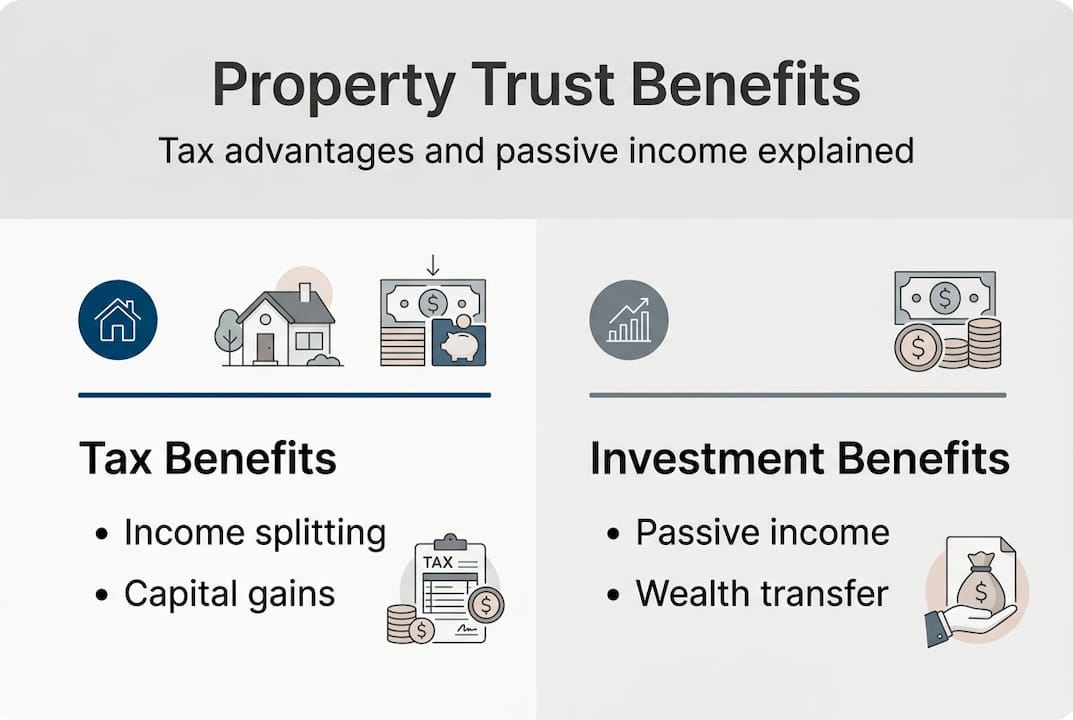
Wealth accumulation accelerates when trusts reinvest distributions rather than paying them out. The trustee can retain income within the trust, paying tax at penalty rates, or distribute to beneficiaries who immediately reinvest in additional properties or assets. This strategy compounds growth while maintaining control over the family’s investment portfolio.
Estate planning benefits make trusts particularly valuable for intergenerational wealth transfer. When structured properly, trusts continue operating after the original settlor’s death, avoiding probate delays and maintaining asset protection. Beneficiaries can be added or removed according to trust deed provisions, providing flexibility as family circumstances change over decades.
The trustee’s role in managing distributions creates opportunities for sophisticated tax planning. Each financial year, the trustee reviews beneficiary tax positions and distributes income to optimise the family’s overall tax outcome. This annual flexibility responds to changing circumstances like career transitions, business losses, or retirement that affect individual tax rates.
Benefits of trusts for investors include:
- Flexibility to adjust income distributions annually based on beneficiary tax positions
- Family income sharing that reduces overall tax liability across generations
- Asset protection from personal creditors and legal claims in many situations
- Succession planning that simplifies wealth transfer and avoids probate complications
Pro Tip: Balance land tax costs against passive income benefits by concentrating high-value properties in personal names and using trusts for mid-range assets where income splitting delivers maximum advantage. This hybrid approach optimises tax outcomes while managing land tax exposure.
Typical investor profiles using trusts include families with multiple adult children, high-income professionals seeking income splitting opportunities, business owners protecting assets from commercial risks, and retirees planning intergenerational wealth transfer. Each profile leverages different trust features to match their specific financial goals and family circumstances.
Passive income strategies work best when rental yields exceed holding costs including land tax, allowing distributions to beneficiaries while maintaining positive cash flow. Properties in high-yield investment categories generate sufficient income to justify trust structures and cover additional administrative expenses.
Comparing property trusts to direct ownership: risks, costs and when is a trust right for you
Direct ownership means holding property title in your personal name, with all income taxed at your marginal rate and all liabilities attaching to you personally. Property trusts separate legal ownership from beneficial ownership, creating flexibility but adding complexity and cost. Understanding when each structure suits your situation requires weighing multiple factors.
| Aspect | Direct ownership | Property trust |
|---|---|---|
| Tax treatment | All income taxed at personal marginal rate | Income split among beneficiaries at their rates |
| Land tax threshold | Higher thresholds in all states | Lower or zero thresholds increase costs |
| Asset protection | Personal assets exposed to property liabilities | Trust structure shields personal assets |
| Administrative costs | Minimal ongoing compliance | Trust deed, annual returns, trustee fees |
| Income flexibility | Fixed to owner’s tax position | Annual distribution discretion |
| Succession planning | Requires will and probate process | Continues operating, avoids probate |
Risks and costs of property trusts include:
- Higher administration fees for trust establishment, annual compliance, and professional trustee services
- Trust deed requirements and ongoing legal obligations that demand professional oversight
- Land tax traps where lower thresholds eliminate income splitting benefits
- Complexity in managing distributions and maintaining proper records
- Potential loss of principal residence exemption if family home held in trust
Trusts prove more suitable when you’re building a multi-property portfolio, have family members in significantly different tax brackets, need asset protection from business or professional risks, or prioritise succession planning for intergenerational wealth. The administrative costs and land tax penalties justify themselves through tax savings and strategic benefits.
Direct ownership remains simpler and more cost-effective for single investment properties, smaller portfolios where income splitting delivers minimal benefit, situations where you qualify for principal residence exemption, or investors who prefer straightforward tax reporting without trustee obligations. The comparison between ownership structures depends heavily on your specific circumstances and long-term goals.
Factors to consider include your current and projected income levels, family tax positions, portfolio size and growth plans, asset protection needs, estate planning objectives, and tolerance for administrative complexity. A $500,000 investment property might suit direct ownership, while a $2 million portfolio across multiple properties likely benefits from trust structures despite higher costs.
Professional advice becomes essential because trust decisions are difficult to reverse once implemented. Transferring property from personal names into trusts triggers stamp duty in most states, effectively locking in your initial structure choice. Getting it right from the start saves tens of thousands in unnecessary taxes and restructuring costs.
Unlock expert help for property trust investments
Navigating property trusts requires more than understanding tax rules and land thresholds. Elite Wealth Creators specialises in guiding Australian investors through trust structures that maximise passive income while minimising tax risks. Our team develops personalised strategies matching your family’s tax positions, portfolio goals, and risk tolerance. Whether you’re establishing your first investment property or optimising an existing portfolio, we provide the strategic edge to make informed decisions about trust structures, property selection, and wealth accumulation. Explore our property investing insights to understand how professional guidance transforms complex decisions into confident action. Discover proven approaches to property trust tax benefits and explore flexible home loan options that support your investment strategy.
Frequently asked questions
What is a property trust?
A property trust is a legal structure where a trustee holds property on behalf of beneficiaries, providing flexibility in income distribution and asset protection. The trust operates as a separate legal entity, allowing strategic tax planning and succession benefits unavailable through direct ownership.
How does a property trust differ from owning property directly?
Direct ownership places property title in your personal name with all income taxed at your rate, while trusts separate legal and beneficial ownership. Trusts enable income splitting among beneficiaries, offer asset protection, and simplify succession planning, but face lower land tax thresholds and higher administrative costs.
What are the main tax benefits of property trusts?
Property trusts allow income distribution to family members in lower tax brackets, potentially saving 10% to 47% in tax. Beneficiaries receiving distributions can claim the 50% capital gains discount on property sales, and strategic distributions utilise unused tax-free thresholds across the family.
Are there risks or costs unique to property trusts?
Property trusts incur higher setup and annual compliance costs including trust deeds, tax returns, and professional fees. The primary risk involves land tax penalties, with trusts facing lower or zero thresholds in NSW, Victoria, and Queensland that can eliminate income splitting benefits.
How do land tax thresholds affect property trusts across Australian states?
NSW trusts pay land tax from dollar one versus $969,000 for individuals. Victoria sets trust thresholds at $25,000 compared to $300,000 for individuals. Queensland offers $350,000 for trusts versus $600,000 for individuals. These differences create substantial cost variations that must be calculated before establishing trust structures.